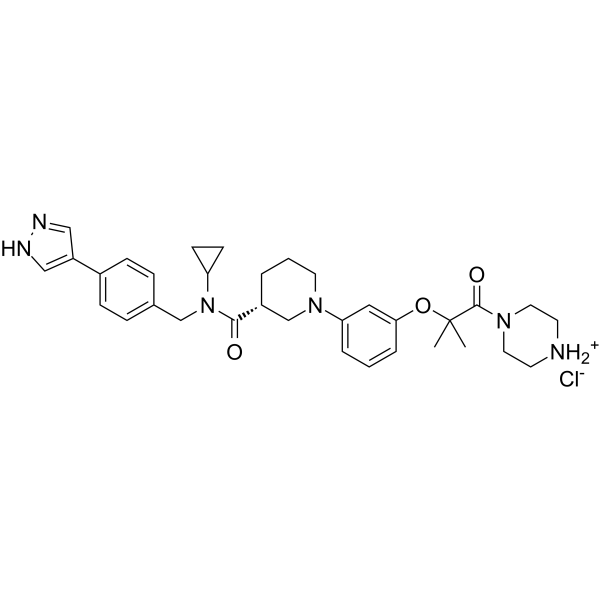
Physicochemical Properties
| Molecular Formula | C33H43CLN6O3 |
| Molecular Weight | 607.19 |
| Exact Mass | 606.308 |
| CAS # | 2632259-93-7 |
| Related CAS # | ZW4864 free base;2632259-92-6 |
| PubChem CID | 164609513 |
| Appearance | White to off-white solid powder |
| Hydrogen Bond Donor Count | 3 |
| Hydrogen Bond Acceptor Count | 6 |
| Rotatable Bond Count | 9 |
| Heavy Atom Count | 43 |
| Complexity | 914 |
| Defined Atom Stereocenter Count | 1 |
| SMILES | C1(N2C[C@H](C(=O)N(C3CC3)CC3C=CC(C4C=NNC=4)=CC=3)CCC2)=CC(OC(C)(C)C(=O)N2CCNCC2)=CC=C1.Cl |
| InChi Key | PQRRIGABHUYXRQ-UFTMZEDQSA-N |
| InChi Code | InChI=1S/C33H42N6O3.ClH/c1-33(2,32(41)37-17-14-34-15-18-37)42-30-7-3-6-29(19-30)38-16-4-5-26(23-38)31(40)39(28-12-13-28)22-24-8-10-25(11-9-24)27-20-35-36-21-27;/h3,6-11,19-21,26,28,34H,4-5,12-18,22-23H2,1-2H3,(H,35,36);1H/t26-;/m1./s1 |
| Chemical Name | (3R)-N-cyclopropyl-1-[3-(2-methyl-1-oxo-1-piperazin-1-ylpropan-2-yl)oxyphenyl]-N-[[4-(1H-pyrazol-4-yl)phenyl]methyl]piperidine-3-carboxamide;hydrochloride |
| HS Tariff Code | 2934.99.9001 |
| Storage |
Powder-20°C 3 years 4°C 2 years In solvent -80°C 6 months -20°C 1 month Note: Please store this product in a sealed and protected environment, avoid exposure to moisture. |
| Shipping Condition | Room temperature (This product is stable at ambient temperature for a few days during ordinary shipping and time spent in Customs) |
Biological Activity
| Targets | IC50: 0.87 μM (β catenin/BCL9 PPI)[1]. Ki: 0.76 μM(β catenin/BCL9 PPI)[1] |
| ln Vitro | ZW4864 (10~40 μM; 24 hours; SW480 and MBA-MD-231 cells) reduces the expression levels of Axin2 and cyclin D1 proteins [1]. ZW4864 (10~40 μM; 72 hours; MDA-MB231, MCF10A, and MDA-MB-468 cells) selectively triggers rapid apoptosis in triple-negative breast cancer cells with hyperactive β-catenin signaling while not Affects normal breast epithelial MCF10A cells [1]. ZW4864 (10~40 μM; 24 hours; SW480 and MBA-MD-231 cells) inhibits the transcription of β-catenin target genes in a concentration-dependent manner without affecting the expression of HPRT, a house-Keeper gene (in SW480 and Wnt 3a activated MDA-MB-231 cells) [1]. ZW4864 dose-dependently inhibits β-catenin signaling activation, downregulates oncogenic β-catenin target genes, and eliminates the invasiveness of β-catenin-dependent cancer cells. ZW4864 inhibits TOPFlash luciferase activity in β-catenin-expressing HEK293 cells in a dose-dependent manner with an IC50 of 11 μM. ZW4864 also dose-dependently inhibits TOPFlash luciferase activity in SW480- and Wnt 3a-activated MDA-MB-468 cells with IC50 of 7.0 and 6.3 μM, respectively. ZW4864 selectively inhibits transactivation of β-catenin signaling [1]. |
| ln Vivo | ZW4864 (20 mg/kg; po) has an oral bioavailability (F) of 83%, indicating acceptable pharmacokinetic characteristics[1]. ZW4864 demonstrates variability at 90 mg/kg; po[1]. In patient-derived xenograft mouse models, ZW4864 efficiently reduces the expression of the β-catenin target gene and demonstrates good pharmacokinetic qualities[1]. |
| Cell Assay |
Western Blot Analysis[1] Cell Types: SW480 and MBA-MD-231 cells Tested Concentrations: 10~40 μM Incubation Duration: 24 hrs (hours) Experimental Results: diminished the expression levels of Axin2 and cyclin D1 proteins. Apoptosis Analysis[1] Cell Types: MDA -MB231, MCF10A and MDA-MB-468 cells Tested Concentrations: 10~40 μM Incubation Duration: 72 hrs (hours) Experimental Results: Selectively triggered rapid apoptosis of triple-negative breast cancer cells with hyperactive β-catenin signaling while sparing normal mammary epithelial MCF10A cells. RT-PCR[1] Cell Types: SW480 and MBA-MD-231 cells Tested Concentrations: 10~40 μM Incubation Duration: 24 hrs (hours) Experimental Results: Suppressed the transcription of β-catenin target genes in a concentration-dependent manner without affecting the expression of HPRT , a house-keeper gene, in both SW480 and Wnt 3a-activated MDA-MB-231 cells. |
| Animal Protocol |
Animal/Disease Models: C57BL/6 mice[1] Doses: 20 mg/kg (pharmacokinetic/PK Analysis) Route of Administration: Po Experimental Results: demonstrated good pharmacokinetic/PK properties with an oral bioavailability (F) of 83%. Animal/Disease Models: Mice[1] Doses: 90 mg/kg Route of Administration: Po Experimental Results: demonstrated a variation in tumor growth in mice. |
| References |
[1]. Discovery of an Orally Bioavailable Small-Molecule Inhibitor for the β-Catenin/B-Cell Lymphoma 9 Protein-Protein Interaction. J Med Chem. 2021;64(16):12109-12131. |
Solubility Data
| Solubility (In Vitro) | DMSO: 41.67 mg/mL (68.63 mM) |
| Solubility (In Vivo) |
Solubility in Formulation 1: ≥ 2.08 mg/mL (3.43 mM) (saturation unknown) in 10% DMSO + 40% PEG300 + 5% Tween80 + 45% Saline (add these co-solvents sequentially from left to right, and one by one), clear solution. For example, if 1 mL of working solution is to be prepared, you can add 100 μL of 20.8 mg/mL clear DMSO stock solution to 400 μL PEG300 and mix evenly; then add 50 μL Tween-80 to the above solution and mix evenly; then add 450 μL normal saline to adjust the volume to 1 mL. Preparation of saline: Dissolve 0.9 g of sodium chloride in 100 mL ddH₂ O to obtain a clear solution. Solubility in Formulation 2: ≥ 2.08 mg/mL (3.43 mM) (saturation unknown) in 10% DMSO + 90% Corn Oil (add these co-solvents sequentially from left to right, and one by one), clear solution. For example, if 1 mL of working solution is to be prepared, you can add 100 μL of 20.8 mg/mL clear DMSO stock solution to 900 μL of corn oil and mix evenly. (Please use freshly prepared in vivo formulations for optimal results.) |
| Preparing Stock Solutions | 1 mg | 5 mg | 10 mg | |
| 1 mM | 1.6469 mL | 8.2347 mL | 16.4693 mL | |
| 5 mM | 0.3294 mL | 1.6469 mL | 3.2939 mL | |
| 10 mM | 0.1647 mL | 0.8235 mL | 1.6469 mL |