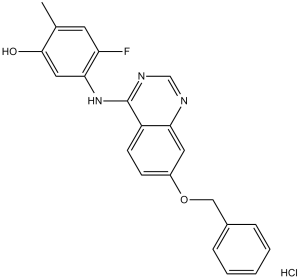
ZM323881 HCl (ZM-323881 Hydrochloride) is a novel, potent and selective tyrosine kinase VEGFR2 inhibitor with potential antitumor activity. It exhibits little to no activity against other kinases like PDGFRβ, FGFR1, ErbB2, VEGFR1, and FGFR1. It inhibits human vascular endothelial growth factor receptor 2 (VEGFR2) with an IC50 of less than 2 nM. ZM-323881. ZM323881 suppresses VEGF-R2 tyrosine phosphorylation and VEGF-A-induced endothelial cell proliferation in vitro (IC50 = 8 nM). At 30 minutes, ZM323881 (10 nM) inhibits Rac1 activation induced by VEGF in HUVECs.
Physicochemical Properties
| Molecular Formula | C22H18FN3O2.HCL |
| Molecular Weight | 411.85656 |
| Exact Mass | 411.114 |
| Elemental Analysis | C, 64.16; H, 4.65; Cl, 8.61; F, 4.61; N, 10.20; O, 7.77 |
| CAS # | 193000-39-4 |
| Related CAS # | ZM323881;193001-14-8 |
| PubChem CID | 22624897 |
| Appearance | Light yellow to yellow solid powder |
| LogP | 5.98 |
| Hydrogen Bond Donor Count | 3 |
| Hydrogen Bond Acceptor Count | 6 |
| Rotatable Bond Count | 5 |
| Heavy Atom Count | 29 |
| Complexity | 490 |
| Defined Atom Stereocenter Count | 0 |
| SMILES | CC1=C(O)C=C(NC2=C3C=CC(OCC4=CC=CC=C4)=CC3=NC=N2)C(F)=C1.Cl |
| InChi Key | AVRHWGLIYGJSOD-UHFFFAOYSA-N |
| InChi Code | InChI=1S/C22H18FN3O2.ClH/c1-14-9-18(23)20(11-21(14)27)26-22-17-8-7-16(10-19(17)24-13-25-22)28-12-15-5-3-2-4-6-15;/h2-11,13,27H,12H2,1H3,(H,24,25,26);1H |
| Chemical Name | 4-fluoro-2-methyl-5-[(7-phenylmethoxyquinazolin-4-yl)amino]phenol;hydrochloride |
| Synonyms | ZM323881; ZM 323881; ZM323881 hydrochloride; ZM-323881; ZM323881 HCl; ZM 323881 hydrochloride; ZM-323881 hydrochloride; ZM 323881 HCl; ZM-323881 HCl |
| HS Tariff Code | 2934.99.9001 |
| Storage |
Powder-20°C 3 years 4°C 2 years In solvent -80°C 6 months -20°C 1 month Note: Please store this product in a sealed and protected environment, avoid exposure to moisture. |
| Shipping Condition | Room temperature (This product is stable at ambient temperature for a few days during ordinary shipping and time spent in Customs) |
Biological Activity
| Targets |
VEGFR2 (IC50 = 2 nM) ZM 323881 HCl selectively inhibits vascular endothelial growth factor receptor 2 (VEGFR-2) tyrosine kinase (IC₅₀ = 60 nM for recombinant VEGFR-2 kinase activity; IC₅₀ = 40 nM for VEGF-induced VEGFR-2 phosphorylation in human aortic endothelial cells) [1] ZM 323881 HCl shows no significant inhibition against VEGFR-1, EGFR, or PDGFR tyrosine kinases (IC₅₀ > 10 μM for all) [2] |
||
| ln Vitro |
ZM323881 is an anilinoquinazoline that exhibits excellent selectivity against PDGFRβ, FGFR1, EGFR, and erbB2 (IC50>50 μM) and potently inhibits VEGFR2 (KDR) tyrosine kinase activity. ZM323881 suppresses VEGFR2 tyrosine phosphorylation and VEGF-A-induced endothelial cell proliferation (IC50=8 nM)[1]. ZM323881 blocks VEGFR-2 activation, but not VEGFR-1, platelet-derived growth factor receptor (PDGFR), hepatocyte growth factor (HGF) receptor, or epidermal growth factor receptor (EGFR). ZM323881, at 1 μM, totally prevents VEGF-induced ERK phosphorylation in HAECs[2]. Recombinant human VEGFR-2 kinase domain was incubated with ATP and a biotinylated peptide substrate in the presence of serial dilutions of ZM 323881 HCl. The reaction was conducted at 37°C for 45 minutes, and the phosphorylated substrate was detected using streptavidin-conjugated horseradish peroxidase and a chromogenic substrate. The inhibition rate was calculated by comparing the absorbance with the vehicle control, and the IC₅₀ value was derived from the dose-response curve [1] To assess selectivity, the same assay protocol was used to test the inhibitory activity of ZM 323881 HCl against recombinant VEGFR-1, EGFR, and PDGFR kinases. The reaction conditions were identical, and IC₅₀ values were determined to confirm the selective targeting of VEGFR-2 [2] |
||
| ln Vivo |
|
||
| Enzyme Assay |
Compounds (ZM323881) are incubated (20 minutes at room temperature) with the enzyme in 96-well plates coated with a poly(Glu, Ala, Tyr) 6:3:1 random copolymer substrate, in an N-2-hydroxyethylpiperazine-N'-2-ethanesulphonate (HEPES) (pH 7.5) buffered solution with 10 mM MnCl2 and 2 μM ATP. The next step involves the sequential incubation of sheep anti-mouse Ig antibody linked to horseradish peroxidase (HRP), mouse IgG anti-phosphotyrosine antibody, and 2,2'-azino-bis(3-ethylbenzthiazoline-6-sulphonic acid) in order to detect phosphorylated tyrosine. Nonlin-ear regression is utilized to interpolate IC50 data [1]. Recombinant human VEGFR-2 kinase domain was incubated with ATP and a biotinylated peptide substrate in the presence of serial dilutions of ZM 323881 HCl. The reaction was conducted at 37°C for 45 minutes, and the phosphorylated substrate was detected using streptavidin-conjugated horseradish peroxidase and a chromogenic substrate. The inhibition rate was calculated by comparing the absorbance with the vehicle control, and the IC₅₀ value was derived from the dose-response curve [1] To assess selectivity, the same assay protocol was used to test the inhibitory activity of ZM 323881 HCl against recombinant VEGFR-1, EGFR, and PDGFR kinases. The reaction conditions were identical, and IC₅₀ values were determined to confirm the selective targeting of VEGFR-2 [2] |
||
| Cell Assay |
Plated at passages 2–8, HUVEC cells isolated from umbilical cords are dosed with ZM323881±VEGF-A (3 ng/mL), EGF (3 ng/mL), or basic fibroblast growth factor (bFGF, 0.3 ng/mL) in 96-wellplates (1000 cells/well). After that, the cultures are incubated for four days. Day 4: The cultures are re-incubated for 4 hours after being pulsed with 1 μCi/well of 3 H-thymidine. After that, the cells are taken out and tested with a beta-counter to see if tritium has been incorporated. Interpolated IC50 data are used[1]. Human aortic endothelial cells (HAECs) were seeded in 96-well plates at 4×10³ cells/well and cultured overnight. ZM 323881 HCl (10 nM-1 μM) was added 1 hour prior to stimulation with VEGF (20 ng/mL). After 72 hours, cell viability was measured using a tetrazolium-based assay to calculate the IC₅₀ for proliferation inhibition. For Western blot analysis, HAECs were treated with the drug (50-200 nM) and VEGF, then lysed and probed with antibodies against phosphorylated VEGFR-2, Akt, ERK1/2, and GAPDH [1] HAECs were seeded in Boyden chambers for migration assays or on Matrigel-coated wells for tube formation assays. ZM 323881 HCl (50-200 nM) was added with VEGF, and migrated cells or formed tubes were counted after 6 hours (migration) or 12 hours (tube formation). For Ca²⁺ mobilization assays, HAECs were loaded with a fluorescent Ca²⁺ indicator, treated with the drug, and stimulated with VEGF or bFGF. Fluorescence intensity was recorded in real-time to measure intracellular Ca²⁺ changes [2] |
||
| Animal Protocol |
|
||
| References |
[1]. ZM323881, a novel inhibitor of vascular endothelial growth factor-receptor-2 tyrosine kinase activity. Microcirculation. 2002 Dec;9(6):513-22. [2]. Selective inhibition of vascular endothelial growth factor receptor-2 (VEGFR-2) identifies a central role for VEGFR-2 in human aortic endothelial cell responses to VEGF. J Recept Signal Transduct Res. 2003;23(2-3):239-54. |
||
| Additional Infomation |
ZM 323881 hydrochloride is a hydrochloride obtained by combining ZM 323881 with one molar equivalent of hydrochloric acid. It has a role as a vascular endothelial growth factor receptor antagonist and an EC 2.7.10.1 (receptor protein-tyrosine kinase) inhibitor. It contains a ZM 323881(1+). ZM 323881 HCl is a synthetic small-molecule inhibitor designed to specifically target VEGFR-2, a key mediator of angiogenesis. Its mechanism of action involves blocking VEGFR-2 tyrosine kinase activity, thereby inhibiting downstream signaling pathways critical for endothelial cell proliferation, migration, and tube formation [1] The selective inhibition of VEGFR-2 by ZM 323881 HCl makes it a valuable tool for studying the specific role of VEGFR-2 in vascular biology and potential therapeutic applications in angiogenesis-related diseases [2] |
Solubility Data
| Solubility (In Vitro) |
|
|||
| Solubility (In Vivo) |
Solubility in Formulation 1: ≥ 2.5 mg/mL (6.07 mM) (saturation unknown) in 10% DMSO + 40% PEG300 + 5% Tween80 + 45% Saline (add these co-solvents sequentially from left to right, and one by one), clear solution. For example, if 1 mL of working solution is to be prepared, you can add 100 μL of 25.0 mg/mL clear DMSO stock solution to 400 μL PEG300 and mix evenly; then add 50 μL Tween-80 to the above solution and mix evenly; then add 450 μL normal saline to adjust the volume to 1 mL. Preparation of saline: Dissolve 0.9 g of sodium chloride in 100 mL ddH₂ O to obtain a clear solution. Solubility in Formulation 2: ≥ 2.5 mg/mL (6.07 mM) (saturation unknown) in 10% DMSO + 90% (20% SBE-β-CD in Saline) (add these co-solvents sequentially from left to right, and one by one), clear solution. For example, if 1 mL of working solution is to be prepared, you can add 100 μL of 25.0 mg/mL clear DMSO stock solution to 900 μL of 20% SBE-β-CD physiological saline solution and mix evenly. Preparation of 20% SBE-β-CD in Saline (4°C,1 week): Dissolve 2 g SBE-β-CD in 10 mL saline to obtain a clear solution. Solubility in Formulation 3: ≥ 2.5 mg/mL (6.07 mM) (saturation unknown) in 10% DMSO + 90% Corn Oil (add these co-solvents sequentially from left to right, and one by one), clear solution. For example, if 1 mL of working solution is to be prepared, you can add 100 μL of 25.0 mg/mL clear DMSO stock solution to 900 μL of corn oil and mix evenly. Solubility in Formulation 4: 1% CMC Na: 20 mg/mL (Please use freshly prepared in vivo formulations for optimal results.) |
| Preparing Stock Solutions | 1 mg | 5 mg | 10 mg | |
| 1 mM | 2.4280 mL | 12.1400 mL | 24.2801 mL | |
| 5 mM | 0.4856 mL | 2.4280 mL | 4.8560 mL | |
| 10 mM | 0.2428 mL | 1.2140 mL | 2.4280 mL |