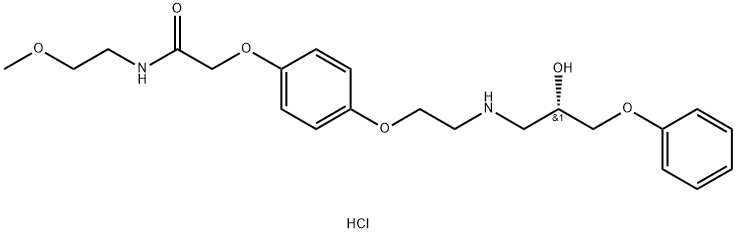
ZD 7114 hydrochloride (also known as ZD7114) is a novel, potent and selective beta-adrenoceptor agonist of brown fat and thermogenesis. It has the promise in the treatment of obesity. ICI D7114 stimulates whole body oxygen consumption in conscious rats, cats and dogs and brown adipose tissue (BAT) activity in conscious rats. Treatment of rats with ICI D7114 stimulated oxygen consumption (ED50, 0.04 mg kg-1, p.o.) and BAT mitochondrial guanosine diphosphate (GDP)-binding (ED50, 0.15 mg kg-1, p.o.) with no chronotropic effects on the heart at these doses.
Physicochemical Properties
| Molecular Formula | C22H30N2O6.HCL |
| Molecular Weight | 454.94434 |
| Exact Mass | 454.187 |
| Elemental Analysis | C, 58.08; H, 6.87; Cl, 7.79; N, 6.16; O, 21.10 |
| CAS # | 129689-28-7 |
| Related CAS # | 129689-30-1;129689-28-7 (HCl); |
| PubChem CID | 9890216 |
| Appearance | Typically exists as solid at room temperature |
| LogP | 3.269 |
| Hydrogen Bond Donor Count | 4 |
| Hydrogen Bond Acceptor Count | 7 |
| Rotatable Bond Count | 15 |
| Heavy Atom Count | 31 |
| Complexity | 439 |
| Defined Atom Stereocenter Count | 1 |
| SMILES | COCCNC(=O)COC1=CC=C(C=C1)OCCNCC(COC2=CC=CC=C2)O.Cl |
| InChi Key | KCAMZVQSGDBGGF-FERBBOLQSA-N |
| InChi Code | InChI=1S/C22H30N2O6.ClH/c1-27-13-12-24-22(26)17-30-21-9-7-20(8-10-21)28-14-11-23-15-18(25)16-29-19-5-3-2-4-6-19;/h2-10,18,23,25H,11-17H2,1H3,(H,24,26);1H/t18-;/m0./s1 |
| Chemical Name | 2-[4-[2-[[(2S)-2-hydroxy-3-phenoxypropyl]amino]ethoxy]phenoxy]-N-(2-methoxyethyl)acetamide;hydrochloride |
| Synonyms | ICI-D7114; ICI-D 7114; ICI-D-7114; ZD7114; ZD 7114 hydrochloride; 129689-28-7; D-7114 hydrochloride; ZD-7114 hydrochloride; ZD-7114 (hydrochloride); (S)-4-[2-HYDROXY-3-PHENOXYPROPYLAMINOETHOXY]-N-(2-METHOXYETHYL)PHENOXYACETAMIDE HYDROCHLORIDE; Z63T1D9750; (S)-2-(4-(2-((2-Hydroxy-3-phenoxypropyl)amino)ethoxy)phenoxy)-N-(2-methoxyethyl)acetamide hydrochloride; ZD 7114; ZD7114 HCl; ZD-7114; ZD 7114 hydrochloride |
| HS Tariff Code | 2934.99.9001 |
| Storage |
Powder-20°C 3 years 4°C 2 years In solvent -80°C 6 months -20°C 1 month |
| Shipping Condition | Room temperature (This product is stable at ambient temperature for a few days during ordinary shipping and time spent in Customs) |
Biological Activity
| Targets | β3-adrenergic receptors |
| ln Vitro | Increasing energy expenditure by treatment with thermogenic drugs is not new, but available drugs have suffered from the problem of lack of selectivity. In the last decade two key findings have allowed the development of selective thermogenic drugs that have promise in the treatment of obesity. 1) The recognition that brown adipose tissue (BAT) plays a role in compensatory increases in energy expenditure has allowed an approach directed at a target organ. 2) The demonstration showing that increases in the activity of BAT may be modulated by an atypical (beta 3) adrenoceptor has led to the development of a new peripherally acting beta-adrenoceptor agonist ICI D7114, which stimulates thermogenesis at doses that have little effect on beta 1 or beta 2 adrenoceptors. Treatment with the compound activates BAT and thermogenesis even in species and situations where the intrinsic capacity is low. 3) The compound has beneficial effects in animal models of obesity and disturbed glucose and lipid homeostasis. [1] |
| ln Vivo | ICI D7114 is a potent and selective stimulant of whole body oxygen consumption with little effect on heart rate in the rat. In addition, administration of ICI D7114 did not produce #2-adrenoceptor-mediated effects such as tremor or hypokalaemia. The results suggest that ICI D7114 may be useful in the treatment of obesity and related diseases such as diabetes.[2] |
| Animal Protocol |
rats treated with ICI D7114 or clenbuterol were dosed by gavage with the compounds dissolved in aqueous 0.025% polysorbate. [2] In the first series, four dogs received gelatin capsules containing 0.1, 1.0 or 10.Omgkg-' of ICI D7114 or a placebo capsule containing lactose. Each dog received each treatment with a washout period of at least one week between treatments. In the second series the effects of 0.01, 0.03 and 0.1 mgkg-t ICI D7114 were compared with placebo. The effects of treatment with placebo capsules or capsules containing 0.1 or 10.0mgkg-' of ICI D7114 were also assessed in five cats in the same way as described for dogs.[2] Dogs with indwelling venous and arterial catheters were dosed with capsules containing ICI D7114 or a placebo preparation of lactose. Blood samples were taken via the catheters at intervals after dosing for the determination of blood potassium with a Nova Stat Profile blood gas analyser.[2] |
| References |
[1]:ICI D7114: a novel selective adrenoceptor agonist of brown fat and thermogenesis. Am J Clin Nutr. 1992 Jan;55(1 Suppl):262S-264S. [2]:ICI D7114 a novel selective beta-adrenoceptor agonist selectively stimulates brown fat and increases whole-body oxygen consumption. Br J Pharmacol. 1991 Sep;104(1):97-104. |
| Additional Infomation | 1. ICI D7114 is a novel, beta-adrenoceptor agonist which stimulates whole body oxygen consumption in conscious rats, cats and dogs and brown adipose tissue (BAT) activity in conscious rats. Treatment of rats with ICI D7114 stimulated oxygen consumption (ED50, 0.04 mg kg-1, p.o.) and BAT mitochondrial guanosine diphosphate (GDP)-binding (ED50, 0.15 mg kg-1, p.o.) with no chronotropic effects on the heart at these doses. 2. Reference beta-adrenoceptor agonists, isoprenaline and clenbuterol, also stimulated oxygen consumption and BAT activity but were less selective because they also produced effects on heart rate at these doses. 3. Treatment of conscious rats with ICI D7114 did not attenuate the chronotropic effects on the heart of a subsequent isoprenaline challenge. 4. Administration of ICI D7114 or of its acid metabolite had no effect in a cat soleus muscle model of tremor or on blood potassium levels in the conscious dog, indicating lack of effects at beta 2-adrenoceptors. 5. The results indicate that ICI D7114 may have activity at atypical beta-adrenoceptors in brown adipose tissue leading to increased whole body oxygen consumption. [2] |
Solubility Data
| Solubility (In Vitro) | May dissolve in DMSO (in most cases), if not, try other solvents such as H2O, Ethanol, or DMF with a minute amount of products to avoid loss of samples |
| Solubility (In Vivo) |
Note: Listed below are some common formulations that may be used to formulate products with low water solubility (e.g. < 1 mg/mL), you may test these formulations using a minute amount of products to avoid loss of samples. Injection Formulations (e.g. IP/IV/IM/SC) Injection Formulation 1: DMSO : Tween 80: Saline = 10 : 5 : 85 (i.e. 100 μL DMSO stock solution → 50 μL Tween 80 → 850 μL Saline) *Preparation of saline: Dissolve 0.9 g of sodium chloride in 100 mL ddH ₂ O to obtain a clear solution. Injection Formulation 2: DMSO : PEG300 :Tween 80 : Saline = 10 : 40 : 5 : 45 (i.e. 100 μL DMSO → 400 μLPEG300 → 50 μL Tween 80 → 450 μL Saline) Injection Formulation 3: DMSO : Corn oil = 10 : 90 (i.e. 100 μL DMSO → 900 μL Corn oil) Example: Take the Injection Formulation 3 (DMSO : Corn oil = 10 : 90) as an example, if 1 mL of 2.5 mg/mL working solution is to be prepared, you can take 100 μL 25 mg/mL DMSO stock solution and add to 900 μL corn oil, mix well to obtain a clear or suspension solution (2.5 mg/mL, ready for use in animals). Injection Formulation 4: DMSO : 20% SBE-β-CD in saline = 10 : 90 [i.e. 100 μL DMSO → 900 μL (20% SBE-β-CD in saline)] *Preparation of 20% SBE-β-CD in Saline (4°C,1 week): Dissolve 2 g SBE-β-CD in 10 mL saline to obtain a clear solution. Injection Formulation 5: 2-Hydroxypropyl-β-cyclodextrin : Saline = 50 : 50 (i.e. 500 μL 2-Hydroxypropyl-β-cyclodextrin → 500 μL Saline) Injection Formulation 6: DMSO : PEG300 : castor oil : Saline = 5 : 10 : 20 : 65 (i.e. 50 μL DMSO → 100 μLPEG300 → 200 μL castor oil → 650 μL Saline) Injection Formulation 7: Ethanol : Cremophor : Saline = 10: 10 : 80 (i.e. 100 μL Ethanol → 100 μL Cremophor → 800 μL Saline) Injection Formulation 8: Dissolve in Cremophor/Ethanol (50 : 50), then diluted by Saline Injection Formulation 9: EtOH : Corn oil = 10 : 90 (i.e. 100 μL EtOH → 900 μL Corn oil) Injection Formulation 10: EtOH : PEG300:Tween 80 : Saline = 10 : 40 : 5 : 45 (i.e. 100 μL EtOH → 400 μLPEG300 → 50 μL Tween 80 → 450 μL Saline) Oral Formulations Oral Formulation 1: Suspend in 0.5% CMC Na (carboxymethylcellulose sodium) Oral Formulation 2: Suspend in 0.5% Carboxymethyl cellulose Example: Take the Oral Formulation 1 (Suspend in 0.5% CMC Na) as an example, if 100 mL of 2.5 mg/mL working solution is to be prepared, you can first prepare 0.5% CMC Na solution by measuring 0.5 g CMC Na and dissolve it in 100 mL ddH2O to obtain a clear solution; then add 250 mg of the product to 100 mL 0.5% CMC Na solution, to make the suspension solution (2.5 mg/mL, ready for use in animals). Oral Formulation 3: Dissolved in PEG400 Oral Formulation 4: Suspend in 0.2% Carboxymethyl cellulose Oral Formulation 5: Dissolve in 0.25% Tween 80 and 0.5% Carboxymethyl cellulose Oral Formulation 6: Mixing with food powders Note: Please be aware that the above formulations are for reference only. InvivoChem strongly recommends customers to read literature methods/protocols carefully before determining which formulation you should use for in vivo studies, as different compounds have different solubility properties and have to be formulated differently. (Please use freshly prepared in vivo formulations for optimal results.) |
| Preparing Stock Solutions | 1 mg | 5 mg | 10 mg | |
| 1 mM | 2.1981 mL | 10.9905 mL | 21.9809 mL | |
| 5 mM | 0.4396 mL | 2.1981 mL | 4.3962 mL | |
| 10 mM | 0.2198 mL | 1.0990 mL | 2.1981 mL |