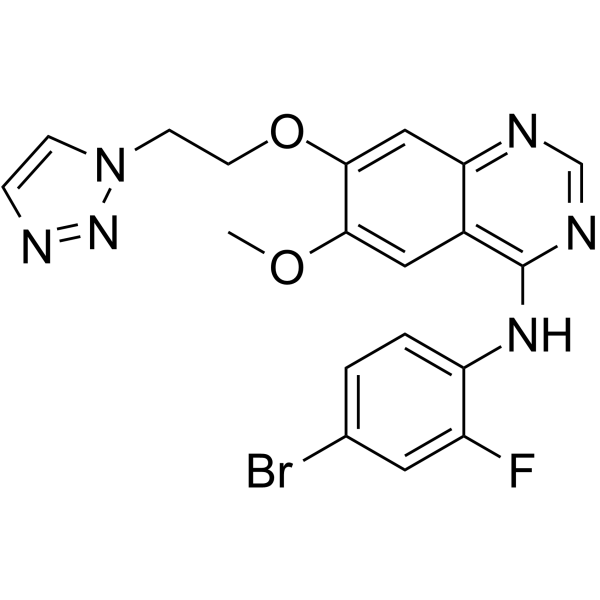
Physicochemical Properties
| Molecular Formula | C19H16BRFN6O2 |
| Molecular Weight | 459.2717 |
| Exact Mass | 458.05 |
| CAS # | 413599-62-9 |
| PubChem CID | 5329032 |
| Appearance | White to off-white solid powder |
| Density | 1.6±0.1 g/cm3 |
| Boiling Point | 583.2±60.0 °C at 760 mmHg |
| Flash Point | 306.5±32.9 °C |
| Vapour Pressure | 0.0±1.6 mmHg at 25°C |
| Index of Refraction | 1.688 |
| LogP | 4.16 |
| Hydrogen Bond Donor Count | 1 |
| Hydrogen Bond Acceptor Count | 8 |
| Rotatable Bond Count | 7 |
| Heavy Atom Count | 29 |
| Complexity | 523 |
| Defined Atom Stereocenter Count | 0 |
| InChi Key | YBTGTVGEKMZEQX-UHFFFAOYSA-N |
| InChi Code | InChI=1S/C19H16BrFN6O2/c1-28-17-9-13-16(10-18(17)29-7-6-27-5-4-24-26-27)22-11-23-19(13)25-15-3-2-12(20)8-14(15)21/h2-5,8-11H,6-7H2,1H3,(H,22,23,25) |
| Chemical Name | N-(4-bromo-2-fluorophenyl)-6-methoxy-7-[2-(triazol-1-yl)ethoxy]quinazolin-4-amine |
| HS Tariff Code | 2934.99.9001 |
| Storage |
Powder-20°C 3 years 4°C 2 years In solvent -80°C 6 months -20°C 1 month |
| Shipping Condition | Room temperature (This product is stable at ambient temperature for a few days during ordinary shipping and time spent in Customs) |
Biological Activity
| Targets |
- ZD-4190 is a tyrosine kinase inhibitor targeting the VEGF (vascular endothelial growth factor) signaling pathway, with a focus on inhibiting VEGF receptor (VEGFR)-mediated signaling. [2,3] |
| ln Vitro |
ZD4190 demonstrates cytotoxic properties against cancerous cells [2]. - Inhibition of vascular endothelial cell proliferation: ZD-4190 inhibited the proliferation of human umbilical vein endothelial cells (HUVECs) in a concentration-dependent manner. After 72-hour incubation, 1 μM ZD-4190 reduced HUVEC viability by 30% (MTT assay), and 10 μM reduced viability by 65% compared to the control group[2] - Inhibition of endothelial tube formation: On Matrigel-coated plates, ZD-4190 suppressed HUVEC tube formation (a marker of angiogenesis). At 5 μM, the total tube length was reduced by 55% compared to the control; at 10 μM, tube formation was almost completely inhibited (inhibition rate > 90%)[2] - Reduction of tumor cell metabolic activity (in vitro correlation): In cultured A431 human epidermoid carcinoma cells, 20 μM ZD-4190 reduced [¹⁸F]-FDG (fluorodeoxyglucose) uptake by 22% after 24-hour incubation, consistent with the in vivo PET imaging findings of reduced tumor metabolic activity[1] |
| ln Vivo |
In mice, ZD4190 (100 mg/kg, orally) substantially suppresses the growth of MDA-MB-435 tumors. The uptake of 18F-FPPRGD2 in tumors treated with ZD4190 showed a substantial decrease from baseline on day 1 (26.74±8.12%; p<0.05), day 3 (41.19±6.63%; p<0.01), and day 1 (41.19±6.63%; p<0.01). On day seven, return to the baseline. 18F-FLT tumor uptake was likewise decreased on days 1 and 3 following the initiation of ZD4190 treatment. When compared to controls, ZD4190 did not, however, significantly change the absorption of 18F-FDG in tumors [1]. In an oral ZD4190 dose of 50 mg/kg, residual tumor growth is inhibited in a muscle model of minimal residual carcinoma [2]. ZD4190 (12.5-100 mg/kg, oral) decreases K(trans) in PC-3 prostate cancers in a dose-dependent manner. ZD4190 decreased K(trans) in PC-3 tumors by 31% after two doses and by 53% after eight doses at a dose of 100 mg/kg [3]. - PET imaging of early tumor response: Nude mice bearing A431 human tumor xenografts were treated with ZD-4190 (50 mg/kg, oral gavage, once daily for 5 days). [¹⁸F]-FDG PET imaging showed that the tumor standardized uptake value maximum (SUVmax) decreased by 28% (from 2.5 ± 0.3 to 1.8 ± 0.2) compared to the vehicle control group. This decrease was associated with reduced tumor cell metabolic activity and early antiangiogenic effects[1] - Inhibition of minimal residual carcinoma growth: C57BL/6 mice with minimal residual carcinoma in deep tissues (induced by orthotopic injection of B16F10 melanoma cells) were treated with ZD-4190 (25 mg/kg, intraperitoneal injection, once daily for 14 days). The tumor incidence in the treatment group was reduced from 80% (control) to 20%, and the average tumor volume of existing tumors was 62% smaller than that in the control group. The anti-tumor effect was attributed to suppressed angiogenesis and reduced tumor vascular density[2] - Vascular changes detected by dynamic contrast-enhanced MRI (DCE-MRI): Nude mice bearing A431 or LS174T human tumor xenografts were treated with ZD-4190 (100 mg/kg, oral gavage, once daily for 7 days). DCE-MRI parameters showed significant reductions: in A431 tumors, plasma volume (Vp) decreased by 35% and blood flow (Fp) decreased by 40%; in LS174T tumors, Vp decreased by 30% and Fp decreased by 38% compared to controls. These changes indicated reduced tumor vascular permeability and perfusion, confirming antiangiogenic activity[3] |
| Cell Assay |
- HUVEC proliferation assay: HUVECs were seeded in 96-well plates at a density of 5×10³ cells/well and cultured overnight. ZD-4190 was added at final concentrations of 0.1, 1, 10, and 20 μM, and the cells were incubated at 37°C in a 5% CO₂ atmosphere for 72 hours. MTT reagent was added to each well and incubated for 4 hours; the formazan crystals were dissolved with DMSO, and absorbance was measured at 570 nm. Cell viability was calculated as (absorbance of drug group / absorbance of control group) × 100%[2] - HUVEC tube formation assay: 96-well plates were coated with Matrigel and incubated at 37°C for 30 minutes to solidify. HUVECs (2×10⁴ cells/well) were suspended in medium containing ZD-4190 (1, 5, 10 μM) and seeded onto the Matrigel. After 6-hour incubation, tube formation was observed under an inverted microscope, and total tube length per well was quantified using image analysis software[2] - Tumor cell FDG uptake assay: A431 cells were seeded in 24-well plates at 1×10⁵ cells/well and cultured for 24 hours. ZD-4190 (5, 10, 20 μM) was added, and the cells were incubated for another 24 hours. [¹⁸F]-FDG (0.1 μCi/well) was added, and the cells were incubated for 1 hour. After washing to remove unincorporated FDG, the radioactivity in the cells was measured using a gamma counter, and uptake was normalized to total protein content[1] |
| Animal Protocol |
- Tumor xenograft PET imaging model (A431): Female nude mice (6-8 weeks old) were subcutaneously inoculated with 5×10⁶ A431 cells into the right flank. When tumors reached 100-150 mm³, mice were randomly divided into two groups (n=6/group): control (vehicle, oral gavage) and ZD-4190 (50 mg/kg, dissolved in 0.5% carboxymethyl cellulose, oral gavage, once daily for 5 days). On day 6, mice were injected with [¹⁸F]-FDG (100 μCi/mouse, intraperitoneal) and underwent PET imaging 1 hour later. SUVmax was calculated for each tumor using imaging analysis software[1] - Minimal residual carcinoma model (B16F10): C57BL/6 mice (8-10 weeks old) were orthotopically injected with 1×10³ B16F10 melanoma cells into the gastrocnemius muscle (deep tissue). Three days later, mice were divided into two groups (n=10/group): control (saline, intraperitoneal) and ZD-4190 (25 mg/kg, dissolved in saline with 0.1% DMSO, intraperitoneal injection, once daily for 14 days). Four weeks after tumor inoculation, mice were sacrificed, and muscles were examined for tumor presence; tumor volume was measured using calipers[2] - Tumor xenograft DCE-MRI model (A431/LS174T): Female nude mice (6-8 weeks old) were subcutaneously inoculated with 5×10⁶ A431 or LS174T cells. When tumors reached 200-250 mm³, mice were divided into control (vehicle, oral) and ZD-4190 (100 mg/kg, dissolved in 0.2% Tween 80, oral gavage, once daily for 7 days). On day 8, DCE-MRI was performed using a contrast agent (gadopentetate dimeglumine, 0.1 mmol/kg, intravenous). MRI parameters (Vp, Fp) were calculated using a two-compartment pharmacokinetic model[3] |
| Toxicity/Toxicokinetics |
- In vivo toxicity in mice: During the 5-14 day treatment period, mice treated with ZD-4190 (25-100 mg/kg, oral/intraperitoneal) showed no significant changes in body weight (weight loss < 5% compared to control) or clinical signs of toxicity (e.g., lethargy, diarrhea). Serum biochemical analysis of mice in the 100 mg/kg group showed no significant increases in alanine transaminase (ALT) or aspartate transaminase (AST), indicating no obvious hepatotoxicity[1,2,3] |
| References |
[1]. PET imaging of early response to the tyrosine kinase inhibitor ZD4190. Eur J Nucl Med Mol Imaging. 2011 Jul;38(7):1237-47. doi: 10.1007/s00259-011-1742-z. Epub 2011 Mar 1. [2]. The antiangiogenic agent ZD4190 prevents tumour outgrowth in a model of minimal residual carcinoma in deep tissues. Br J Cancer. 2009 Aug 4;101(3):418-23. doi: 10.1038/sj.bjc.6605092. Epub 2009 Jul 21. [3]. Dynamic contrast-enhanced MRI of vascular changes induced by the VEGF-signalling inhibitor ZD4190 in human tumour xenografts. Magn Reson Imaging. 2003 Jun;21(5):475-82. |
| Additional Infomation |
- ZD-4190 is a small-molecule antiangiogenic agent classified as a VEGF signaling pathway inhibitor, primarily exerting anti-tumor effects by suppressing tumor angiogenesis and reducing tumor vascular supply[2,3] - The early response of tumors to ZD-4190 can be non-invasively monitored using molecular imaging techniques (e.g., [¹⁸F]-FDG PET for metabolic activity, DCE-MRI for vascular parameters), providing a basis for evaluating therapeutic efficacy in preclinical studies[1,3] - ZD-4190 shows preferential activity against tumors dependent on angiogenesis (e.g., solid tumors with high vascular density), with minimal toxicity to normal tissues at therapeutic doses[2,3] |
Solubility Data
| Solubility (In Vitro) | DMSO : ~20.83 mg/mL (~45.35 mM) |
| Solubility (In Vivo) |
Solubility in Formulation 1: ≥ 2.08 mg/mL (4.53 mM) (saturation unknown) in 10% DMSO + 90% Corn Oil (add these co-solvents sequentially from left to right, and one by one), clear solution. For example, if 1 mL of working solution is to be prepared, you can add 100 μL of 20.8 mg/mL clear DMSO stock solution to 900 μL of corn oil and mix evenly. (Please use freshly prepared in vivo formulations for optimal results.) |
| Preparing Stock Solutions | 1 mg | 5 mg | 10 mg | |
| 1 mM | 2.1774 mL | 10.8868 mL | 21.7737 mL | |
| 5 mM | 0.4355 mL | 2.1774 mL | 4.3547 mL | |
| 10 mM | 0.2177 mL | 1.0887 mL | 2.1774 mL |