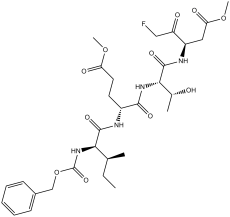
Z-IETD-FMK, also known as Z-IE(OMe)TD(OMe)-FMK, is a novel Caspase-8/9 inhibitor that is specific, selective, irreversible, and cell permeable. Z-IETD-FMK works by preventing PHA- or anti-CD3 plus anti-CD28-induced T cell proliferation without harming dormant T cells. Normal cell growth is unaffected by Z-IETD-FMK in the absence of an activation signal. When present in concentrations of 100μM, Z-IETD-FMK has also been discovered to significantly inhibit NF-κB activation. In addition to its capacity to suppress cell proliferation, Z-IETD-FMK is also said to suppress TRAIL-mediated cell apoptosis. In both HCT116 and SW480 cells, it equally protects procaspases 9, 2, and 3 as well as PARP.
Physicochemical Properties
| Molecular Formula | C30H43FN4O11 | |
| Molecular Weight | 654.68 | |
| Exact Mass | 654.291 | |
| Elemental Analysis | C, 53.67; H, 6.27; F, 3.03; N, 8.94; O, 28.08 | |
| CAS # | 210344-98-2 | |
| Related CAS # |
|
|
| PubChem CID | 25108681 | |
| Appearance | White to light yellow solid powder | |
| Density | 1.2±0.1 g/cm3 | |
| Boiling Point | 925.7±65.0 °C at 760 mmHg | |
| Flash Point | 513.6±34.3 °C | |
| Vapour Pressure | 0.0±0.3 mmHg at 25°C | |
| Index of Refraction | 1.518 | |
| LogP | 3.92 | |
| Hydrogen Bond Donor Count | 5 | |
| Hydrogen Bond Acceptor Count | 12 | |
| Rotatable Bond Count | 22 | |
| Heavy Atom Count | 46 | |
| Complexity | 1050 | |
| Defined Atom Stereocenter Count | 6 | |
| SMILES | FC([H])([H])C([C@@]([H])(C([H])([H])C(=O)OC([H])([H])[H])N([H])C([C@]([H])([C@@]([H])(C([H])([H])[H])O[H])N([H])C([C@@]([H])(C([H])([H])C([H])([H])C(=O)OC([H])([H])[H])N([H])C([C@@]([H])([C@@]([H])(C([H])([H])[H])C([H])([H])C([H])([H])[H])N([H])C(=O)OC([H])([H])C1C([H])=C([H])C([H])=C([H])C=1[H])=O)=O)=O)=O |
|
| InChi Key | PHLCQASLWHYEMX-DEKIMQJDSA-N | |
| InChi Code | InChI=1S/C30H43FN4O11/c1-6-17(2)25(35-30(43)46-16-19-10-8-7-9-11-19)28(41)32-20(12-13-23(38)44-4)27(40)34-26(18(3)36)29(42)33-21(22(37)15-31)14-24(39)45-5/h7-11,17-18,20-21,25-26,36H,6,12-16H2,1-5H3,(H,32,41)(H,33,42)(H,34,40) | |
| Chemical Name | methyl (4S)-5-[[(2S,3R)-1-[[(3S)-5-fluoro-1-methoxy-1,4-dioxopentan-3-yl]amino]-3-hydroxy-1-oxobutan-2-yl]amino]-4-[[(2S,3S)-3-methyl-2-(phenylmethoxycarbonylamino)pentanoyl]amino]-5-oxopentanoate | |
| Synonyms | Z-IE(OMe)TD(OMe)-FMK; Z-IETD-FMK; Granzyme B Inhibitor III; MDK-4982; MDK4982; MDK 4982; Z-Ile-Glu(OMe)-Thr-Asp(OMe)-CH₂F | |
| HS Tariff Code | 2934.99.9001 | |
| Storage |
Powder-20°C 3 years 4°C 2 years In solvent -80°C 6 months -20°C 1 month Note: Please store this product in a sealed and protected environment, avoid exposure to moisture. |
|
| Shipping Condition | Room temperature (This product is stable at ambient temperature for a few days during ordinary shipping and time spent in Customs) |
Biological Activity
| Targets | Caspase-8 |
| ln Vitro |
In retinal cells exposed to various apoptotic stimuli, Z-IETD-FMK, which blocks caspase-8 cleavage and only partially blocks caspase-3 and PARP cleavage, inhibits the execution of apoptosis.[1] Z-IETD-FMK (50 μM) significantly inhibits the activation of caspase 3 and lessens the death of cardiomyocytes brought on by ceramide.[2] The production of activated/memory T cells, T cell cytokines, and NF-kappaB responses to TCR:CD3 engagement in T cell cultures are all impacted by Z-IETD-FMK'scaspase-8inhibition.[3] |
| ln Vivo |
Z-IETD-FMK inhibits caspase-8 in living organisms, which decreases memory/activated CD4 and CD8 T cells and raises susceptibility to T. cruzi infection.[3] Injured retinal ganglion cells are encouraged to regenerate and survive after CNS injuries by Z-IETD-FMK. [4] |
| Cell Assay | Drugs and ceramide were simultaneously added to the cell culture medium, and after 24 hours, the number of living cells was counted. |
| Animal Protocol |
T. cruzi-infected mice 0.4 mg/3 days |
| References |
[1]. Invest Ophthalmol Vis Sci . 1999 Oct;40(11):2660-7. [2]. J Card Fail . 2000 Sep;6(3):243-9. [3]. J Immunol . 2005 May 15;174(10):6314-21. [4]. J Neurosci . 2011 Jul 20;31(29):10494-505. |
Solubility Data
| Solubility (In Vitro) |
|
|||
| Solubility (In Vivo) |
Solubility in Formulation 1: ≥ 2.08 mg/mL (3.18 mM) (saturation unknown) in 10% DMSO + 40% PEG300 + 5% Tween80 + 45% Saline (add these co-solvents sequentially from left to right, and one by one), clear solution. For example, if 1 mL of working solution is to be prepared, you can add 100 μL of 20.8 mg/mL clear DMSO stock solution to 400 μL PEG300 and mix evenly; then add 50 μL Tween-80 to the above solution and mix evenly; then add 450 μL normal saline to adjust the volume to 1 mL. Preparation of saline: Dissolve 0.9 g of sodium chloride in 100 mL ddH₂ O to obtain a clear solution. Solubility in Formulation 2: ≥ 2.08 mg/mL (3.18 mM) (saturation unknown) in 10% DMSO + 90% (20% SBE-β-CD in Saline) (add these co-solvents sequentially from left to right, and one by one), clear solution. For example, if 1 mL of working solution is to be prepared, you can add 100 μL of 20.8 mg/mL clear DMSO stock solution to 900 μL of 20% SBE-β-CD physiological saline solution and mix evenly. Preparation of 20% SBE-β-CD in Saline (4°C,1 week): Dissolve 2 g SBE-β-CD in 10 mL saline to obtain a clear solution. Solubility in Formulation 3: ≥ 2.08 mg/mL (3.18 mM) (saturation unknown) in 10% DMSO + 90% Corn Oil (add these co-solvents sequentially from left to right, and one by one), clear solution. For example, if 1 mL of working solution is to be prepared, you can add 100 μL of 20.8 mg/mL clear DMSO stock solution to 900 μL of corn oil and mix evenly. (Please use freshly prepared in vivo formulations for optimal results.) |
| Preparing Stock Solutions | 1 mg | 5 mg | 10 mg | |
| 1 mM | 1.5275 mL | 7.6373 mL | 15.2746 mL | |
| 5 mM | 0.3055 mL | 1.5275 mL | 3.0549 mL | |
| 10 mM | 0.1527 mL | 0.7637 mL | 1.5275 mL |