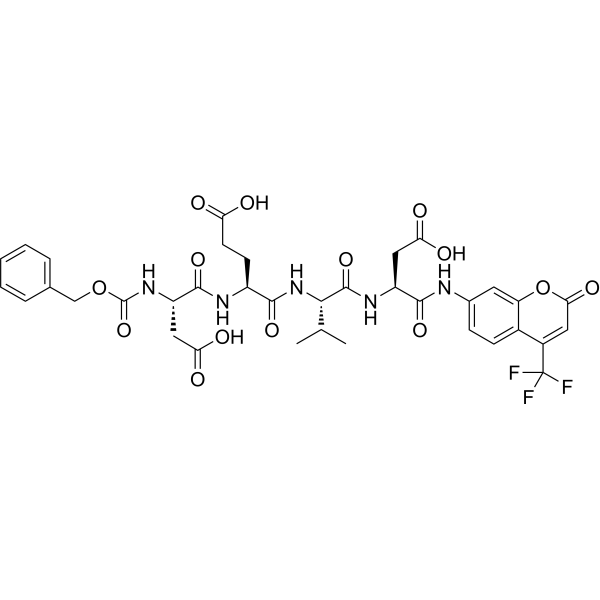
Physicochemical Properties
| Molecular Formula | C36H38F3N5O14 |
| Molecular Weight | 821.707240581512 |
| Exact Mass | 821.236 |
| CAS # | 1135416-11-3 |
| PubChem CID | 25108569 |
| Sequence | zDEVD-AFC |
| SequenceShortening | DEVD |
| Appearance | White to off-white solid powder |
| Density | 1.5±0.1 g/cm3 |
| Boiling Point | 1160.9±65.0 °C at 760 mmHg |
| Flash Point | 655.9±34.3 °C |
| Vapour Pressure | 0.0±0.3 mmHg at 25°C |
| Index of Refraction | 1.591 |
| LogP | 4.15 |
| Hydrogen Bond Donor Count | 8 |
| Hydrogen Bond Acceptor Count | 17 |
| Rotatable Bond Count | 20 |
| Heavy Atom Count | 58 |
| Complexity | 1600 |
| Defined Atom Stereocenter Count | 4 |
| SMILES | CC(C)[C@@H](C(=O)N[C@@H](CC(=O)O)C(=O)NC1=CC2=C(C=C1)C(=CC(=O)O2)C(F)(F)F)NC(=O)[C@H](CCC(=O)O)NC(=O)[C@H](CC(=O)O)NC(=O)OCC3=CC=CC=C3 |
| InChi Key | JEPURZRNABGOCW-CQUCHYGKSA-N |
| InChi Code | InChI=1S/C36H38F3N5O14/c1-17(2)30(34(55)42-23(14-27(47)48)32(53)40-19-8-9-20-21(36(37,38)39)13-29(51)58-25(20)12-19)44-31(52)22(10-11-26(45)46)41-33(54)24(15-28(49)50)43-35(56)57-16-18-6-4-3-5-7-18/h3-9,12-13,17,22-24,30H,10-11,14-16H2,1-2H3,(H,40,53)(H,41,54)(H,42,55)(H,43,56)(H,44,52)(H,45,46)(H,47,48)(H,49,50)/t22-,23-,24-,30-/m0/s1 |
| Chemical Name | (4S)-5-[[(2S)-1-[[(2S)-3-carboxy-1-oxo-1-[[2-oxo-4-(trifluoromethyl)chromen-7-yl]amino]propan-2-yl]amino]-3-methyl-1-oxobutan-2-yl]amino]-4-[[(2S)-3-carboxy-2-(phenylmethoxycarbonylamino)propanoyl]amino]-5-oxopentanoic acid |
| Synonyms | Z-DEVD-AFC; 1135416-11-3; (5S,8S,11S,14S)-8-(2-carboxyethyl)-5-(carboxymethyl)-11-isopropyl-3,6,9,12-tetraoxo-14-((2-oxo-4-(trifluoromethyl)-2H-chromen-7-yl)carbamoyl)-1-phenyl-2-oxa-4,7,10,13-tetraazahexadecan-16-oicacid; (4S)-5-[[(2S)-1-[[(2S)-3-Carboxy-1-oxo-1-[[2-oxo-4-(trifluoromethyl)chromen-7-yl]amino]propan-2-yl]amino]-3-methyl-1-oxobutan-2-yl]amino]-4-[[(2S)-3-carboxy-2-(phenylmethoxycarbonylamino)propanoyl]amino]-5-oxopentanoic acid; Caspase 3 Apopain Substrate; SCHEMBL5888314; Fluorogenic substrate for Caspase-3; |
| HS Tariff Code | 2934.99.9001 |
| Storage |
Powder-20°C 3 years 4°C 2 years In solvent -80°C 6 months -20°C 1 month Note: Please store this product in a sealed and protected environment, avoid exposure to moisture. |
| Shipping Condition | Room temperature (This product is stable at ambient temperature for a few days during ordinary shipping and time spent in Customs) |
Biological Activity
| Targets | Caspase-3 |
| Cell Assay |
Caspase-3-like enzymes activity assessment [1] Caspase-3 activity was measured in retinal neural cell cultures using Z-Asp-Glu-Val-Asp-AFC (Z-DEVD-AFC), a cell-permeant substrate for caspase-3, which causes a shift in fluorescence upon cleavage of the AFC fluorophore. The cells were washed and then lysed at 4 °C in 50 mM KCl, 50 mM PIPES, 10 mM EGTA, 2 mM MgCl2, 0.5% Triton X-100, supplemented with 100 μM phenylmethylsulfonyl fluoride (PMSF), 1 mM dithiothreitol (DTT), 1 μg/ml chymostatin, 1 μg/ml leupeptin, 1 μg/ml antiparin, 1 μg/ml pepstatin A, pH 7.4, at 4 °C. Retinal neural cell lysates were frozen three times in liquid nitrogen, and centrifuged at 15 800×g for 10 min at 4 °C. The supernatant was collected and the protein concentration was determined by the Bradford/Bio-Rad method. To measure caspase activity, 20 μg of protein were incubated with 100 μM DEVD-AFC in reaction buffer (25 mM HEPES, 0.1% (w/v) 3-[(3-cholamidopropyl) dimethylammonio]-1-propane-sulfonate (CHAPS), 10 mM DTT, 100 μM PMSF) for 30 min at 37 °C. The reaction was stopped with ice-cold reaction buffer. The fluorescence was monitored with a Spex Fluoromax spectrofluorometer, with excitation at 420 nm and emission at 505 nm with a band pass of 5 nm. Caspase-3-like enzymes activity was expressed as the percentage of the control for equal protein loading. |
| References |
[1]. High glucose induces caspase-independent cell death in retinal neural cells. Neurobiol Dis. 2007;25(3):464-472. |
| Additional Infomation | Diabetic retinopathy is a leading cause of blindness among adults in the western countries. It has been reported that neurodegeneration may occur in diabetic retinas, but the mechanisms underlying retinal cell death are poorly understood. We found that high glucose increased the number of cells with condensed nuclei and the number of TUNEL-positive cells, and caused an increase in the translocation of phosphatidylserine to the outer leaflet of the plasma membrane, indicating that high glucose induces apoptosis in cultured retinal neural cells. The activity of caspases did not increase in high glucose-treated cells, but apoptosis-inducing factor (AIF) levels decreased in the mitochondria and increased in the nucleus, indicating a translocation to the nucleus where it may cause DNA fragmentation. These results demonstrate that elevated glucose induces apoptosis in cultured retinal neural cells. The increase in apoptosis is not dependent on caspase activation, but is mediated through AIF release from the mitochondria.[1] |
Solubility Data
| Solubility (In Vitro) | DMSO : ~50 mg/mL (~60.85 mM) |
| Solubility (In Vivo) |
Note: Listed below are some common formulations that may be used to formulate products with low water solubility (e.g. < 1 mg/mL), you may test these formulations using a minute amount of products to avoid loss of samples. Injection Formulations (e.g. IP/IV/IM/SC) Injection Formulation 1: DMSO : Tween 80: Saline = 10 : 5 : 85 (i.e. 100 μL DMSO stock solution → 50 μL Tween 80 → 850 μL Saline) *Preparation of saline: Dissolve 0.9 g of sodium chloride in 100 mL ddH ₂ O to obtain a clear solution. Injection Formulation 2: DMSO : PEG300 :Tween 80 : Saline = 10 : 40 : 5 : 45 (i.e. 100 μL DMSO → 400 μLPEG300 → 50 μL Tween 80 → 450 μL Saline) Injection Formulation 3: DMSO : Corn oil = 10 : 90 (i.e. 100 μL DMSO → 900 μL Corn oil) Example: Take the Injection Formulation 3 (DMSO : Corn oil = 10 : 90) as an example, if 1 mL of 2.5 mg/mL working solution is to be prepared, you can take 100 μL 25 mg/mL DMSO stock solution and add to 900 μL corn oil, mix well to obtain a clear or suspension solution (2.5 mg/mL, ready for use in animals). Injection Formulation 4: DMSO : 20% SBE-β-CD in saline = 10 : 90 [i.e. 100 μL DMSO → 900 μL (20% SBE-β-CD in saline)] *Preparation of 20% SBE-β-CD in Saline (4°C,1 week): Dissolve 2 g SBE-β-CD in 10 mL saline to obtain a clear solution. Injection Formulation 5: 2-Hydroxypropyl-β-cyclodextrin : Saline = 50 : 50 (i.e. 500 μL 2-Hydroxypropyl-β-cyclodextrin → 500 μL Saline) Injection Formulation 6: DMSO : PEG300 : castor oil : Saline = 5 : 10 : 20 : 65 (i.e. 50 μL DMSO → 100 μLPEG300 → 200 μL castor oil → 650 μL Saline) Injection Formulation 7: Ethanol : Cremophor : Saline = 10: 10 : 80 (i.e. 100 μL Ethanol → 100 μL Cremophor → 800 μL Saline) Injection Formulation 8: Dissolve in Cremophor/Ethanol (50 : 50), then diluted by Saline Injection Formulation 9: EtOH : Corn oil = 10 : 90 (i.e. 100 μL EtOH → 900 μL Corn oil) Injection Formulation 10: EtOH : PEG300:Tween 80 : Saline = 10 : 40 : 5 : 45 (i.e. 100 μL EtOH → 400 μLPEG300 → 50 μL Tween 80 → 450 μL Saline) Oral Formulations Oral Formulation 1: Suspend in 0.5% CMC Na (carboxymethylcellulose sodium) Oral Formulation 2: Suspend in 0.5% Carboxymethyl cellulose Example: Take the Oral Formulation 1 (Suspend in 0.5% CMC Na) as an example, if 100 mL of 2.5 mg/mL working solution is to be prepared, you can first prepare 0.5% CMC Na solution by measuring 0.5 g CMC Na and dissolve it in 100 mL ddH2O to obtain a clear solution; then add 250 mg of the product to 100 mL 0.5% CMC Na solution, to make the suspension solution (2.5 mg/mL, ready for use in animals). Oral Formulation 3: Dissolved in PEG400 Oral Formulation 4: Suspend in 0.2% Carboxymethyl cellulose Oral Formulation 5: Dissolve in 0.25% Tween 80 and 0.5% Carboxymethyl cellulose Oral Formulation 6: Mixing with food powders Note: Please be aware that the above formulations are for reference only. InvivoChem strongly recommends customers to read literature methods/protocols carefully before determining which formulation you should use for in vivo studies, as different compounds have different solubility properties and have to be formulated differently. (Please use freshly prepared in vivo formulations for optimal results.) |
| Preparing Stock Solutions | 1 mg | 5 mg | 10 mg | |
| 1 mM | 1.2170 mL | 6.0849 mL | 12.1697 mL | |
| 5 mM | 0.2434 mL | 1.2170 mL | 2.4339 mL | |
| 10 mM | 0.1217 mL | 0.6085 mL | 1.2170 mL |