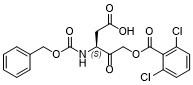
Z-Asp-CH2-DCB is a novel potent and irreversible caspase inhibitor with anti-inflammatory activity. Also inhibits the caspase-like activity of proteases. Z-Asp-CH2-DCB suppresses the production of IL-1β, TNF-α, IL-6, and IFN-γ in a dose-dependent manner.
Physicochemical Properties
| Molecular Formula | C20H17NO7CL2 |
| Molecular Weight | 454.25748 |
| Exact Mass | 453.038 |
| Elemental Analysis | C, 52.88; H, 3.77; Cl, 15.61; N, 3.08; O, 24.65 |
| CAS # | 153088-73-4 |
| PubChem CID | 9911778 |
| Appearance | White to off-white solid powder |
| Density | 1.4±0.1 g/cm3 |
| Boiling Point | 674.2±55.0 °C at 760 mmHg |
| Flash Point | 361.6±31.5 °C |
| Vapour Pressure | 0.0±2.2 mmHg at 25°C |
| Index of Refraction | 1.594 |
| LogP | 5.29 |
| Hydrogen Bond Donor Count | 2 |
| Hydrogen Bond Acceptor Count | 7 |
| Rotatable Bond Count | 11 |
| Heavy Atom Count | 30 |
| Complexity | 614 |
| Defined Atom Stereocenter Count | 1 |
| SMILES | C1=CC=C(C=C1)COC(=O)N[C@@H](CC(=O)O)C(=O)COC(=O)C2=C(C=CC=C2Cl)Cl |
| InChi Key | FKJMFCOMZYPWCO-HNNXBMFYSA-N |
| InChi Code | InChI=1S/C20H17Cl2NO7/c21-13-7-4-8-14(22)18(13)19(27)29-11-16(24)15(9-17(25)26)23-20(28)30-10-12-5-2-1-3-6-12/h1-8,15H,9-11H2,(H,23,28)(H,25,26)/t15-/m0/s1 |
| Chemical Name | (3S)-5-(2,6-dichlorobenzoyl)oxy-4-oxo-3-(phenylmethoxycarbonylamino)pentanoic acid |
| Synonyms | Z-Asp-CH2-DCB; PASE-1 INHIBITOR V; FHN88734; FHN-88734; FHN 88734; |
| HS Tariff Code | 2934.99.9001 |
| Storage |
Powder-20°C 3 years 4°C 2 years In solvent -80°C 6 months -20°C 1 month Note: Please store this product in a sealed and protected environment, avoid exposure to moisture. |
| Shipping Condition | Room temperature (This product is stable at ambient temperature for a few days during ordinary shipping and time spent in Customs) |
Biological Activity
| ln Vitro | In a dose-dependent way, Z-Asp-CH2-DCB (10-100 μM) inhibits the production of IL-1β, TNF-α, IL-6, and IFN-γ in SEB-stimulated (200 ng; 16 h) PBMC. Additionally, there was an inhibition of MCP-1, MIP-1α, and MIP-1β chemokine production. On TSST-1-activated PBMC, Z-Asp-CH2-DCB had a comparable inhibitory impact, decreasing MCP-1, MIP-1α, TNF-α, IFN-γ, IL-1β, IL-6, and MIP-1β, in that order. 10%, 36%, 25%, 10%, 11%, 25%, and 30% of cell levels in the untreated state [1]. In PBMC treated with 200 ng SEB/ml, Z-Asp-CH2-DCB (10-100 μM; 48 hours) suppresses T cell proliferation [1]. |
| ln Vivo | Z-Asp-CH2-DCB (1 mg; i.p.; every day for 3 weeks) inhibits the apoptosis of septal cells induced by SU5416 [1]. |
| Cell Assay |
Cell viability assay [1] Cell Types: human peripheral blood mononuclear cells Tested Concentrations: 10, 50, 100 μM Incubation Duration: 48 hrs (hours) Experimental Results: T cell proliferation was inhibited in SEB-stimulated PBMC. |
| Animal Protocol |
Animal/Disease Models: Male SD (SD (Sprague-Dawley)) rats (SU5416+ Z-Asp-CH2-DCB group) [1] Doses: 1 mg Route of Administration: intraperitoneal (ip) injection; one time/day for 3 weeks Experimental Results: caspase in the lungs of SU5416-treated rats 3-like activity was Dramatically increased, while there was no increase in apoptotic activity in the lungs of rats treated with SU5416+Z-Asp-CH2-DCB. |
| References |
[1]. Caspase inhibitors attenuate superantigen-induced inflammatory cytokines, chemokines, and T-cell proliferation. Clin Diagn Lab Immunol. 2004 May;11(3):621-4. [2]. Inhibition of VEGF receptors causes lung cell apoptosis and emphysema. J Clin Invest. 2000 Dec;106(11):1311-9. [3]. Caspase inhibitors affect the kinetics and dimensions of tracheary elements in xylogenic Zinnia (Zinnia elegans) cell cultures. BMC Plant Biol. 2010 Aug 6;10:162. |
Solubility Data
| Solubility (In Vitro) | DMSO : ~100 mg/mL (~220.14 mM) |
| Solubility (In Vivo) |
Solubility in Formulation 1: ≥ 2.08 mg/mL (4.58 mM) (saturation unknown) in 10% DMSO + 40% PEG300 + 5% Tween80 + 45% Saline (add these co-solvents sequentially from left to right, and one by one), clear solution. For example, if 1 mL of working solution is to be prepared, you can add 100 μL of 20.8 mg/mL clear DMSO stock solution to 400 μL PEG300 and mix evenly; then add 50 μL Tween-80 to the above solution and mix evenly; then add 450 μL normal saline to adjust the volume to 1 mL. Preparation of saline: Dissolve 0.9 g of sodium chloride in 100 mL ddH₂ O to obtain a clear solution. Solubility in Formulation 2: ≥ 2.08 mg/mL (4.58 mM) (saturation unknown) in 10% DMSO + 90% (20% SBE-β-CD in Saline) (add these co-solvents sequentially from left to right, and one by one), clear solution. For example, if 1 mL of working solution is to be prepared, you can add 100 μL of 20.8 mg/mL clear DMSO stock solution to 900 μL of 20% SBE-β-CD physiological saline solution and mix evenly. Preparation of 20% SBE-β-CD in Saline (4°C,1 week): Dissolve 2 g SBE-β-CD in 10 mL saline to obtain a clear solution. Solubility in Formulation 3: ≥ 2.08 mg/mL (4.58 mM) (saturation unknown) in 10% DMSO + 90% Corn Oil (add these co-solvents sequentially from left to right, and one by one), clear solution. For example, if 1 mL of working solution is to be prepared, you can add 100 μL of 20.8 mg/mL clear DMSO stock solution to 900 μL of corn oil and mix evenly. (Please use freshly prepared in vivo formulations for optimal results.) |
| Preparing Stock Solutions | 1 mg | 5 mg | 10 mg | |
| 1 mM | 2.2014 mL | 11.0069 mL | 22.0138 mL | |
| 5 mM | 0.4403 mL | 2.2014 mL | 4.4028 mL | |
| 10 mM | 0.2201 mL | 1.1007 mL | 2.2014 mL |