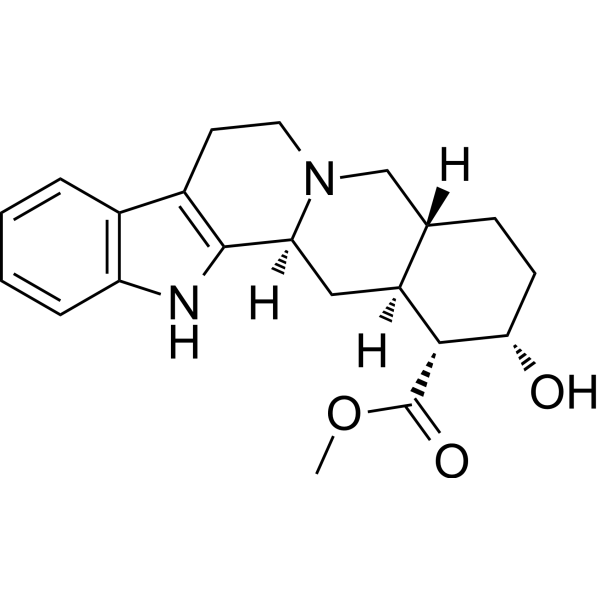
Physicochemical Properties
| Molecular Formula | C21H26N2O3 |
| Molecular Weight | 354.45 |
| Exact Mass | 354.194 |
| Elemental Analysis | C, 71.16; H, 7.39; N, 7.90; O, 13.54 |
| CAS # | 146-48-5 |
| Related CAS # | Yohimbine-13C,d3;1261254-59-4;Yohimbine-d3;133146-00-6;Yohimbine Hydrochloride;65-19-0 |
| PubChem CID | 8969 |
| Appearance | Typically exists as solid at room temperature |
| Density | 1.3±0.1 g/cm3 |
| Boiling Point | 543.0±50.0 °C at 760 mmHg |
| Melting Point | 231-233 °C(lit.) |
| Flash Point | 282.2±30.1 °C |
| Vapour Pressure | 0.0±1.5 mmHg at 25°C |
| Index of Refraction | 1.661 |
| LogP | 2.2 |
| Hydrogen Bond Donor Count | 2 |
| Hydrogen Bond Acceptor Count | 4 |
| Rotatable Bond Count | 2 |
| Heavy Atom Count | 26 |
| Complexity | 555 |
| Defined Atom Stereocenter Count | 5 |
| SMILES | [H][C@]12C(NC3=C4C=CC=C3)=C4CCN1C[C@@]5(CC[C@H](O)[C@H](C(OC)=O)[C@]5(C2)[H])[H] |
| InChi Key | BLGXFZZNTVWLAY-SCYLSFHTSA-N |
| InChi Code | InChI=1S/C21H26N2O3/c1-26-21(25)19-15-10-17-20-14(13-4-2-3-5-16(13)22-20)8-9-23(17)11-12(15)6-7-18(19)24/h2-5,12,15,17-19,22,24H,6-11H2,1H3/t12-,15-,17-,18-,19+/m0/s1 |
| Chemical Name | methyl (1S,15R,18S,19R,20S)-18-hydroxy-1,3,11,12,14,15,16,17,18,19,20,21-dodecahydroyohimban-19-carboxylate |
| HS Tariff Code | 2934.99.9001 |
| Storage |
Powder-20°C 3 years 4°C 2 years In solvent -80°C 6 months -20°C 1 month |
| Shipping Condition | Room temperature (This product is stable at ambient temperature for a few days during ordinary shipping and time spent in Customs) |
Biological Activity
| Targets |
alpha 2-adrenergic receptor In vitroactivity:Yohimbine(Antagonil) has been used as a mydriatic and in the treatment of impotence. It is also alleged to be an aphrodisiac. Yohimbine is a pre-synaptic alpha 2-adrenergic blocking agent. Yohimbine may exert its beneficial effect on erectile ability through blockade of central alpha 2-adrenergic receptors producing an increase in sympathetic drive secondary to an increase in norepinephrine release and in firing rate of cells in the brain noradrenergic nuclei. |
| ln Vitro |
In vitroactivity:Yohimbine(Antagonil) has been used as a mydriatic and in the treatment of impotence. It is also alleged to be an aphrodisiac. Yohimbine is a pre-synaptic alpha 2-adrenergic blocking agent. Yohimbine may exert its beneficial effect on erectile ability through blockade of central alpha 2-adrenergic receptors producing an increase in sympathetic drive secondary to an increase in norepinephrine release and in firing rate of cells in the brain noradrenergic nuclei. Yohimbine inhibited the synergistic platelet aggregation induced by subthreshold concentrations of epinephrine (1 μmol/L) and arachidonic acid (0.2 mmol/L) in human platelet-rich plasma (PRP). The inhibition was concentration-dependent, with a calculated IC50 value of 0.6 μmol/L.[1] |
| ln Vivo | Yohimbine can be utilized to create animal models of cardiac augmentation, hypertension, and neurological symptoms. |
| Cell Assay |
Platelet aggregation was monitored using a dual-channel lumi-aggregometer at 37°C. Platelet-rich plasma (PRP) was pre-treated with yohimbine for 1 minute. Subthreshold concentrations of epinephrine (1 μmol/L) and arachidonic acid (0.2 mmol/L) were then added to the PRP to induce synergistic aggregation. The resulting aggregation was recorded for 5 minutes by measuring the change in light transmission. Dose-response curves were constructed to calculate the 50% inhibitory concentration (IC50) of yohimbine.[1] |
| Animal Protocol | Yohimbine (YO) was freshly dissolved before each experiment by vortexing in sterile 0.15 m NaCl for 5 min at room temperature, followed by passage through a 0.45 μm syringe filter to remove particulate residue. Rats were injected intraperitoneally with 2.0 ml of 0.15 m NaCl vehicle alone, or with vehicle containing YO at a dose of 5.0 mg/kg BW. Injection volumes were adjusted around an average of 2.0 ml per rat to account for small between-animal differences in BW within each experimental cohort. The 5.0 mg/kg BW dose of YO was selected based on recent findings demonstrating that a lower dose of YO (i.e., 1.0 mg/kg BW) did not produce significant effects on food intake, CFA, or central Fos activation (Myers et al., 2005).[J Neurosci . 2006 Nov 1;26(44):11442-53.] Food was removed from cages at 3:30 P.M. (i.e., 3.5 h before dark onset). At 3:00 P.M. on the following day (i.e., 23.5 h later), food-deprived rats (n = 8 DSAP; n = 8 sham control) were injected intraperitoneally with either YO (n = 4 DSAP; n = 4 sham control) or vehicle (n = 4 DSAP; n = 4 sham control). A measured amount of pelleted chow was provided 30 min later, at 3:30 P.M.. Cumulative food intake by each rat, corrected for spillage, was determined after 30 min, 60 min, and 18 h of food access. Rats then were returned to ad libitum chow access for 48 h. The 24 h food deprivation and feeding test was repeated in a counterbalanced design in which rats treated previously intraperitoneally with YO subsequently received vehicle intraperitoneally, and vice versa. Thus, each rat served as its own control for determining the effect of YO on deprivation-induced food intake.[J Neurosci . 2006 Nov 1;26(44):11442-53.] |
| ADME/Pharmacokinetics |
Absorption, Distribution and Excretion Rapidly absorbed following oral administration. Bioavailability is highly variable, ranging from 7 to 87% (mean 33%). Metabolism / Metabolites Yohimbine appears to undergo extensive metabolism in an organ of high flow such as the liver or kidney, however, the precise metabolic fate of yohimbine has not been fully determined. Biological Half-Life Elimination half-life is approximately 36 minutes. |
| Toxicity/Toxicokinetics |
Hepatotoxicity In small clinical trials and case series, yohimbine therapy has not been linked to serum enzyme elevations or clinical liver disease. Although yohimbine is often found in weight loss and muscle building herbal combinations, it has not been associated with cases of clinically apparent acute liver injury. Likelihood score: E (unlikely cause of clinically apparent liver injury). Drug Class: Herbal and Dietary Supplements |
| References |
[1]. Saeed SA, et al. Signaling mechanisms mediated by G-protein coupled receptors in human platelets. Acta Pharmacol Sin. 2004 Jul;25(7):887-892. [2]. Blanchard RJ, et al. Yohimbine potentiates active defensive responses to threatening stimuli in Swiss-Webster mice. Pharmacol Biochem Behav. 1993 Mar;44(3):673-681. [3]. Fuller BB, et al. Downregulation of tyrosinase activity in human melanocyte cell cultures by yohimbine. J Invest Dermatol. 2000 Feb;114(2):268-276. |
| Additional Infomation |
Yohimbine is an indole alkaloid with alpha2-adrenoceptor antagonist activity. It is produced by Corynanthe johimbe and Rauwolfia serpentina. It has a role as an alpha-adrenergic antagonist, a serotonergic antagonist and a dopamine receptor D2 antagonist. It is functionally related to a yohimbic acid. A plant alkaloid with alpha-2-adrenergic blocking activity. Yohimbine has been used as a mydriatic and in the treatment of impotence. It is also alleged to be an aphrodisiac. Yohimbine is an indole alkaloid derived from the bark of the Central African yohimbe tree (Pausinystalia yohimbe) that is widely used as therapy for erectile dysfunction. Yohimbine use has been associated with occasional severe adverse events, but has not been linked to serum enzyme elevations or clinically apparent acute liver injury. Yohimbine has been reported in Rauvolfia yunnanensis, Rauvolfia serpentina, and other organisms with data available. A plant alkaloid with alpha-2-adrenergic blocking activity. Yohimbine has been used as a mydriatic and in the treatment of ERECTILE DYSFUNCTION. See also: Yohimbine Hydrochloride (has salt form) ... View More ... Drug Indication Indicated as a sympatholytic and mydriatic. Impotence has been successfully treated with yohimbine in male patients with vascular or diabetic origins and psychogenic origins. Mechanism of Action Yohimbine is a pre-synaptic alpha 2-adrenergic blocking agent. The exact mechanism for its use in impotence has not been fully elucidated. However, yohimbine may exert its beneficial effect on erectile ability through blockade of central alpha 2-adrenergic receptors producing an increase in sympathetic drive secondary to an increase in norepinephrine release and in firing rate of cells in the brain noradrenergic nuclei. Yohimbine-mediated norepinephrine release at the level of the corporeal tissues may also be involved. In addition, beneficial effects may involve other neurotransmitters such as dopamine and serotonin and cholinergic receptors. Pharmacodynamics Yohimbine is an indolalkylamine alkaloid with chemical similarity to reserpine. Yohimbine blocks presynaptic alpha-2 adrenergic receptors. Its action on peripheral blood vessels resembles that of reserpine, though it is weaker and of short duration. Yohimbine's peripheral autonomic nervous system effect is to increase parasympathetic (cholinergic) and decrease sympathetic (adrenergic) activity. It is to be noted that in male sexual performance, erection is linked to cholinergic activity and to alpha-2 adrenergic blockade which may theoretically result in increased penile inflow, decreased penile outflow or both. Yohimbine exerts a stimulating action on the mood and may increase anxiety. Such actions have not been adequately studied or related to dosage although they appear to require high doses of the drug. Yohimbine has a mild anti-diuretic action, probably via stimulation of hypothalmic center and release of posterior pituitary hormone. Reportedly Yohimbine exerts no significant influence on cardiac stimulation and other effects mediated by (beta)-adrenergic receptors. Its effect on blood pressure, if any, would be to lower it; however, no adequate studies are at hand to quantitate this effect in terms of Yohimbine dosage. In this study, yohimbine was used as a pharmacological tool to block α2-adrenergic receptors on human platelets. Its inhibitory effect demonstrated that the synergistic platelet aggregation between epinephrine and arachidonic acid is mediated through α2-adrenergic receptor activation.[1] |
Solubility Data
| Solubility (In Vitro) |
DMSO : ~5 mg/mL (~14.11 mM) H2O : ~1 mg/mL (~2.82 mM) |
| Solubility (In Vivo) |
Solubility in Formulation 1: ≥ 0.5 mg/mL (1.41 mM) (saturation unknown) in 10% DMSO + 40% PEG300 + 5% Tween80 + 45% Saline (add these co-solvents sequentially from left to right, and one by one), clear solution. For example, if 1 mL of working solution is to be prepared, you can add 100 μL of 5.0 mg/mL clear DMSO stock solution to 400 μL PEG300 and mix evenly; then add 50 μL Tween-80 to the above solution and mix evenly; then add 450 μL normal saline to adjust the volume to 1 mL. Preparation of saline: Dissolve 0.9 g of sodium chloride in 100 mL ddH₂ O to obtain a clear solution. Solubility in Formulation 2: ≥ 0.5 mg/mL (1.41 mM) (saturation unknown) in 10% DMSO + 90% (20% SBE-β-CD in Saline) (add these co-solvents sequentially from left to right, and one by one), clear solution. For example, if 1 mL of working solution is to be prepared, you can add 100 μL of 5.0 mg/mL clear DMSO stock solution to 900 μL of 20% SBE-β-CD physiological saline solution and mix evenly. Preparation of 20% SBE-β-CD in Saline (4°C,1 week): Dissolve 2 g SBE-β-CD in 10 mL saline to obtain a clear solution. Solubility in Formulation 3: ≥ 0.5 mg/mL (1.41 mM) (saturation unknown) in 10% DMSO + 90% Corn Oil (add these co-solvents sequentially from left to right, and one by one), clear solution. For example, if 1 mL of working solution is to be prepared, you can add 100 μL of 5.0 mg/mL clear DMSO stock solution to 900 μL of corn oil and mix evenly. (Please use freshly prepared in vivo formulations for optimal results.) |
| Preparing Stock Solutions | 1 mg | 5 mg | 10 mg | |
| 1 mM | 2.8213 mL | 14.1064 mL | 28.2127 mL | |
| 5 mM | 0.5643 mL | 2.8213 mL | 5.6425 mL | |
| 10 mM | 0.2821 mL | 1.4106 mL | 2.8213 mL |