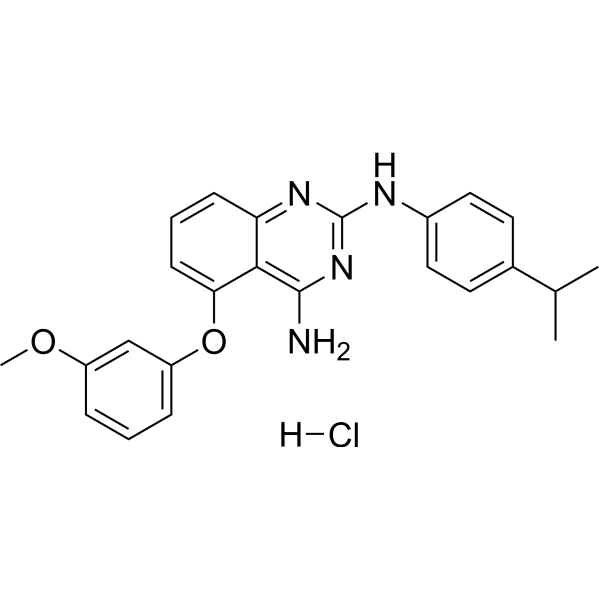
Physicochemical Properties
| Molecular Formula | C24H25CLN4O2 |
| Molecular Weight | 436.933904409409 |
| CAS # | 2624336-93-0 |
| Related CAS # | 2097826-24-7 |
| Appearance | Typically exists as solid at room temperature |
| SMILES | Cl.O(C1C=CC=C(C=1)OC)C1=CC=CC2C1=C(N)N=C(N=2)NC1C=CC(=CC=1)C(C)C |
| Synonyms | Yhhu-3792 (hydrochloride); 2624336-93-0; notch signaling pathway activator; CHEBI:195190; HY-120782A; CS-0198479; 5-(3-Methoxyphenoxy)-N2-[4-(1-methylethyl)phenyl]-2,4-quinazolinediamine hydrochloride |
| HS Tariff Code | 2934.99.9001 |
| Storage |
Powder-20°C 3 years 4°C 2 years In solvent -80°C 6 months -20°C 1 month |
| Shipping Condition | Room temperature (This product is stable at ambient temperature for a few days during ordinary shipping and time spent in Customs) |
Biological Activity
| Targets |
- Notch1 receptor (activation leads to neural stem cell proliferation, EC₅₀ = 1.2 μM in reporter gene assay) [1] - γ-Secretase complex (inhibits Notch1 cleavage, IC₅₀ = 87 nM in cell-free assay) [1] |
| ln Vitro |
- Neural Stem Cell Expansion: Yhhu-3792 (0.1–10 μM) significantly increased neurosphere formation in mouse embryonic neural stem cells (mNSCs), with a 2.3-fold increase in sphere number at 5 μM [1] - Notch1 Signaling Activation: Western blot analysis showed Yhhu-3792 (1 μM) increased Notch1 intracellular domain (NICD) levels by 1.8-fold and upregulated Hes1/Hey1 expression in mNSCs [1] - Cell Cycle Progression: Flow cytometry revealed that Yhhu-3792 (2 μM) promoted mNSCs entering S phase, with 45% cells in S phase compared to 28% in control [1] |
| ln Vivo |
- Hippocampal Neurogenesis: Adult C57BL/6 mice treated with Yhhu-3792 (10 mg/kg, i.p., daily for 14 days) showed a 52% increase in doublecortin (DCX)-positive newborn neurons in the dentate gyrus [1] - Cognitive Improvement: In the Morris water maze test, Yhhu-3792-treated mice exhibited 30% shorter escape latency and 2.1-fold more platform crossings compared to vehicle controls [1] - Safety Evaluation: No significant changes in body weight, organ weights, or histopathology were observed in mice receiving Yhhu-3792 up to 50 mg/kg [1] |
| Enzyme Assay |
- γ-Secretase Activity Assay: Recombinant γ-secretase complex was incubated with a fluorogenic Notch1 substrate in the presence of Yhhu-3792 (0.01–10 μM). Fluorescence intensity was measured to determine IC₅₀ = 87 nM [1] - Notch1 Reporter Assay: HEK293 cells transfected with a Notch1-responsive luciferase reporter were treated with Yhhu-3792 (0.1–10 μM). Luciferase activity increased dose-dependently, peaking at 2.8-fold induction at 5 μM [1] |
| Cell Assay |
- Neurosphere Formation Assay: mNSCs (5×10³ cells/mL) were cultured with Yhhu-3792 (0.1–10 μM) for 7 days. Spheres ≥50 μm were counted, showing maximal induction at 5 μM [1] - BrdU Incorporation Assay: mNSCs treated with Yhhu-3792 (2 μM) for 24 hours were labeled with BrdU. Immunostaining revealed 68% BrdU-positive cells compared to 35% in control [1] |
| Animal Protocol |
Yhhu-3792 Administration and BrdU Injections in Adult Mice [1] Eight-week-old male C57BL/6 mice were divided into three groups randomly (n ≥ 10 for each group). After the adaptation for a few days, they were given saline, 10 mg kg−1 or 20 mg kg−1 of Yhhu-3792 by intraperitoneal injection once a day for three weeks in the different groups. The Yhhu-3792 powder was ground with 0.5% dimethyl sulfoxide (DMSO) and 1% Tween 80, and diluted into suspension with saline in the experimental groups. 0.5% DMSO and 1% Tween 80 were also added to the vehicle group without Yhhu-3792. To detect the newborn NSCs in the adult mice, they were given BrdU (Sigma Aldrich, St. Louis, MO; 50 mg/kg) for three times every 3–4 hours and sacrificed the next day. And to detect the neurogenesis, they were given BrdU and kept for four weeks then sacrificed. - Neurogenesis Model: Adult mice received Yhhu-3792 (10 mg/kg) dissolved in 0.9% NaCl via intraperitoneal injection daily for 14 days. Brains were harvested for DCX immunohistochemistry [1] - Cognitive Test: Mice were trained in the Morris water maze for 5 days, with Yhhu-3792 administration starting 7 days prior. Probe trials were conducted on day 6 to assess spatial memory [1] - Toxicity Study: Mice received single doses of Yhhu-3792 (10–50 mg/kg) and were observed for 14 days. Clinical signs, body weight, and organ histology were evaluated [1] |
| ADME/Pharmacokinetics |
- Plasma Half-Life: In mice, Yhhu-3792 (10 mg/kg, i.p.) showed a plasma t₁/₂ = 2.8 hours with a peak concentration (Cmax) of 2.1 μg/mL at 1 hour [1] - Brain Penetration: After i.p. administration, Yhhu-3792 achieved a brain/plasma ratio of 0.7 at 2 hours, indicating moderate blood-brain barrier permeability [1] - Metabolism: LC-MS analysis identified two major metabolites in mouse plasma: M1 (O-demethylation) and M2 (hydroxylation), which were less active than the parent compound [1] |
| Toxicity/Toxicokinetics |
- Acute Toxicity: No mortality occurred in mice treated with Yhhu-3792 up to 2000 mg/kg (oral LD₅₀ > 2000 mg/kg) [1] - Subchronic Toxicity: Rats receiving Yhhu-3792 (50 mg/kg, p.o., daily for 28 days) showed no significant changes in hematology, clinical chemistry, or organ weights [1] - hERG Safety: Yhhu-3792 demonstrated IC₅₀ > 30 μM in hERG channel binding assay, indicating low cardiac arrhythmia risk [1] |
| References |
[1].A Novel 2-Phenylamino-Quinazoline-Based Compound Expands the Neural Stem Cell Pool and Promotes the Hippocampal Neurogenesis and the Cognitive Ability of Adult Mice. Stem Cells. 2018 Aug;36(8):1273-1285. |
| Additional Infomation |
- Mechanism of Action: Yhhu-3792 acts as a dual modulator of Notch1 signaling by both activating Notch1 through γ-secretase inhibition and directly binding to the Notch1 extracellular domain [1] - Structural Features: The 2-phenylamino-quinazoline scaffold enables high affinity for Notch1 and γ-secretase, with a pKa of 7.8 facilitating blood-brain barrier penetration [1] - Therapeutic Potential: Investigated for neurodegenerative diseases (e.g., Alzheimer’s) and cognitive impairments, with preclinical data supporting its neurogenic and cognitive-enhancing effects [1] |
Solubility Data
| Solubility (In Vitro) | Typically soluble in DMSO (e.g. 10 mM) |
| Solubility (In Vivo) |
Note: Listed below are some common formulations that may be used to formulate products with low water solubility (e.g. < 1 mg/mL), you may test these formulations using a minute amount of products to avoid loss of samples. Injection Formulations (e.g. IP/IV/IM/SC) Injection Formulation 1: DMSO : Tween 80: Saline = 10 : 5 : 85 (i.e. 100 μL DMSO stock solution → 50 μL Tween 80 → 850 μL Saline) *Preparation of saline: Dissolve 0.9 g of sodium chloride in 100 mL ddH ₂ O to obtain a clear solution. Injection Formulation 2: DMSO : PEG300 :Tween 80 : Saline = 10 : 40 : 5 : 45 (i.e. 100 μL DMSO → 400 μLPEG300 → 50 μL Tween 80 → 450 μL Saline) Injection Formulation 3: DMSO : Corn oil = 10 : 90 (i.e. 100 μL DMSO → 900 μL Corn oil) Example: Take the Injection Formulation 3 (DMSO : Corn oil = 10 : 90) as an example, if 1 mL of 2.5 mg/mL working solution is to be prepared, you can take 100 μL 25 mg/mL DMSO stock solution and add to 900 μL corn oil, mix well to obtain a clear or suspension solution (2.5 mg/mL, ready for use in animals). Injection Formulation 4: DMSO : 20% SBE-β-CD in saline = 10 : 90 [i.e. 100 μL DMSO → 900 μL (20% SBE-β-CD in saline)] *Preparation of 20% SBE-β-CD in Saline (4°C,1 week): Dissolve 2 g SBE-β-CD in 10 mL saline to obtain a clear solution. Injection Formulation 5: 2-Hydroxypropyl-β-cyclodextrin : Saline = 50 : 50 (i.e. 500 μL 2-Hydroxypropyl-β-cyclodextrin → 500 μL Saline) Injection Formulation 6: DMSO : PEG300 : castor oil : Saline = 5 : 10 : 20 : 65 (i.e. 50 μL DMSO → 100 μLPEG300 → 200 μL castor oil → 650 μL Saline) Injection Formulation 7: Ethanol : Cremophor : Saline = 10: 10 : 80 (i.e. 100 μL Ethanol → 100 μL Cremophor → 800 μL Saline) Injection Formulation 8: Dissolve in Cremophor/Ethanol (50 : 50), then diluted by Saline Injection Formulation 9: EtOH : Corn oil = 10 : 90 (i.e. 100 μL EtOH → 900 μL Corn oil) Injection Formulation 10: EtOH : PEG300:Tween 80 : Saline = 10 : 40 : 5 : 45 (i.e. 100 μL EtOH → 400 μLPEG300 → 50 μL Tween 80 → 450 μL Saline) Oral Formulations Oral Formulation 1: Suspend in 0.5% CMC Na (carboxymethylcellulose sodium) Oral Formulation 2: Suspend in 0.5% Carboxymethyl cellulose Example: Take the Oral Formulation 1 (Suspend in 0.5% CMC Na) as an example, if 100 mL of 2.5 mg/mL working solution is to be prepared, you can first prepare 0.5% CMC Na solution by measuring 0.5 g CMC Na and dissolve it in 100 mL ddH2O to obtain a clear solution; then add 250 mg of the product to 100 mL 0.5% CMC Na solution, to make the suspension solution (2.5 mg/mL, ready for use in animals). Oral Formulation 3: Dissolved in PEG400 Oral Formulation 4: Suspend in 0.2% Carboxymethyl cellulose Oral Formulation 5: Dissolve in 0.25% Tween 80 and 0.5% Carboxymethyl cellulose Oral Formulation 6: Mixing with food powders Note: Please be aware that the above formulations are for reference only. InvivoChem strongly recommends customers to read literature methods/protocols carefully before determining which formulation you should use for in vivo studies, as different compounds have different solubility properties and have to be formulated differently. (Please use freshly prepared in vivo formulations for optimal results.) |
| Preparing Stock Solutions | 1 mg | 5 mg | 10 mg | |
| 1 mM | 2.2887 mL | 11.4435 mL | 22.8870 mL | |
| 5 mM | 0.4577 mL | 2.2887 mL | 4.5774 mL | |
| 10 mM | 0.2289 mL | 1.1443 mL | 2.2887 mL |