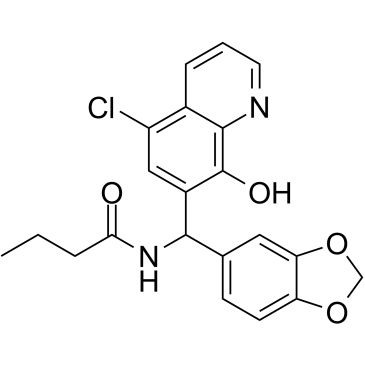
Physicochemical Properties
| Molecular Formula | C21H19CLN2O4 |
| Molecular Weight | 398.8396 |
| Exact Mass | 398.1 |
| Elemental Analysis | C, 63.24; H, 4.80; Cl, 8.89; N, 7.02; O, 16.05 |
| CAS # | 423145-35-1 |
| Related CAS # | 423145-35-1 |
| PubChem CID | 3138755 |
| Appearance | White to off-white solid powder |
| LogP | 4.5 |
| Hydrogen Bond Donor Count | 2 |
| Hydrogen Bond Acceptor Count | 5 |
| Rotatable Bond Count | 5 |
| Heavy Atom Count | 28 |
| Complexity | 551 |
| Defined Atom Stereocenter Count | 0 |
| InChi Key | BIQMEYCMAGHOEQ-UHFFFAOYSA-N |
| InChi Code | InChI=1S/C21H19ClN2O4/c1-2-4-18(25)24-19(12-6-7-16-17(9-12)28-11-27-16)14-10-15(22)13-5-3-8-23-20(13)21(14)26/h3,5-10,19,26H,2,4,11H2,1H3,(H,24,25) |
| Chemical Name | N-[1,3-benzodioxol-5-yl-(5-chloro-8-hydroxyquinolin-7-yl)methyl]butanamide |
| Synonyms | YUM-70; YUM70; N-(Benzo[d][1,3]dioxol-5-yl(5-chloro-8-hydroxyquinolin-7-yl)methyl)butyramide; N-[Benzo[1,3]dioxol-5-yl-(5-chloro-8-hydroxy-quinolin-7-yl)-methyl]-butyramide; MLS000548411; SMR000172091; N-[1,3-benzodioxol-5-yl-(5-chloro-8-hydroxyquinolin-7-yl)methyl]butanamide; BAS 02169251; YUM 70 |
| HS Tariff Code | 2934.99.9001 |
| Storage |
Powder-20°C 3 years 4°C 2 years In solvent -80°C 6 months -20°C 1 month |
| Shipping Condition | Room temperature (This product is stable at ambient temperature for a few days during ordinary shipping and time spent in Customs) |
Biological Activity
| Targets | GRP78 (IC50 = 1.5 μM) |
| ln Vitro | When compared to normal pancreas-derived HPNE cells (IC50>30 μM), YUM70 selectively cytotoxicly affects MIA PaCa-2, PANC-1, and BxPC-3 cells (IC50=2.8, 4.5, and 9.6 μM) [1]. In PaCa-2 cells, 5 μM for 24 hours causes endoplasmic reticulum (ER)-mediated MIA [1]. |
| ln Vivo | Tumor growth in the MIA PaCa-2 xenograft model is inhibited by YUM70 (30 mg/kg; i.p., five times per week for seven weeks) [1]. Mice models show that YUM70 (15 mg/kg; intravenous administration) demonstrates t1/2 (1.40 h), CL (724.04 mL/h/kg), and Vss (1162.73 mL/kg) [1]. The model demonstrates low bioavailability (6.71%), t1/2 (2.74 h), and CL (9230.15 mL/h/kg) for YUM70 (30 mg/kg; oral) [1]. |
| Enzyme Assay |
Thermal shift assay[1] The fluorescence-based thermal shift assay was carried out using the Thermofluor instrument. The thermal shift of purified GRP78 (0.5 mg/ml in 50 mM Tris-HCl pH 8.0 buffer) in the presence or absence of YUM70 was determined as described. Briefly, 5 μl protein-dye (1,8 ANS, 0.3 mM) solutions were dispensed in each well of 384-well microplate and an equal volume of the test compound solutions was dispensed to each well, then, 3 μl of silicone oil was added to each well to avoid evaporation. 1% DMSO (no test compound) in buffer was used as a control. The plate was heated at a temperature range from 25 to 80 °C with 0.5 °C/min. Fluorescence was measured by fiber optics and fluorescence emission was detected by measuring light intensity using CCD camera. Compounds were tested in triplicate. ATPase assay[1] ATP turnover and ADP generation was measured using the ADP-Glo™ Kinase Assay kit. Reaction mixtures were prepared in 384-well white OptiPlate and contained 0.1 μg His-tagged recombinant protein (full length or ATPase domain) and increasing concentrations of respective compounds in standard ATPase assay buffer. Reactions were pre-incubated with compounds for 30 min at 37 °C, followed by the addition of 2 μM ATP and further 2 hr incubation. Luminescence was read on a plate reader. |
| Cell Assay |
Western Blot Analysis[1] Cell Types: MIA PaCa-2, PANC-1 cells Tested Concentrations: 0.1, 1, 2.5, 5, 10 μM Incubation Duration: 2, 4, 8, 24, 48 hrs (hours) Experimental Results: At a certain dose and time Protein levels of FAM129A, DDIT3, CHAC-1, DDIT4, UPP1 and GRP78 were increased in a dependent manner. Cellular thermal shift assay (CETSA)[1] CETSA was carried out in PANC-1 cell lysate as previously described. Briefly, cells were harvested, washed with PBS, and diluted with cell lysis buffer (25 mM Tris-HCl pH 7.5 and 10 mM MgCl2) supplemented with the complete protease inhibitor cocktail. The cell suspension was freeze-thawed three times in liquid nitrogen. The soluble fraction was separated from debris by spinning down at 20000 × g for 20 min. The cell lysate was diluted with lysate buffer and treated with YUM70 (100 μM) and DMSO separately. After 30 min incubation at room temperature, the respective lysates were divided into smaller aliquots (50 μl) and heated individually at different temperatures for 3 minutes followed by cooling for 3 minutes at room temperature. The heated lysates were centrifuged at 20000 × g for 20 minutes at 4 °C to separate the soluble fractions from precipitates. Supernatants were transferred to a new microfuge tube, quantified, and analyzed by SDS-PAGE followed by Western blot. Caspase activity assay[1] Cells were plated in 384 well plates at 4000 cells/well. The next day cells were treated with YUM70 or tunicamycin at indicated doses for the indicated times. At the end of the treatment Caspase-3/7-GLO reagent (25 μl) was added to the well and incubated for 30 min at room temperature. Luciferase activity was measured using luminometer. Annexin V–FITC apoptosis assay[1] MIA PaCa-2, PANC-1, and BxPC-3 cells (1–2×10⁵)/well were seeded in 6 well plates, allowed to attach overnight, and then received indicated treatments for 48 hrs. Cells were washed with cold PBS, then resuspended and stained with Propidium iodide (PI) and Annexin V-FITC using Annexin V–FITC Apoptosis Detection Kit according to the manufacturer’s protocol. |
| Animal Protocol |
Animal/Disease Models: 8weeks old female NCr nude mice were injected with MIA PaCa-2 cells [1] Doses: 30 mg/kg Route of Administration: intraperitoneal (ip) injection 5 days per week for 7 weeks Experimental Results: Significant tumor growth was observed during treatment Delayed, no significant change in weight. MIA PaCa-2 cells (2.0 × 10⁶, 100 μl) in PBS, were injected subcutaneously into the dorsal flank of 8-week old female NCr nude mice (Taconic Bioscience, Bar Harbor, Maine). All animal experiments were performed in accordance with protocols approved by the Institutional Animal Care and Use Committee. Tumor size was monitored twice a week through caliper measurement and tumor volumes were calculated using the formula: 0.5 × D × d2, where D and d were the longest and shortest perpendicular diameters, respectively. Mice were randomly grouped (n = 5 in the control group and n = 5 in the treatment group) when the average tumor size reached 50 mm3. Control mice (n = 5) received vehicle (10% DMSO, 60% propylene glycol and 30% saline v/v, 100 μL) alone. YUM70 (30 mg/kg in 10% DMSO, 60% propylene glycol and 30% saline v/v, 100 μL) was administrated by intraperitoneal injection 5 days a week. Tumor volumes and body weights were measured twice a week to monitor tumor burden and weight loss during treatment. The study was concluded when the tumor size in the control group reached 1000 mm3. At the end of the experiment, animals were euthanized and tumor, heart, pancreas, liver, kidney, lung, and spleen were collected, fixed, and paraffin-embedded for histology. Tumor volumes were compared using the unpaired Student’s t-test.[1] |
| References |
[1]. The hydroxyquinoline analog YUM70 inhibits GRP78 to induce ER stress-mediated apoptosis in pancreatic cancer. Cancer Res. 2021 Feb 2;canres.1540.2020. |
| Additional Infomation |
GRP78 (Glucose-regulated protein, 78 kDa) is a key regulator of ER (endoplasmic reticulum) stress signaling. Cancer cells are highly proliferative and have high demand for protein synthesis and folding, which results in significant stress on the ER. To respond to ER stress and maintain cellular homeostasis, cells activate the unfolded protein response (UPR) that promotes either survival or apoptotic death. Cancer cells utilize the UPR to promote survival and growth. In this study, we describe the discovery of a series of novel hydroxyquinoline GRP78 inhibitors. A representative analog, YUM70, inhibited pancreatic cancer cell growth in vitro and showed in vivo efficacy in a pancreatic cancer xenograft model with no toxicity to normal tissues. YUM70 directly bound GRP78 and inactivated its function, resulting in ER stress-mediated apoptosis. A YUM70 analog conjugated with BODIPY show co-localization of the compound with GRP78 in the ER. Moreover, a YUM70-PROTAC (PROteolysis TArgeting Chimera) was synthesized to force degradation of GRP78 in pancreatic cancer cells. YUM70 showed a strong synergistic cytotoxicity with topotecan and vorinostat. Together, our study demonstrates that YUM70 is a novel inducer of ER stress with preclinical efficacy as a monotherapy or in combination with topoisomerase and HDAC inhibitors in pancreatic cancer.[1] In conclusion, we demonstrated that YUM70 treatment induces ER stress and triggers UPR by inhibiting GRP78. As a result, eIF2α is phosphorylated leading to the induction of CHOP and apoptosis in both cell culture and xenograft models. Importantly, YUM70 slowed tumor growth in a pancreatic cancer xenograft model. Although YUM70 is moderately effective as a single agent in pancreatic cancer, it can be safely combined with topotecan and vorinostat. YUM70 is an excellent tool compound to further interrogate the role of GRP78 inhibition in pancreatic cancer. Altogether, our study highlights GRP78 as a promising target to treat KRAS mutant pancreatic cancer and YUM70 as a novel anticancer agent that could be used in combination with select drugs to improve treatment efficacy and overcome drug resistance.[1] |
Solubility Data
| Solubility (In Vitro) | DMSO 80~100 mg/mL (200.6~250.7 mM) |
| Solubility (In Vivo) |
Solubility in Formulation 1: 2.5 mg/mL (6.27 mM) in 10% DMSO + 40% PEG300 +5% Tween-80 + 45% Saline (add these co-solvents sequentially from left to right, and one by one), suspension solution; with sonication. For example, if 1 mL of working solution is to be prepared, you can add 100 μL of 25.0 mg/mL clear DMSO stock solution to 400 μL PEG300 and mix evenly; then add 50 μL Tween-80 + to the above solution and mix evenly; then add 450 μL normal saline to adjust the volume to 1 mL. Preparation of saline: Dissolve 0.9 g of sodium chloride in 100 mL ddH₂ O to obtain a clear solution. (Please use freshly prepared in vivo formulations for optimal results.) |
| Preparing Stock Solutions | 1 mg | 5 mg | 10 mg | |
| 1 mM | 2.5073 mL | 12.5364 mL | 25.0727 mL | |
| 5 mM | 0.5015 mL | 2.5073 mL | 5.0145 mL | |
| 10 mM | 0.2507 mL | 1.2536 mL | 2.5073 mL |