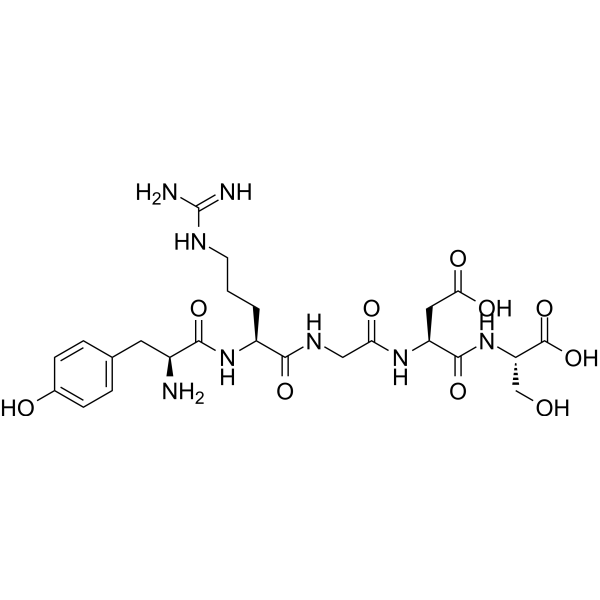
Physicochemical Properties
| Molecular Formula | C24H36N8O10 |
| Molecular Weight | 596.59024 |
| Exact Mass | 596.255 |
| CAS # | 134282-68-1 |
| PubChem CID | 10326176 |
| Sequence | H-Tyr-Arg-Gly-Asp-Ser-OH; Tyr-Arg-Gly-Asp-Ser |
| SequenceShortening | YRGDS |
| Appearance | White to off-white solid powder |
| LogP | -6.3 |
| Hydrogen Bond Donor Count | 11 |
| Hydrogen Bond Acceptor Count | 12 |
| Rotatable Bond Count | 18 |
| Heavy Atom Count | 42 |
| Complexity | 982 |
| Defined Atom Stereocenter Count | 4 |
| SMILES | O=C(O)C[C@@H](C(N[C@H](C(O)=O)CO)=O)NC(CNC([C@@H](NC([C@@H](N)CC1=CC=C(O)C=C1)=O)CCCNC(N)=N)=O)=O |
| InChi Key | ATBGHBUVWQJECJ-QAETUUGQSA-N |
| InChi Code | InChI=1S/C24H36N8O10/c25-14(8-12-3-5-13(34)6-4-12)20(38)31-15(2-1-7-28-24(26)27)21(39)29-10-18(35)30-16(9-19(36)37)22(40)32-17(11-33)23(41)42/h3-6,14-17,33-34H,1-2,7-11,25H2,(H,29,39)(H,30,35)(H,31,38)(H,32,40)(H,36,37)(H,41,42)(H4,26,27,28)/t14-,15-,16-,17-/m0/s1 |
| Chemical Name | (3S)-3-[[2-[[(2S)-2-[[(2S)-2-amino-3-(4-hydroxyphenyl)propanoyl]amino]-5-(diaminomethylideneamino)pentanoyl]amino]acetyl]amino]-4-[[(1S)-1-carboxy-2-hydroxyethyl]amino]-4-oxobutanoic acid |
| Synonyms | H-Tyr-Arg-Gly-Asp-Ser-OH; 134282-68-1; YRGDS; (3S)-3-[[2-[[(2S)-2-[[(2S)-2-amino-3-(4-hydroxyphenyl)propanoyl]amino]-5-(diaminomethylideneamino)pentanoyl]amino]acetyl]amino]-4-[[(1S)-1-carboxy-2-hydroxyethyl]amino]-4-oxobutanoic acid; H-Tyr-Arg-Gly-Asp-Ser-OH trifluoroacetate salt; H2N-Tyr-Arg-Gly-Asp-Ser-OH; ATBGHBUVWQJECJ-QAETUUGQSA-N; |
| HS Tariff Code | 2934.99.9001 |
| Storage |
Powder-20°C 3 years 4°C 2 years In solvent -80°C 6 months -20°C 1 month Note: Please store this product in a sealed and protected environment (e.g. under nitrogen), avoid exposure to moisture and light. |
| Shipping Condition | Room temperature (This product is stable at ambient temperature for a few days during ordinary shipping and time spent in Customs) |
Biological Activity
| Targets | Adhesion peptide |
| ln Vitro | Many inflammatory processes are characterized by an early phase of neutrophil migration and a later phase of monocyte migration into the inflammatory site. Mechanisms that govern the transition between phases are the subject of these investigations. Acute lung inflammation induced by C5 fragments in the rabbit leads to an initial neutrophil influx and plasma leakage into the alveolar space, followed by monocyte influx that we have previously shown to be dependent on prior emigration of neutrophils. Neutrophil enzymes are known to cleave intact fibronectin into fragments that are monocyte chemotaxins in vitro. Accordingly, generation of appropriate fibronectin fragments in situ by proteolytic enzymes from infiltrating neutrophils might represent a potential mechanism for attraction of monocytes into the lung. The studies reported herein demonstrate that a 120-kD fragment of fibronectin containing the RGDS fibroblast cell-binding domain induced monocyte migration into the rabbit lung in vivo. Intact fibronectin was inactive. A significant proportion of the monocyte migration was neutrophil independent. Intact fibronectin was present in bronchoalveolar lavage fluid from C5 fragment-treated animals rendered neutropenic, but absent in lavage from normal C5 fragment-treated animals. Fibronectin fragments were present in bronchoalveolar lavage fluid from both C5 fragment-treated and control rabbits. In addition, the amount of fibronectin was significantly increased in lavage of C5 fragment-treated normal but not neutropenic animals. Monoclonal antibodies directed against an epitope of fibronectin containing the RGDS cell-binding domain significantly inhibited the C5 fragment-induced monocyte migration, but not neutrophil migration. These studies suggest that chemotactic fibronectin fragments may in part be responsible for the recruitment of monocytes into areas of acute lung inflammation [1]. |
| References | [1]. Fibronectin fragments containing the RGDS cell-binding domain mediate monocyte migration into the rabbit lung. A potential mechanism for C5 fragment-induced monocyte lung accumulation. J Clin Invest. 1990 Oct;86(4):1065-75. |
Solubility Data
| Solubility (In Vitro) | May dissolve in DMSO (in most cases), if not, try other solvents such as H2O, Ethanol, or DMF with a minute amount of products to avoid loss of samples |
| Solubility (In Vivo) |
Note: Listed below are some common formulations that may be used to formulate products with low water solubility (e.g. < 1 mg/mL), you may test these formulations using a minute amount of products to avoid loss of samples. Injection Formulations (e.g. IP/IV/IM/SC) Injection Formulation 1: DMSO : Tween 80: Saline = 10 : 5 : 85 (i.e. 100 μL DMSO stock solution → 50 μL Tween 80 → 850 μL Saline) *Preparation of saline: Dissolve 0.9 g of sodium chloride in 100 mL ddH ₂ O to obtain a clear solution. Injection Formulation 2: DMSO : PEG300 :Tween 80 : Saline = 10 : 40 : 5 : 45 (i.e. 100 μL DMSO → 400 μLPEG300 → 50 μL Tween 80 → 450 μL Saline) Injection Formulation 3: DMSO : Corn oil = 10 : 90 (i.e. 100 μL DMSO → 900 μL Corn oil) Example: Take the Injection Formulation 3 (DMSO : Corn oil = 10 : 90) as an example, if 1 mL of 2.5 mg/mL working solution is to be prepared, you can take 100 μL 25 mg/mL DMSO stock solution and add to 900 μL corn oil, mix well to obtain a clear or suspension solution (2.5 mg/mL, ready for use in animals). Injection Formulation 4: DMSO : 20% SBE-β-CD in saline = 10 : 90 [i.e. 100 μL DMSO → 900 μL (20% SBE-β-CD in saline)] *Preparation of 20% SBE-β-CD in Saline (4°C,1 week): Dissolve 2 g SBE-β-CD in 10 mL saline to obtain a clear solution. Injection Formulation 5: 2-Hydroxypropyl-β-cyclodextrin : Saline = 50 : 50 (i.e. 500 μL 2-Hydroxypropyl-β-cyclodextrin → 500 μL Saline) Injection Formulation 6: DMSO : PEG300 : castor oil : Saline = 5 : 10 : 20 : 65 (i.e. 50 μL DMSO → 100 μLPEG300 → 200 μL castor oil → 650 μL Saline) Injection Formulation 7: Ethanol : Cremophor : Saline = 10: 10 : 80 (i.e. 100 μL Ethanol → 100 μL Cremophor → 800 μL Saline) Injection Formulation 8: Dissolve in Cremophor/Ethanol (50 : 50), then diluted by Saline Injection Formulation 9: EtOH : Corn oil = 10 : 90 (i.e. 100 μL EtOH → 900 μL Corn oil) Injection Formulation 10: EtOH : PEG300:Tween 80 : Saline = 10 : 40 : 5 : 45 (i.e. 100 μL EtOH → 400 μLPEG300 → 50 μL Tween 80 → 450 μL Saline) Oral Formulations Oral Formulation 1: Suspend in 0.5% CMC Na (carboxymethylcellulose sodium) Oral Formulation 2: Suspend in 0.5% Carboxymethyl cellulose Example: Take the Oral Formulation 1 (Suspend in 0.5% CMC Na) as an example, if 100 mL of 2.5 mg/mL working solution is to be prepared, you can first prepare 0.5% CMC Na solution by measuring 0.5 g CMC Na and dissolve it in 100 mL ddH2O to obtain a clear solution; then add 250 mg of the product to 100 mL 0.5% CMC Na solution, to make the suspension solution (2.5 mg/mL, ready for use in animals). Oral Formulation 3: Dissolved in PEG400 Oral Formulation 4: Suspend in 0.2% Carboxymethyl cellulose Oral Formulation 5: Dissolve in 0.25% Tween 80 and 0.5% Carboxymethyl cellulose Oral Formulation 6: Mixing with food powders Note: Please be aware that the above formulations are for reference only. InvivoChem strongly recommends customers to read literature methods/protocols carefully before determining which formulation you should use for in vivo studies, as different compounds have different solubility properties and have to be formulated differently. (Please use freshly prepared in vivo formulations for optimal results.) |
| Preparing Stock Solutions | 1 mg | 5 mg | 10 mg | |
| 1 mM | 1.6762 mL | 8.3810 mL | 16.7619 mL | |
| 5 mM | 0.3352 mL | 1.6762 mL | 3.3524 mL | |
| 10 mM | 0.1676 mL | 0.8381 mL | 1.6762 mL |