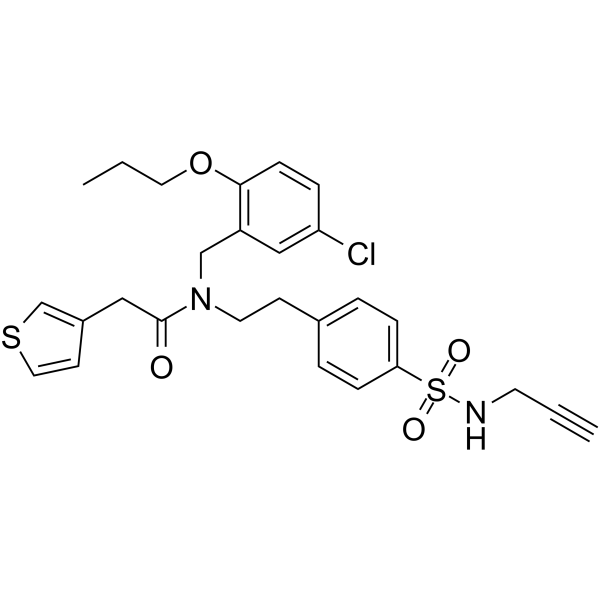
YQ128 (YQ-128 ) is a novel, potent, selective and second-generation inhibitor of NOD-like receptor P3 (NLRP3) inflammasome (IC50= 0.30 µM) with anti-inflammatory activity. It acts by suppressing IL-1β production, and is BBB/CNS penetrant.
Physicochemical Properties
| Molecular Formula | C27H29CLN2O4S2 |
| Molecular Weight | 545.109 |
| Exact Mass | 544.125 |
| Elemental Analysis | C, 59.49; H, 5.36; Cl, 6.50; N, 5.14; O, 11.74; S, 11.76 |
| CAS # | 2454246-18-3 |
| PubChem CID | 139600339 |
| Appearance | White to off-white solid powder |
| Density | 1.3±0.1 g/cm3 |
| Boiling Point | 705.8±70.0 °C at 760 mmHg |
| Flash Point | 380.6±35.7 °C |
| Vapour Pressure | 0.0±2.2 mmHg at 25°C |
| Index of Refraction | 1.606 |
| LogP | 5.47 |
| Hydrogen Bond Donor Count | 1 |
| Hydrogen Bond Acceptor Count | 6 |
| Rotatable Bond Count | 13 |
| Heavy Atom Count | 36 |
| Complexity | 832 |
| Defined Atom Stereocenter Count | 0 |
| SMILES | ClC1C=CC(=C(C=1)CN(C(CC1=CSC=C1)=O)CCC1C=CC(=CC=1)S(NCC#C)(=O)=O)OCCC |
| InChi Key | SFPYRFRNYALLHS-UHFFFAOYSA-N |
| InChi Code | InChI=1S/C27H29ClN2O4S2/c1-3-13-29-36(32,33)25-8-5-21(6-9-25)11-14-30(27(31)17-22-12-16-35-20-22)19-23-18-24(28)7-10-26(23)34-15-4-2/h1,5-10,12,16,18,20,29H,4,11,13-15,17,19H2,2H3 |
| Chemical Name | N-(5-chloro-2-propoxybenzyl)-N-(4-(N-(prop-2-yn-1-yl)sulfamoyl)phenethyl)-2-(thiophen-3-yl)acetamide |
| Synonyms | YQ-128YQ128 YQ 128 |
| HS Tariff Code | 2934.99.9001 |
| Storage |
Powder-20°C 3 years 4°C 2 years In solvent -80°C 6 months -20°C 1 month |
| Shipping Condition | Room temperature (This product is stable at ambient temperature for a few days during ordinary shipping and time spent in Customs) |
Biological Activity
| ln Vitro | At an IC50 of 1.59 µM, YQ128 (0.3-100 µM; 30 minutes) dose-dependently inhibits the release of IL-1β from peritoneal macrophages after an LPS/ATP challenge [1]. YQ128 (20 µM; 2 hours) does not appear to be toxic to hCMEC/D3 cells [1]. |
| ln Vivo | YQ128 (iv; 20 mg/kg) has an intermediate terminal plasma half-life (t1/2) of 6.6 hours following intravenous administration [1]. With a tmax of 12 hours and a cmax of 73 ng/mL, respectively, YQ128 (oral; 20 mg/kg) demonstrated delayed gastrointestinal absorption. The estimated oral bioavailability (Foral) is 10% [1]. With a rapid total clearance (CLtot) of 41 mL/min/kg and a steady-state volume of distribution (Vdss) of 8.5 L/kg, YQ128 demonstrates a wide extravascular distribution[1]. It has been demonstrated that YQ128 (10 mg/kg) in C57BL/6 mice induces the production of IL-1β in an NLRP3-dependent manner [1]. |
| Cell Assay |
Cell viability assay [1] Cell Types: mouse peritoneal macrophages Tested Concentrations: 0.3, 1.0, 3.0, 10, 30, 100 µM Incubation Duration: 30 minutes Experimental Results: Inhibition of IL- release from peritoneal macrophages after LPS/ATP challenge 1β IC50 is 1.59 µM. |
| Animal Protocol |
Animal/Disease Models: SD (SD (Sprague-Dawley)) rat (200-250 g) [1] Doses: 20 mg/kg (pharmacokinetic/PK/PK analysis) Route of Administration: intravenous (iv) (iv)injection Experimental Results: After intravenous (iv) (iv)administration, the intermediate terminal plasma half-life ( t1/2) is 6.6 hrs (hrs (hours)). |
| References |
[1]. Discovery of Second-Generation NLRP3 Inflammasome Inhibitors: Design, Synthesis, and Biological Characterization. J Med Chem. 2019 Oct 31. |
Solubility Data
| Solubility (In Vitro) | DMSO : ~250 mg/mL (~458.62 mM) |
| Solubility (In Vivo) |
Solubility in Formulation 1: ≥ 2.08 mg/mL (3.82 mM) (saturation unknown) in 10% DMSO + 40% PEG300 + 5% Tween80 + 45% Saline (add these co-solvents sequentially from left to right, and one by one), clear solution. For example, if 1 mL of working solution is to be prepared, you can add 100 μL of 20.8 mg/mL clear DMSO stock solution to 400 μL PEG300 and mix evenly; then add 50 μL Tween-80 to the above solution and mix evenly; then add 450 μL normal saline to adjust the volume to 1 mL. Preparation of saline: Dissolve 0.9 g of sodium chloride in 100 mL ddH₂ O to obtain a clear solution. Solubility in Formulation 2: ≥ 2.08 mg/mL (3.82 mM) (saturation unknown) in 10% DMSO + 90% Corn Oil (add these co-solvents sequentially from left to right, and one by one), clear solution. For example, if 1 mL of working solution is to be prepared, you can add 100 μL of 20.8 mg/mL clear DMSO stock solution to 900 μL of corn oil and mix evenly. (Please use freshly prepared in vivo formulations for optimal results.) |
| Preparing Stock Solutions | 1 mg | 5 mg | 10 mg | |
| 1 mM | 1.8345 mL | 9.1725 mL | 18.3449 mL | |
| 5 mM | 0.3669 mL | 1.8345 mL | 3.6690 mL | |
| 10 mM | 0.1834 mL | 0.9172 mL | 1.8345 mL |