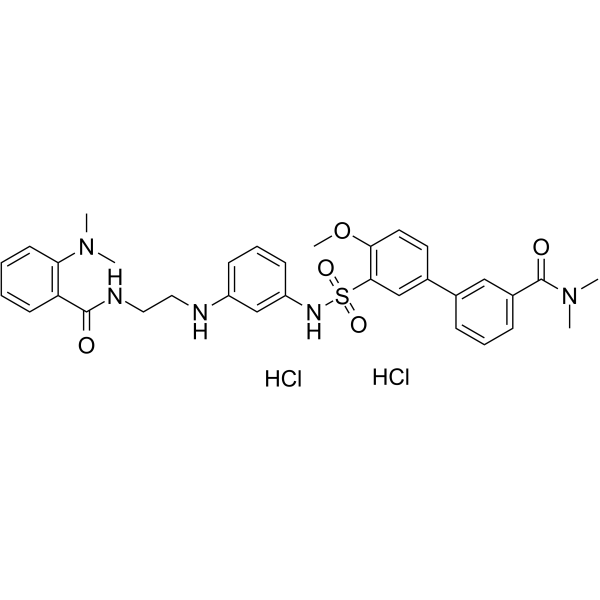
Physicochemical Properties
| Molecular Formula | C33H39CL2N5O5S |
| Molecular Weight | 688.664264917374 |
| Exact Mass | 687.204 |
| CAS # | 1804978-82-2 |
| Related CAS # | YNT-185;1804978-81-1 |
| PubChem CID | 140307520 |
| Appearance | Off-white to light yellow solid powder |
| Hydrogen Bond Donor Count | 5 |
| Hydrogen Bond Acceptor Count | 8 |
| Rotatable Bond Count | 12 |
| Heavy Atom Count | 46 |
| Complexity | 1030 |
| Defined Atom Stereocenter Count | 0 |
| SMILES | Cl.Cl.S(C1C(=CC=C(C2C=CC=C(C(N(C)C)=O)C=2)C=1)OC)(NC1C=CC=C(C=1)NCCNC(C1C=CC=CC=1N(C)C)=O)(=O)=O |
| InChi Key | AIORBDHFHVKRIY-UHFFFAOYSA-N |
| InChi Code | InChI=1S/C33H37N5O5S.2ClH/c1-37(2)29-15-7-6-14-28(29)32(39)35-19-18-34-26-12-9-13-27(22-26)36-44(41,42)31-21-24(16-17-30(31)43-5)23-10-8-11-25(20-23)33(40)38(3)4;;/h6-17,20-22,34,36H,18-19H2,1-5H3,(H,35,39);2*1H |
| Chemical Name | 2-(dimethylamino)-N-[2-[3-[[5-[3-(dimethylcarbamoyl)phenyl]-2-methoxyphenyl]sulfonylamino]anilino]ethyl]benzamide;dihydrochloride |
| HS Tariff Code | 2934.99.9001 |
| Storage |
Powder-20°C 3 years 4°C 2 years In solvent -80°C 6 months -20°C 1 month Note: Please store this product in a sealed and protected environment, avoid exposure to moisture. |
| Shipping Condition | Room temperature (This product is stable at ambient temperature for a few days during ordinary shipping and time spent in Customs) |
Biological Activity
| Targets | OX2 Receptor 0.028 μM (EC50) OX1 Receptor 2.75 μM (EC50) |
| ln Vivo | Mice treated with YNT-185 dihydrochloride (20–40 mg/kg; ip) show increased wakefulness[2]. In wild-type mice, but not in OXRDKO mice, YNT-185 dihydrochloride (300 nmol; icv) dose-dependently and dose-dependently increases wake time for three hours, accompanied by a reduction in NREM sleep time[2]. |
| Animal Protocol |
Animal/Disease Models: Male wild-type C57BL/6J mice[2] Doses: 20, 40 mg/kg Route of Administration: Ip Experimental Results: Wake time was also Dramatically increased. |
| References |
[1]. Design and Synthesis of Non-Peptide, Selective Orexin Receptor 2 Agonists. J Med Chem. 2015;58(20):7931-7937. [2]. Nonpeptide orexin type-2 receptor agonist ameliorates narcolepsy-cataplexy symptoms in mouse models. Proc Natl Acad Sci U S A. 2017;114(22):5731-5736. |
Solubility Data
| Solubility (In Vitro) |
DMSO: 125 mg/mL (181.51 mM) H2O: 100 mg/mL (145.21 mM) |
| Solubility (In Vivo) |
Solubility in Formulation 1: 12.5 mg/mL (18.15 mM) in Saline (add these co-solvents sequentially from left to right, and one by one), clear solution; with sonication (<60°C). Preparation of saline: Dissolve 0.9 g of sodium chloride in 100 mL ddH₂ O to obtain a clear solution. (Please use freshly prepared in vivo formulations for optimal results.) |
| Preparing Stock Solutions | 1 mg | 5 mg | 10 mg | |
| 1 mM | 1.4521 mL | 7.2605 mL | 14.5210 mL | |
| 5 mM | 0.2904 mL | 1.4521 mL | 2.9042 mL | |
| 10 mM | 0.1452 mL | 0.7260 mL | 1.4521 mL |