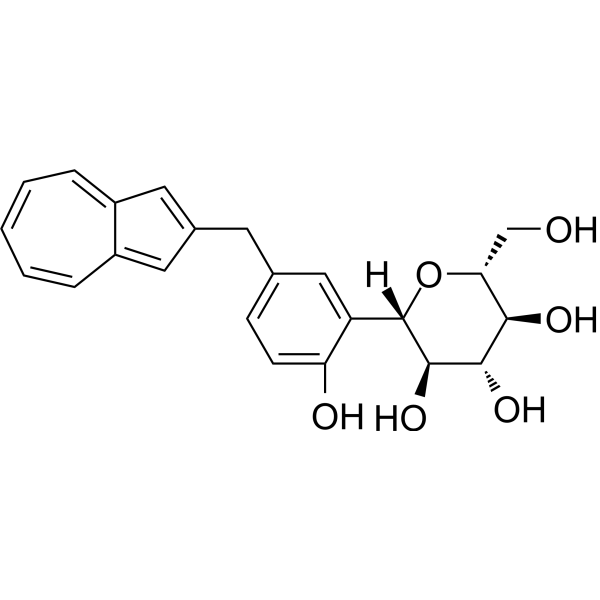
Physicochemical Properties
| Molecular Formula | C23H24O6 |
| Molecular Weight | 396.433067321777 |
| Exact Mass | 396.157 |
| Elemental Analysis | C, 69.68; H, 6.10; O, 24.21 |
| CAS # | 655237-16-4 |
| Related CAS # | 655237-16-4; 918802-70-7 (choline); 918802-69-4 (anion); 1610007-47-0 (choline) |
| PubChem CID | 11560307 |
| Appearance | Typically exists as solid at room temperature |
| LogP | 2 |
| Hydrogen Bond Donor Count | 5 |
| Hydrogen Bond Acceptor Count | 6 |
| Rotatable Bond Count | 4 |
| Heavy Atom Count | 29 |
| Complexity | 516 |
| Defined Atom Stereocenter Count | 5 |
| SMILES | C1=CC=C2C=C(C=C2C=C1)CC3=CC(=C(C=C3)O)[C@H]4[C@@H]([C@H]([C@@H]([C@H](O4)CO)O)O)O |
| InChi Key | AGJJCLBOHJQGFA-ZQGJOIPISA-N |
| InChi Code | InChI=1S/C23H24O6/c24-12-19-20(26)21(27)22(28)23(29-19)17-11-13(6-7-18(17)25)8-14-9-15-4-2-1-3-5-16(15)10-14/h1-7,9-11,19-28H,8,12H2/t19-,20-,21+,22-,23+/m1/s1 |
| Chemical Name | (2S,3R,4R,5S,6R)-2-[5-(azulen-2-ylmethyl)-2-hydroxyphenyl]-6-(hydroxymethyl)oxane-3,4,5-triol |
| Synonyms | YM-543 free acid; 655237-16-4; YM543 (free base); CHEMBL2397450; 00x1DX441H; D-Glucitol, 1,5-anhydro-1-C-(5-(2-azulenylmethyl)-2-hydroxyphenyl)-, (1S)-; (2S,3R,4R,5S,6R)-2-(5-(Azulen-2-ylmethyl)-2-hydroxyphenyl)-6-(hydroxymethyl)tetrahydro-2H-pyran-3,4,5-triol; starbld0043423; |
| HS Tariff Code | 2934.99.9001 |
| Storage |
Powder-20°C 3 years 4°C 2 years In solvent -80°C 6 months -20°C 1 month |
| Shipping Condition | Room temperature (This product is stable at ambient temperature for a few days during ordinary shipping and time spent in Customs) |
Biological Activity
| Targets |
- Sodium-glucose cotransporter 2 (SGLT2) (IC50 = 2.9 nM) [1] - Sodium-glucose cotransporter 1 (SGLT1) (IC50 = 3600 nM) [1] |
| ln Vitro |
- Selective SGLT2 inhibition: YM543 potently inhibited human SGLT2 with an IC50 of 2.9 nM, showing 1240-fold selectivity over human SGLT1 (IC50 = 3600 nM). Inhibition of SGLT2-mediated glucose uptake was concentration-dependent, and the compound did not significantly affect other glucose transporters (e.g., GLUT1) [1] - Metabolite profiling in human liver microsomes: Incubation of YM543 with human liver microsomes resulted in the formation of two major metabolites (M1 and M2) via oxidation reactions. The metabolic pathways were primarily mediated by cytochrome P450 enzymes, with CYP3A4 contributing the most to metabolite formation [2] |
| ln Vivo |
In KK/Ay type 2 diabetic mice, YM543 free base (0-3 mg/kg; po) increases urine glucose excretion and improves glucose tolerance while lowering blood glucose levels; these effects last for up to 12 hours[1].
- Anti-diabetic effect in diabetic rodents: In db/db mice, oral administration of YM543 (0.03-1 mg/kg) dose-dependently reduced blood glucose levels and increased urinary glucose excretion. At 1 mg/kg, fasting blood glucose was decreased by ~40% compared to vehicle control, and the effect lasted for more than 12 hours. In streptozotocin-induced diabetic rats, YM543 (0.3-3 mg/kg, p.o.) also significantly lowered blood glucose and improved glucose tolerance [1] - Metabolism in humanized liver mice: Chimeric mice with humanized livers were orally administered YM543 (10 mg/kg). Plasma and urine samples collected at various time points showed metabolite profiles similar to those in human liver microsomes, with M1 and M2 as the main metabolites. The total exposure (AUC) of metabolites in humanized liver mice was comparable to that predicted in humans [2] |
| Enzyme Assay |
SGLT inhibition assay: HEK293 cells stably expressing human SGLT2 or SGLT1 were incubated with YM543 (0.001-10000 nM) and [¹⁴C]-labeled glucose. After 30 minutes, the uptake of radioactive glucose was measured using a scintillation counter. IC50 values were calculated from dose-response curves, representing the concentration inhibiting 50% of glucose uptake [1] |
| Cell Assay |
- Glucose transporter selectivity assay: Various cell lines expressing GLUT1, GLUT2, or other glucose transporters were treated with YM543 (10 μM) and [¹⁴C]-glucose. Glucose uptake was measured, and no significant inhibition of these transporters was observed compared to SGLT2 [1] - Animal Protocol - Diabetic mouse model: Db/db mice (8-10 weeks old) were randomized into groups and orally administered YM543 (0.03, 0.1, 0.3, 1 mg/kg) or vehicle once daily for 7 days. Blood glucose levels were measured using a glucometer, and urinary glucose was quantified using a colorimetric assay. On day 7, an oral glucose tolerance test was performed [1] - Humanized liver mouse metabolism study: Chimeric mice with humanized livers (human hepatocyte replacement index >70%) were fasted overnight, then orally administered YM543 (10 mg/kg) dissolved in 0.5% methylcellulose. Blood samples were collected at 0.5, 1, 2, 4, 8, and 24 hours, and urine at 0-24 hours. Plasma and urine were analyzed by LC-MS/MS to identify and quantify YM543 and its metabolites [2] |
| Animal Protocol |
Animal/Disease Models: KK/Ay 2 diabetic mice[1] Doses: 0.1, 0.3, 1, and 3 mg/kg Route of Administration: oral administration Experimental Results: Had a strong and sustained antihyperglycemic effect in both KK/Ay type 2 diabetic mice. Animal/Disease Models: Male Sprague–Dawley rats[1] Doses: 1.0 and 3.0 mg/kg Route of Administration: intravenous (iv) injection (1.0 mg/kg) and oral administration (3.0 mg/kg) Experimental Results: 1.19 Administration iv (1 mg/kg) po (3 mg/kg) T1/2 (h) 0.9 1.3 CLtot (L/h/kg) 2483 Vdss (L/kg) 3360 Cmax (ng/mL) 101 Tmax (h) 0.5 AUC0-inf (ng h/mL) 403 F % 29 |
| ADME/Pharmacokinetics |
- Oral absorption: In rats, oral administration of YM543 (1 mg/kg) showed a bioavailability of ~60%. Peak plasma concentration (Cmax) was reached within 1 hour [1] - Metabolism: In humanized liver mice, YM543 underwent oxidation to form M1 (hydroxylated derivative) and M2 (carboxylic acid derivative), with M1 accounting for ~30% of total plasma radioactivity [2] - Excretion: In rats, ~70% of administered YM543 was excreted in feces and ~20% in urine within 48 hours, primarily as metabolites [1] |
| References |
[1]. Synthesis and biological evaluation of C-glucosides with azulene rings as selective SGLT2 inhibitors for the treatment of type 2 diabetes mellitus: discovery of YM543. Bioorg Med Chem. 2013 Jul 1;21(13):3934-48. [2]. Nakada N. Evaluation of the Utility of Chimeric Mice with Humanized Livers for the Characterization and Profiling of the Metabolites of a Selective Inhibitor (YM543) of the Sodium-Glucose Cotransporter 2. Pharm Res. 2017 Apr;34(4):874-886. |
| Additional Infomation |
- YM543 is a selective SGLT2 inhibitor developed for the treatment of type 2 diabetes mellitus. Its mechanism of action involves inhibiting renal glucose reabsorption via SGLT2, thereby increasing urinary glucose excretion and lowering blood glucose [1] - The high selectivity for SGLT2 over SGLT1 (expressed in the intestine) reduces the risk of gastrointestinal side effects associated with SGLT1 inhibition [1] |
Solubility Data
| Solubility (In Vitro) | May dissolve in DMSO (in most cases), if not, try other solvents such as H2O, Ethanol, or DMF with a minute amount of products to avoid loss of samples |
| Solubility (In Vivo) |
Note: Listed below are some common formulations that may be used to formulate products with low water solubility (e.g. < 1 mg/mL), you may test these formulations using a minute amount of products to avoid loss of samples. Injection Formulations (e.g. IP/IV/IM/SC) Injection Formulation 1: DMSO : Tween 80: Saline = 10 : 5 : 85 (i.e. 100 μL DMSO stock solution → 50 μL Tween 80 → 850 μL Saline) *Preparation of saline: Dissolve 0.9 g of sodium chloride in 100 mL ddH ₂ O to obtain a clear solution. Injection Formulation 2: DMSO : PEG300 :Tween 80 : Saline = 10 : 40 : 5 : 45 (i.e. 100 μL DMSO → 400 μLPEG300 → 50 μL Tween 80 → 450 μL Saline) Injection Formulation 3: DMSO : Corn oil = 10 : 90 (i.e. 100 μL DMSO → 900 μL Corn oil) Example: Take the Injection Formulation 3 (DMSO : Corn oil = 10 : 90) as an example, if 1 mL of 2.5 mg/mL working solution is to be prepared, you can take 100 μL 25 mg/mL DMSO stock solution and add to 900 μL corn oil, mix well to obtain a clear or suspension solution (2.5 mg/mL, ready for use in animals). Injection Formulation 4: DMSO : 20% SBE-β-CD in saline = 10 : 90 [i.e. 100 μL DMSO → 900 μL (20% SBE-β-CD in saline)] *Preparation of 20% SBE-β-CD in Saline (4°C,1 week): Dissolve 2 g SBE-β-CD in 10 mL saline to obtain a clear solution. Injection Formulation 5: 2-Hydroxypropyl-β-cyclodextrin : Saline = 50 : 50 (i.e. 500 μL 2-Hydroxypropyl-β-cyclodextrin → 500 μL Saline) Injection Formulation 6: DMSO : PEG300 : castor oil : Saline = 5 : 10 : 20 : 65 (i.e. 50 μL DMSO → 100 μLPEG300 → 200 μL castor oil → 650 μL Saline) Injection Formulation 7: Ethanol : Cremophor : Saline = 10: 10 : 80 (i.e. 100 μL Ethanol → 100 μL Cremophor → 800 μL Saline) Injection Formulation 8: Dissolve in Cremophor/Ethanol (50 : 50), then diluted by Saline Injection Formulation 9: EtOH : Corn oil = 10 : 90 (i.e. 100 μL EtOH → 900 μL Corn oil) Injection Formulation 10: EtOH : PEG300:Tween 80 : Saline = 10 : 40 : 5 : 45 (i.e. 100 μL EtOH → 400 μLPEG300 → 50 μL Tween 80 → 450 μL Saline) Oral Formulations Oral Formulation 1: Suspend in 0.5% CMC Na (carboxymethylcellulose sodium) Oral Formulation 2: Suspend in 0.5% Carboxymethyl cellulose Example: Take the Oral Formulation 1 (Suspend in 0.5% CMC Na) as an example, if 100 mL of 2.5 mg/mL working solution is to be prepared, you can first prepare 0.5% CMC Na solution by measuring 0.5 g CMC Na and dissolve it in 100 mL ddH2O to obtain a clear solution; then add 250 mg of the product to 100 mL 0.5% CMC Na solution, to make the suspension solution (2.5 mg/mL, ready for use in animals). Oral Formulation 3: Dissolved in PEG400 Oral Formulation 4: Suspend in 0.2% Carboxymethyl cellulose Oral Formulation 5: Dissolve in 0.25% Tween 80 and 0.5% Carboxymethyl cellulose Oral Formulation 6: Mixing with food powders Note: Please be aware that the above formulations are for reference only. InvivoChem strongly recommends customers to read literature methods/protocols carefully before determining which formulation you should use for in vivo studies, as different compounds have different solubility properties and have to be formulated differently. (Please use freshly prepared in vivo formulations for optimal results.) |
| Preparing Stock Solutions | 1 mg | 5 mg | 10 mg | |
| 1 mM | 2.5225 mL | 12.6126 mL | 25.2251 mL | |
| 5 mM | 0.5045 mL | 2.5225 mL | 5.0450 mL | |
| 10 mM | 0.2523 mL | 1.2613 mL | 2.5225 mL |