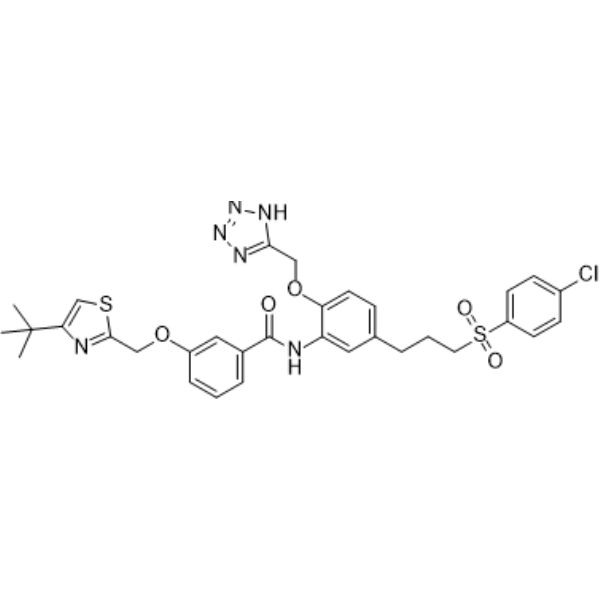
Physicochemical Properties
| Molecular Formula | C32H33CLN6O5S2 |
| Molecular Weight | 681.224623441696 |
| Exact Mass | 680.164 |
| CAS # | 179102-65-9 |
| PubChem CID | 5312141 |
| Appearance | Typically exists as solid at room temperature |
| LogP | 6.2 |
| Hydrogen Bond Donor Count | 2 |
| Hydrogen Bond Acceptor Count | 10 |
| Rotatable Bond Count | 14 |
| Heavy Atom Count | 46 |
| Complexity | 1070 |
| Defined Atom Stereocenter Count | 0 |
| InChi Key | ZEZUDOUQZAREDI-UHFFFAOYSA-N |
| InChi Code | InChI=1S/C32H33ClN6O5S2/c1-32(2,3)28-20-45-30(35-28)19-43-24-8-4-7-22(17-24)31(40)34-26-16-21(9-14-27(26)44-18-29-36-38-39-37-29)6-5-15-46(41,42)25-12-10-23(33)11-13-25/h4,7-14,16-17,20H,5-6,15,18-19H2,1-3H3,(H,34,40)(H,36,37,38,39) |
| Chemical Name | 3-[(4-tert-butyl-1,3-thiazol-2-yl)methoxy]-N-[5-[3-(4-chlorophenyl)sulfonylpropyl]-2-(2H-tetrazol-5-ylmethoxy)phenyl]benzamide |
| HS Tariff Code | 2934.99.9001 |
| Storage |
Powder-20°C 3 years 4°C 2 years In solvent -80°C 6 months -20°C 1 month |
| Shipping Condition | Room temperature (This product is stable at ambient temperature for a few days during ordinary shipping and time spent in Customs) |
Biological Activity
| ln Vitro | Leukotriene (LT) D4 and thromboxane (TX) A2 receptors are antagonistic towards YM158. With pA2 values of roughly 8.87 and 8.81, respectively, YM158 demonstrated competitive dual antagonistic effects on TXA2 and LTD4 receptor-mediated contraction of isolated guinea pig trachea, according to an in vitro functional assay. Its antagonistic activity on the TXA2 receptor is 2.5 times stronger than that of cetrolast, and it is roughly 6.5 times less antagonistic on the LTD4 receptor than montelukast. YM158 also prevents tracheal constriction caused by PGD2 and PGF2α. YM158 inhibits the ileal contraction of guinea pigs induced by LTD4 and antagonizes human and guinea pig platelet aggregation induced by the stable TXA2 analog U46619. With an IC50 value of 0.58 nM, YM158 inhibits guinea pig ileal contraction induced by 1 nM LTD4 in a concentration-dependent manner[1]. |
| ln Vivo | Orally administered dual LTD4 and TXA2 receptor antagonist YM158 is anticipated to be more effective than single antagonists in treating a wider variety of asthma sufferers. Through passive sensitization of guinea pigs and vehicle controls, the impact of YM158 on these asthmatic reactions was investigated. The antagonism of po YM158 on LTD4 and TXA2 receptor activity was demonstrated within the same dose range because the inhibitory effect of YM158 on the increase in airway resistance induced by LTD4 or U46619 was dose-dependent when administered orally 1 hour before injection of LTD4 or U46619, with ED50 values of 8.6 and 14 mg/kg, respectively. Under a variety of circumstances, oral YM158 demonstrated notable effects on antigen-induced responses that were somewhat comparable to the combination of pranlukast and datroban; that is, when LTD4 was dominant, TXA2 was dominant, or both Mediators participate equally. A combination of pranlukast (30 mg/kg), datroban (10 mg/kg), and either YM158 (30 mg/kg) or datroban (10 mg/kg) prolongs the beginning of effect considerably in the group that did not receive indomethacin. asthma reaction and greatly reduce symptoms [2]. |
| References |
[1]. In vitro pharmacologic profile of YM158, a new dual antagonist for LTD4 and TXA2 receptors. J Pharmacol Exp Ther. 1998 Nov;287(2):633-9. [2]. Effects of lipid mediator antagonists on predominant mediator-controlled asthmatic reactions in passively sensitized guinea pigs. J Pharmacol Exp Ther. 1999 Sep;290(3):1285-91. |
Solubility Data
| Solubility (In Vitro) | May dissolve in DMSO (in most cases), if not, try other solvents such as H2O, Ethanol, or DMF with a minute amount of products to avoid loss of samples |
| Solubility (In Vivo) |
Note: Listed below are some common formulations that may be used to formulate products with low water solubility (e.g. < 1 mg/mL), you may test these formulations using a minute amount of products to avoid loss of samples. Injection Formulations (e.g. IP/IV/IM/SC) Injection Formulation 1: DMSO : Tween 80: Saline = 10 : 5 : 85 (i.e. 100 μL DMSO stock solution → 50 μL Tween 80 → 850 μL Saline) *Preparation of saline: Dissolve 0.9 g of sodium chloride in 100 mL ddH ₂ O to obtain a clear solution. Injection Formulation 2: DMSO : PEG300 :Tween 80 : Saline = 10 : 40 : 5 : 45 (i.e. 100 μL DMSO → 400 μLPEG300 → 50 μL Tween 80 → 450 μL Saline) Injection Formulation 3: DMSO : Corn oil = 10 : 90 (i.e. 100 μL DMSO → 900 μL Corn oil) Example: Take the Injection Formulation 3 (DMSO : Corn oil = 10 : 90) as an example, if 1 mL of 2.5 mg/mL working solution is to be prepared, you can take 100 μL 25 mg/mL DMSO stock solution and add to 900 μL corn oil, mix well to obtain a clear or suspension solution (2.5 mg/mL, ready for use in animals). Injection Formulation 4: DMSO : 20% SBE-β-CD in saline = 10 : 90 [i.e. 100 μL DMSO → 900 μL (20% SBE-β-CD in saline)] *Preparation of 20% SBE-β-CD in Saline (4°C,1 week): Dissolve 2 g SBE-β-CD in 10 mL saline to obtain a clear solution. Injection Formulation 5: 2-Hydroxypropyl-β-cyclodextrin : Saline = 50 : 50 (i.e. 500 μL 2-Hydroxypropyl-β-cyclodextrin → 500 μL Saline) Injection Formulation 6: DMSO : PEG300 : castor oil : Saline = 5 : 10 : 20 : 65 (i.e. 50 μL DMSO → 100 μLPEG300 → 200 μL castor oil → 650 μL Saline) Injection Formulation 7: Ethanol : Cremophor : Saline = 10: 10 : 80 (i.e. 100 μL Ethanol → 100 μL Cremophor → 800 μL Saline) Injection Formulation 8: Dissolve in Cremophor/Ethanol (50 : 50), then diluted by Saline Injection Formulation 9: EtOH : Corn oil = 10 : 90 (i.e. 100 μL EtOH → 900 μL Corn oil) Injection Formulation 10: EtOH : PEG300:Tween 80 : Saline = 10 : 40 : 5 : 45 (i.e. 100 μL EtOH → 400 μLPEG300 → 50 μL Tween 80 → 450 μL Saline) Oral Formulations Oral Formulation 1: Suspend in 0.5% CMC Na (carboxymethylcellulose sodium) Oral Formulation 2: Suspend in 0.5% Carboxymethyl cellulose Example: Take the Oral Formulation 1 (Suspend in 0.5% CMC Na) as an example, if 100 mL of 2.5 mg/mL working solution is to be prepared, you can first prepare 0.5% CMC Na solution by measuring 0.5 g CMC Na and dissolve it in 100 mL ddH2O to obtain a clear solution; then add 250 mg of the product to 100 mL 0.5% CMC Na solution, to make the suspension solution (2.5 mg/mL, ready for use in animals). Oral Formulation 3: Dissolved in PEG400 Oral Formulation 4: Suspend in 0.2% Carboxymethyl cellulose Oral Formulation 5: Dissolve in 0.25% Tween 80 and 0.5% Carboxymethyl cellulose Oral Formulation 6: Mixing with food powders Note: Please be aware that the above formulations are for reference only. InvivoChem strongly recommends customers to read literature methods/protocols carefully before determining which formulation you should use for in vivo studies, as different compounds have different solubility properties and have to be formulated differently. (Please use freshly prepared in vivo formulations for optimal results.) |
| Preparing Stock Solutions | 1 mg | 5 mg | 10 mg | |
| 1 mM | 1.4680 mL | 7.3398 mL | 14.6795 mL | |
| 5 mM | 0.2936 mL | 1.4680 mL | 2.9359 mL | |
| 10 mM | 0.1468 mL | 0.7340 mL | 1.4680 mL |