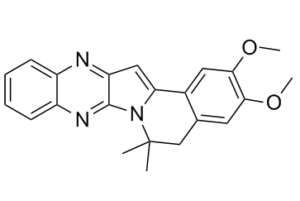
YM-90709 is a novel antagonist of interleukin-5 receptor which inhibits the binding of interleukin-5 to interleukin-5 receptor. YM-90709 inhibit the binding of IL-5 to its receptor on peripheral human eosinophils and butyric acid-treated eosinophilic HL-60 clone 15 cells, with IC50 values of 1.0 and 0.57 microM, respectively. Interleukin-5 (IL-5) plays an important role in the activation of eosinophils in allergic inflammation including asthma and atopic dermatitis. In contrast, YM-90709 did not affect the binding of granulocyte-macrophage colony-stimulating factor (GM-CSF) to its receptor on eosinophils and eosinophilic HL-60 clone 15 cells. In functional assays, YM-90709 inhibited IL-5-prolonged eosinophil survival with an IC50 value of 0.45 microM and did not affect the GM-CSF-prolonged eosinophil survival. Furthermore, YM-90709 inhibited the IL-5-induced but not GM-CSF-induced tyrosine phosphorylation of Janus kinase 2 (JAK2) in eosinophilic HL-60 clone 15 cells. These results indicate that YM-90709 is a novel IL-5 inhibitor which selectively blocks the binding of IL-5 to the IL-5 receptor (IL-5R).
Physicochemical Properties
| Molecular Formula | C22H21N3O2 | |
| Molecular Weight | 359.42 | |
| Exact Mass | 359.163 | |
| CAS # | 163769-88-8 | |
| Related CAS # |
|
|
| PubChem CID | 1103147 | |
| Appearance | Brown to orange solid powder | |
| Density | 1.3±0.1 g/cm3 | |
| Boiling Point | 579.6±50.0 °C at 760 mmHg | |
| Flash Point | 304.3±30.1 °C | |
| Vapour Pressure | 0.0±1.5 mmHg at 25°C | |
| Index of Refraction | 1.666 | |
| LogP | 5.89 | |
| Hydrogen Bond Donor Count | 0 | |
| Hydrogen Bond Acceptor Count | 4 | |
| Rotatable Bond Count | 2 | |
| Heavy Atom Count | 27 | |
| Complexity | 556 | |
| Defined Atom Stereocenter Count | 0 | |
| InChi Key | HIXSPVQXXDULHS-UHFFFAOYSA-N | |
| InChi Code | InChI=1S/C22H21N3O2/c1-22(2)12-13-9-19(26-3)20(27-4)10-14(13)18-11-17-21(25(18)22)24-16-8-6-5-7-15(16)23-17/h5-11H,12H2,1-4H3 | |
| Chemical Name | 16,17-dimethoxy-21,21-dimethyl-1,3,10-triazapentacyclo[11.8.0.02,11.04,9.014,19]henicosa-2,4,6,8,10,12,14,16,18-nonaene | |
| Synonyms |
|
|
| HS Tariff Code | 2934.99.9001 | |
| Storage |
Powder-20°C 3 years 4°C 2 years In solvent -80°C 6 months -20°C 1 month |
|
| Shipping Condition | Room temperature (This product is stable at ambient temperature for a few days during ordinary shipping and time spent in Customs) |
Biological Activity
| ln Vitro | YM-90709 (0-100 μM; 1 hour) inhibits [125I]-IL-5 binding to IL-5R on eosinophilic HL-60 clone 15 cells and human peripheral eosinophils[1]. Eosinophilic HL-60 clone 15 cells treated with YM-90709 (0-100 μM; 96 hours) affects IL-5 and GM-CSF and prolongs eosinophil survival[1]. YM-90709 (0-100 μM; 5 min; Eosinophilic HL-60 clone 15 cells) inhibits Janus kinase 2 tyrosine phosphorylation and eosinophil survival induced by IL-5, but not by GM-CSF[2]. |
| ln Vivo | The antigen-induced infiltration of eosinophils and lymphocytes, but not neutrophils or monocytes, into the bronchoalveolar lavage fluid (BALF) of inbred female Brown-Norway (BN) rats is inhibited by YM-90709 (0.01–10 mg/kg; intravenous injection, 72 hours)[2]. |
| Cell Assay |
Cell Viability Assay[1] Cell Types: Purified eosinophils were suspended at 5×10⁵ cells/ml in RPMI-1640 medium. Tested Concentrations: 0.01, 0.1, 1, 10 and 100 μM Incubation Duration: 96 hrs (hours) Experimental Results: The survival time of eosinophils was prolonged. Western Blot Analysis[1] Cell Types: Eosinophilic HL-60 clone 15 cells in RPMI-1640 medium containing 10% FBS, antibiotics, 50 mM 2-ME and 25 mM HEPPES. Tested Concentrations: Incubation Duration: 5 min Experimental Results: decreased the IL-5-induced phosphorylation of JAK2 to near basal levels. |
| Animal Protocol |
Animal/Disease Models: Inbred female Brown-Norway (BN) rats and used at 4-6 weeks of age[2]. Doses: 0.01, 0.1, 1, 10 mg/kg Route of Administration: intravenous (iv) injection; 72 hrs (hours) Experimental Results: Inhibited WBC and eosinophil infiltration in a dose-dependent manner. |
| References |
[1]. Characterization of YM-90709 as a novel antagonist which inhibits the binding of interleukin-5 to interleukin-5 receptor. Int Immunopharmacol. 2002 Nov;2(12):1693-702. [2]. Effect of a novel interleukin-5 receptor antagonist, YM-90709, on antigen-induced eosinophil infiltration into the airway of BDF1 mice. Immunol Lett. 2005 Apr 15;98(1):161-5. |
| Additional Infomation | LSM-2128 is a quinoxaline derivative. |
Solubility Data
| Solubility (In Vitro) |
|
|||
| Solubility (In Vivo) |
Solubility in Formulation 1: ≥ 2.08 mg/mL (5.79 mM) (saturation unknown) in 10% DMSO + 40% PEG300 + 5% Tween80 + 45% Saline (add these co-solvents sequentially from left to right, and one by one), clear solution. For example, if 1 mL of working solution is to be prepared, you can add 100 μL of 20.8 mg/mL clear DMSO stock solution to 400 μL PEG300 and mix evenly; then add 50 μL Tween-80 to the above solution and mix evenly; then add 450 μL normal saline to adjust the volume to 1 mL. Preparation of saline: Dissolve 0.9 g of sodium chloride in 100 mL ddH₂ O to obtain a clear solution. Solubility in Formulation 2: 2.08 mg/mL (5.79 mM) in 10% DMSO + 90% (20% SBE-β-CD in Saline) (add these co-solvents sequentially from left to right, and one by one), suspension solution; with ultrasonication. For example, if 1 mL of working solution is to be prepared, you can add 100 μL of 20.8 mg/mL clear DMSO stock solution to 900 μL of 20% SBE-β-CD physiological saline solution and mix evenly. Preparation of 20% SBE-β-CD in Saline (4°C,1 week): Dissolve 2 g SBE-β-CD in 10 mL saline to obtain a clear solution. (Please use freshly prepared in vivo formulations for optimal results.) |
| Preparing Stock Solutions | 1 mg | 5 mg | 10 mg | |
| 1 mM | 2.7823 mL | 13.9113 mL | 27.8226 mL | |
| 5 mM | 0.5565 mL | 2.7823 mL | 5.5645 mL | |
| 10 mM | 0.2782 mL | 1.3911 mL | 2.7823 mL |