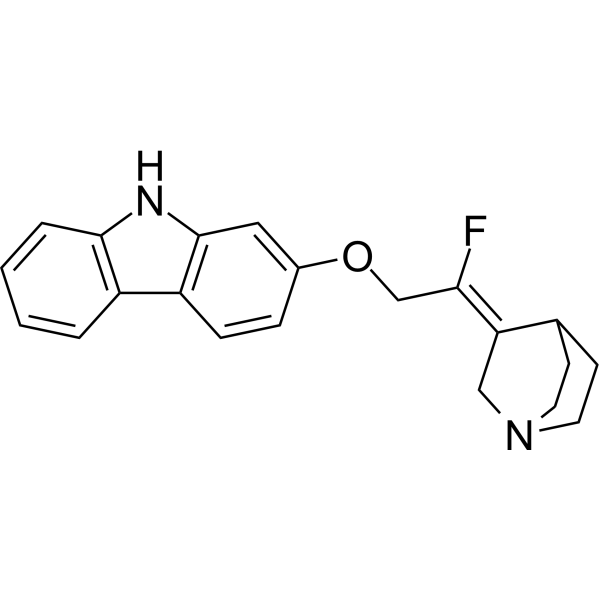
Physicochemical Properties
| Molecular Formula | C21H21N2OF |
| Molecular Weight | 336.403 |
| Exact Mass | 336.163 |
| CAS # | 182959-28-0 |
| Related CAS # | YM-53601;182959-33-7 |
| PubChem CID | 15858955 |
| Appearance | Typically exists as solid at room temperature |
| Density | 1.3±0.1 g/cm3 |
| Boiling Point | 541.2±40.0 °C at 760 mmHg |
| Flash Point | 281.1±27.3 °C |
| Vapour Pressure | 0.0±1.4 mmHg at 25°C |
| Index of Refraction | 1.689 |
| LogP | 5.72 |
| Hydrogen Bond Donor Count | 1 |
| Hydrogen Bond Acceptor Count | 3 |
| Rotatable Bond Count | 3 |
| Heavy Atom Count | 25 |
| Complexity | 528 |
| Defined Atom Stereocenter Count | 0 |
| SMILES | F/C(COC1=CC(NC2=C3C=CC=C2)=C3C=C1)=C4CN5CCC/4CC5 |
| InChi Key | XNDCPFTULXRWQH-HNENSFHCSA-N |
| InChi Code | InChI=1S/C21H21FN2O/c22-19(18-12-24-9-7-14(18)8-10-24)13-25-15-5-6-17-16-3-1-2-4-20(16)23-21(17)11-15/h1-6,11,14,23H,7-10,12-13H2/b19-18- |
| Chemical Name | 2-[(2E)-2-(1-azabicyclo[2.2.2]octan-3-ylidene)-2-fluoroethoxy]-9H-carbazole |
| HS Tariff Code | 2934.99.9001 |
| Storage |
Powder-20°C 3 years 4°C 2 years In solvent -80°C 6 months -20°C 1 month |
| Shipping Condition | Room temperature (This product is stable at ambient temperature for a few days during ordinary shipping and time spent in Customs) |
Biological Activity
| ln Vitro | In liver microsomes from different rat, hamster, guinea pig, rhesus monkey, and human HepG2 cells, YM-53601 free base inhibits squalene synthase activity with IC50 values of 90, 170, 46, 45, and 79 nM, respectively. 1)]. At an IC50 of 170 nM, YM-53601 free base prevents hamster liver squalene synthase from converting [3H]farnesyl diphosphate to [3H]squalene[2]. H35 cells are more sensitive to doxorubicin, lonidamine, and thapsigargin when exposed to YM-53601 (1 μM) free base. In HepG2 and H35 cells, YM-53601 (1 μM) free base lowers the levels of mitochondrial cholesterol [4]. |
| ln Vivo | In rats, the free base YM-53601 suppresses the production of cholesterol (ED50 = 32 mg/kg) [1]. At an oral dosage of 50 mg/kg/day for five days, YM-53601 freebase also lowers plasma non-HDL cholesterol levels in hamsters by almost 70% [2]. Hepatocellular carcinoma (HCC) cells' doxorubicin-mediated growth arrest and cell death are enhanced in vivo by the free base YM-53601 [4]. |
| Cell Assay |
Cell Viability Assay[4] Cell Types: H35 and HepG2 cells Tested Concentrations: 1 μM Incubation Duration: 24 hrs (hours) Experimental Results: diminished mitochondrial cholesterol levels in H35 and HepG2 cells. |
| Animal Protocol |
Animal/Disease Models: 5 to 6 weeks old male BALB/c athymic (nu/nu) nude mice [4] Doses: 15 mg/kg given Medicine: Daily po (oral gavage) treatment for 2 weeks. Experimental Results: Dramatically diminished intra-tumoral cholesterol levels. |
| References |
[1]. YM-53601, a novel squalene synthase inhibitor, reduces plasma cholesterol and triglyceride levels in several animal species. Br J Pharmacol. 2000 Sep;131(1):63-70. [2]. Syntheses of 3-ethylidenequinuclidine derivatives as squalene synthase inhibitors. Part 2: enzyme inhibition and effects on plasma lipid levels. Bioorg Med Chem. 2003 Aug 15;11(17):3735-45. [3]. Farnesyl-diphosphate farnesyltransferase 1 regulates hepatitis C virus propagation. FEBS Lett. 2014 May 2;588(9):1813-20. [4]. Mitochondrial cholesterol contributes to chemotherapy resistance in hepatocellular carcinoma. Cancer Res. 2008 Jul 1;68(13):5246-56. |
Solubility Data
| Solubility (In Vitro) | May dissolve in DMSO (in most cases), if not, try other solvents such as H2O, Ethanol, or DMF with a minute amount of products to avoid loss of samples |
| Solubility (In Vivo) |
Note: Listed below are some common formulations that may be used to formulate products with low water solubility (e.g. < 1 mg/mL), you may test these formulations using a minute amount of products to avoid loss of samples. Injection Formulations (e.g. IP/IV/IM/SC) Injection Formulation 1: DMSO : Tween 80: Saline = 10 : 5 : 85 (i.e. 100 μL DMSO stock solution → 50 μL Tween 80 → 850 μL Saline) *Preparation of saline: Dissolve 0.9 g of sodium chloride in 100 mL ddH ₂ O to obtain a clear solution. Injection Formulation 2: DMSO : PEG300 :Tween 80 : Saline = 10 : 40 : 5 : 45 (i.e. 100 μL DMSO → 400 μLPEG300 → 50 μL Tween 80 → 450 μL Saline) Injection Formulation 3: DMSO : Corn oil = 10 : 90 (i.e. 100 μL DMSO → 900 μL Corn oil) Example: Take the Injection Formulation 3 (DMSO : Corn oil = 10 : 90) as an example, if 1 mL of 2.5 mg/mL working solution is to be prepared, you can take 100 μL 25 mg/mL DMSO stock solution and add to 900 μL corn oil, mix well to obtain a clear or suspension solution (2.5 mg/mL, ready for use in animals). Injection Formulation 4: DMSO : 20% SBE-β-CD in saline = 10 : 90 [i.e. 100 μL DMSO → 900 μL (20% SBE-β-CD in saline)] *Preparation of 20% SBE-β-CD in Saline (4°C,1 week): Dissolve 2 g SBE-β-CD in 10 mL saline to obtain a clear solution. Injection Formulation 5: 2-Hydroxypropyl-β-cyclodextrin : Saline = 50 : 50 (i.e. 500 μL 2-Hydroxypropyl-β-cyclodextrin → 500 μL Saline) Injection Formulation 6: DMSO : PEG300 : castor oil : Saline = 5 : 10 : 20 : 65 (i.e. 50 μL DMSO → 100 μLPEG300 → 200 μL castor oil → 650 μL Saline) Injection Formulation 7: Ethanol : Cremophor : Saline = 10: 10 : 80 (i.e. 100 μL Ethanol → 100 μL Cremophor → 800 μL Saline) Injection Formulation 8: Dissolve in Cremophor/Ethanol (50 : 50), then diluted by Saline Injection Formulation 9: EtOH : Corn oil = 10 : 90 (i.e. 100 μL EtOH → 900 μL Corn oil) Injection Formulation 10: EtOH : PEG300:Tween 80 : Saline = 10 : 40 : 5 : 45 (i.e. 100 μL EtOH → 400 μLPEG300 → 50 μL Tween 80 → 450 μL Saline) Oral Formulations Oral Formulation 1: Suspend in 0.5% CMC Na (carboxymethylcellulose sodium) Oral Formulation 2: Suspend in 0.5% Carboxymethyl cellulose Example: Take the Oral Formulation 1 (Suspend in 0.5% CMC Na) as an example, if 100 mL of 2.5 mg/mL working solution is to be prepared, you can first prepare 0.5% CMC Na solution by measuring 0.5 g CMC Na and dissolve it in 100 mL ddH2O to obtain a clear solution; then add 250 mg of the product to 100 mL 0.5% CMC Na solution, to make the suspension solution (2.5 mg/mL, ready for use in animals). Oral Formulation 3: Dissolved in PEG400 Oral Formulation 4: Suspend in 0.2% Carboxymethyl cellulose Oral Formulation 5: Dissolve in 0.25% Tween 80 and 0.5% Carboxymethyl cellulose Oral Formulation 6: Mixing with food powders Note: Please be aware that the above formulations are for reference only. InvivoChem strongly recommends customers to read literature methods/protocols carefully before determining which formulation you should use for in vivo studies, as different compounds have different solubility properties and have to be formulated differently. (Please use freshly prepared in vivo formulations for optimal results.) |
| Preparing Stock Solutions | 1 mg | 5 mg | 10 mg | |
| 1 mM | 2.9727 mL | 14.8633 mL | 29.7265 mL | |
| 5 mM | 0.5945 mL | 2.9727 mL | 5.9453 mL | |
| 10 mM | 0.2973 mL | 1.4863 mL | 2.9727 mL |