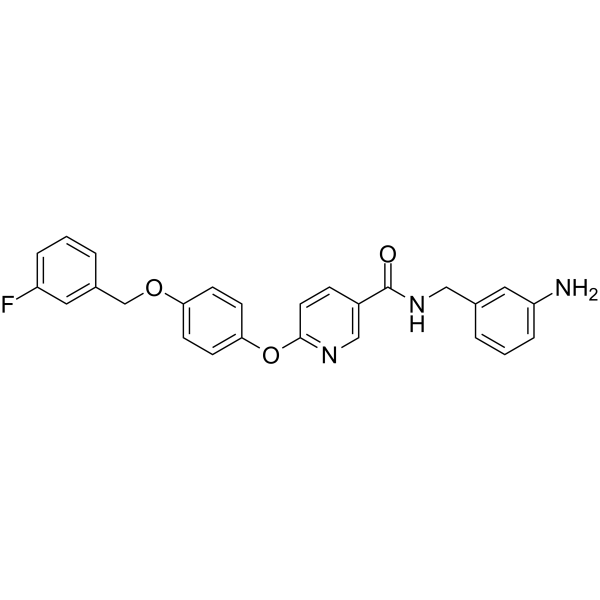
Physicochemical Properties
| Molecular Formula | C26H22FN3O3 |
| Molecular Weight | 443.469589710236 |
| Exact Mass | 443.164 |
| CAS # | 838819-70-8 |
| Related CAS # | YM-244769 hydrochloride;837424-39-2;YM-244769 dihydrochloride;1780390-65-9 |
| PubChem CID | 11442117 |
| Appearance | Off-white to light yellow solid powder |
| LogP | 4.4 |
| Hydrogen Bond Donor Count | 2 |
| Hydrogen Bond Acceptor Count | 6 |
| Rotatable Bond Count | 8 |
| Heavy Atom Count | 33 |
| Complexity | 601 |
| Defined Atom Stereocenter Count | 0 |
| SMILES | O=C(C1C=CC(OC2C=CC(OCC3C=C(F)C=CC=3)=CC=2)=NC=1)NCC1C=C(N)C=CC=1 |
| InChi Key | JZMLHJRKSJXARY-UHFFFAOYSA-N |
| InChi Code | InChI=1S/C26H22FN3O3/c27-21-5-1-4-19(13-21)17-32-23-8-10-24(11-9-23)33-25-12-7-20(16-29-25)26(31)30-15-18-3-2-6-22(28)14-18/h1-14,16H,15,17,28H2,(H,30,31) |
| Chemical Name | N-[(3-aminophenyl)methyl]-6-[4-[(3-fluorophenyl)methoxy]phenoxy]pyridine-3-carboxamide |
| HS Tariff Code | 2934.99.9001 |
| Storage |
Powder-20°C 3 years 4°C 2 years In solvent -80°C 6 months -20°C 1 month Note: Please store this product in a sealed and protected environment, avoid exposure to moisture. |
| Shipping Condition | Room temperature (This product is stable at ambient temperature for a few days during ordinary shipping and time spent in Customs) |
Biological Activity
| ln Vitro | At IC50 values of 68 ± 2.9, 96 ± 3.5, and 18 ± 1.0 nM, respectively, YM-244769 (0.003-1 μM) dose-dependently reduces the initial rate of 45Ca2+ absorption by NCX1, NCX2, and NCX3 transfectants [1]. Lactate dehydrogenase (LDH) release in SH-SY5Y cells and LLC-PK1 cells is efficiently inhibited by YM-244769 (0.3 or 1 μM) [1]. Reverse mode selectivity is possessed by YM-244769 [1]. At an IC50 of 0.05 μM, YM-244769 (1 and 10 μM) inhibits unidirectional outward INCX (Ca2+ entry mode) in a concentration- and [Na+]i-dependent manner. With a Hill coefficient of about 1, the IC50 values for bidirectional outward and inward INCX are comparable at about 100 nM [3]. Trypsin sensitivity is absent in YM-244769 [3]. |
| ln Vivo | In mice, YM-244769 (0.1–1 mg/kg; oral; once) dramatically raises the Ca2+/Cr ratio and urine Ca2+ excretion in a dose-dependent manner [2]. |
| Cell Assay |
Cell Viability Assay[1] Cell Types: SH-SY5Y cells treated with NCX1 or NCX3 antisense nucleic acid Tested Concentrations: 0.3 and 1 μM Incubation Duration: Experimental Results: Hypoxia/reoxygenation-induced LDH release was Dramatically attenuated: cells in treated cells The reduction in damage was greater in cells treated with NCX3 antisense (61% increase) than in cells treated with NCX1 antisense (35% reduction). In SH-SY5Y cells treated with NCX1 antisense, 0.3 or 1 μM inhibited hypoxia/reoxygenation-induced cell damage more effectively than cells treated with NCX3 antisense. |
| Animal Protocol |
Animal/Disease Models: wild-type C57BL/6J mice and NCX-KO mice [2] Doses: 0.1, 0.3 and 1 mg/kg Route of Administration: Oral administration once Experimental Results:Caused a dose-dependent increase (up to approximately 200%) in urine output and urinary electrolyte excretion (Na+, K+, and Cl-). The same natriuretic effect was observed in NCX1-KO and WT but disappeared in NCX2-KO and double KO. |
| References |
[1]. Iwamoto T, Kita S. YM-244769, a novel Na+/Ca2+ exchange inhibitor that preferentially inhibits NCX3, efficiently protects against hypoxia/reoxygenation-induced SH-SY5Y neuronal cell damage. Mol Pharmacol. 2006 Dec;70(6):2075-83. [2]. Genetic knockout and pharmacologic inhibition of NCX2 cause natriuresis and hypercalciuria. Biochem Biophys Res Commun. 2015 Jan 9;456(2):670-5. [3]. Inhibitory effect of YM-244769, a novel Na+/Ca2+ exchanger inhibitor on Na+/Ca2+ exchange current in guinea pig cardiac ventricular myocytes. Naunyn Schmiedebergs Arch Pharmacol. 2016 Nov;389(11):1205-1214. |
Solubility Data
| Solubility (In Vitro) | DMSO : ~120 mg/mL (~270.59 mM) |
| Solubility (In Vivo) |
Solubility in Formulation 1: ≥ 2.08 mg/mL (4.69 mM) (saturation unknown) in 10% DMSO + 90% Corn Oil (add these co-solvents sequentially from left to right, and one by one), clear solution. For example, if 1 mL of working solution is to be prepared, you can add 100 μL of 20.8 mg/mL clear DMSO stock solution to 900 μL of corn oil and mix evenly. (Please use freshly prepared in vivo formulations for optimal results.) |
| Preparing Stock Solutions | 1 mg | 5 mg | 10 mg | |
| 1 mM | 2.2549 mL | 11.2747 mL | 22.5494 mL | |
| 5 mM | 0.4510 mL | 2.2549 mL | 4.5099 mL | |
| 10 mM | 0.2255 mL | 1.1275 mL | 2.2549 mL |