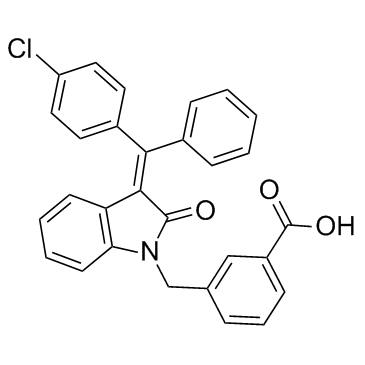
Physicochemical Properties
| Molecular Formula | C₂₉H₂₀CLNO₃ |
| Molecular Weight | 465.93 |
| Exact Mass | 465.113 |
| CAS # | 1273323-67-3 |
| PubChem CID | 51033997 |
| Appearance | Light yellow to yellow solid powder |
| LogP | 6.609 |
| Hydrogen Bond Donor Count | 1 |
| Hydrogen Bond Acceptor Count | 3 |
| Rotatable Bond Count | 5 |
| Heavy Atom Count | 34 |
| Complexity | 780 |
| Defined Atom Stereocenter Count | 0 |
| SMILES | C1=CC=C(C=C1)/C(=C\2/C3=CC=CC=C3N(C2=O)CC4=CC(=CC=C4)C(=O)O)/C5=CC=C(C=C5)Cl |
| InChi Key | BPBOVHROVFJFAH-CYYJNZCTSA-N |
| InChi Code | InChI=1S/C29H20ClNO3/c30-23-15-13-21(14-16-23)26(20-8-2-1-3-9-20)27-24-11-4-5-12-25(24)31(28(27)32)18-19-7-6-10-22(17-19)29(33)34/h1-17H,18H2,(H,33,34)/b27-26+ |
| Chemical Name | (E)-3-((3-((4-chlorophenyl)(phenyl)methylene)-2-oxoindolin-1-yl)methyl)benzoic acid |
| Synonyms | YLF466DC24 YLF-466D C-24YLF 466D C24 C 24 |
| HS Tariff Code | 2934.99.9001 |
| Storage |
Powder-20°C 3 years 4°C 2 years In solvent -80°C 6 months -20°C 1 month |
| Shipping Condition | Room temperature (This product is stable at ambient temperature for a few days during ordinary shipping and time spent in Customs) |
Biological Activity
| Targets |
AMPK Adenosine Monophosphate-Activated Protein Kinase (AMPK). [1] |
| ln Vitro |
In order to determine if YLF-466D can promote platelet AMPK and hence decrease aggregation, its effects on platelet AMPK and aggregation are investigated. Activation-dependent phosphorylation at Thr172 confirms that YLF-466D activates platelet AMPK. YLF-466D suppresses thrombin-induced platelet aggregation, which is consistent with this finding. The aforementioned suppression is noted in the aggregation induced by ADP, collagen, and thrombin, suggesting that YLF-466D's antiaggregatory activity is widespread and not exclusive to platelet agonists. With the greatest potency at 150 μM, all effects on AMPK and aggregation are concentration-dependent. Approximately 84, 55, and 87 μM are the IC50 values against thrombin-, ADP-, and collagen-induced aggregation, respectively[1]. In washed rat platelets, YLF-466D activated AMPK in a concentration-dependent manner (50-150 µM), as evidenced by increased phosphorylation at Thr172. [1] YLF-466D (50-150 µM) inhibited platelet aggregation induced by various agonists: thrombin (IC₅₀ ≈ 84 µM), ADP (IC₅₀ ≈ 55 µM), and collagen (IC₅₀ ≈ 87 µM). This anti-aggregatory effect was not agonist-specific. [1] The AMPK activation and aggregation inhibition by YLF-466D (150 µM) were abolished by pretreatment with the AMPK inhibitors compound C (10 µM) and ara-A (500 µM), confirming the mediation through AMPK. [1] YLF-466D treatment led to the phosphorylation (activation) of endothelial nitric oxide synthase (eNOS) at Ser1177 in platelets. [1] YLF-466D significantly elevated intracellular levels of cyclic nucleotides: cGMP and, to a lesser but significant extent, cAMP. These increases were prevented by AMPK inhibitors. [1] Consistent with elevated cGMP and cAMP, YLF-466D induced phosphorylation of Vasodilator-Stimulated Phosphoprotein (VASP) at both Ser239 (a PKG-dependent site) and Ser157 (a PKA-dependent site). This phosphorylation was also blocked by AMPK inhibitors. [1] In whole blood (a more physiologically relevant system than washed platelets), YLF-466D (50-150 µM) inhibited collagen-induced aggregation. This effect was also reversed by AMPK inhibitors. [1] |
| References |
[1]. Antiplatelet effect of a newly developed AMP-activated protein kinase activator YLF-466D. Eur J Pharmacol. 2015 Aug 5;760:81-7. |
| Additional Infomation |
YLF-466D (3-[(3E)-3-[(4-chlorophenyl)phenylmethylene]-2,3-dihydro-2-oxo-1H-indol-1-yl]methyl]-benzoic acid) is a novel alkene oxindole derivative developed as an AMPK activator through structural optimization of a previous compound PT1. [1] The study demonstrates that the antiplatelet mechanism of YLF-466D involves activation of the AMPK / eNOS / cGMP-PKG signaling axis, and possibly a cGMP-mediated cross-talk leading to cAMP elevation and PKA activation. [1] The authors suggest that YLF-466D has potential for application in antiplatelet therapy, but its in vivo antithrombotic efficacy and clinical validation remain to be assessed in future studies. [1] |
Solubility Data
| Solubility (In Vitro) | DMSO : ≥ 100 mg/mL (~214.62 mM) |
| Solubility (In Vivo) |
Solubility in Formulation 1: ≥ 2.5 mg/mL (5.37 mM) (saturation unknown) in 10% DMSO + 40% PEG300 + 5% Tween80 + 45% Saline (add these co-solvents sequentially from left to right, and one by one), clear solution. For example, if 1 mL of working solution is to be prepared, you can add 100 μL of 25.0 mg/mL clear DMSO stock solution to 400 μL PEG300 and mix evenly; then add 50 μL Tween-80 to the above solution and mix evenly; then add 450 μL normal saline to adjust the volume to 1 mL. Preparation of saline: Dissolve 0.9 g of sodium chloride in 100 mL ddH₂ O to obtain a clear solution. Solubility in Formulation 2: ≥ 2.5 mg/mL (5.37 mM) (saturation unknown) in 10% DMSO + 90% Corn Oil (add these co-solvents sequentially from left to right, and one by one), clear solution. For example, if 1 mL of working solution is to be prepared, you can add 100 μL of 25.0 mg/mL clear DMSO stock solution to 900 μL of corn oil and mix evenly. (Please use freshly prepared in vivo formulations for optimal results.) |
| Preparing Stock Solutions | 1 mg | 5 mg | 10 mg | |
| 1 mM | 2.1462 mL | 10.7312 mL | 21.4625 mL | |
| 5 mM | 0.4292 mL | 2.1462 mL | 4.2925 mL | |
| 10 mM | 0.2146 mL | 1.0731 mL | 2.1462 mL |