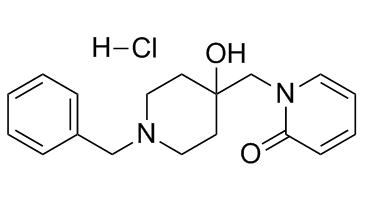
YL-0919 is a novel, potent and orally bioactive antidepressant acting as 5-HT1A receptor agonist (Ki=0.19 nM) and selective serotonin reuptake inhibitor.
Physicochemical Properties
| Molecular Formula | C18H23CLN2O2 |
| Molecular Weight | 334.8404 |
| Exact Mass | 334.14 |
| Elemental Analysis | C, 64.57; H, 6.92; Cl, 10.59; N, 8.37; O, 9.56 |
| CAS # | 1339058-04-6 |
| PubChem CID | 122412736 |
| Appearance | White to off-white solid powder |
| Melting Point | 216 - 218 °C |
| Hydrogen Bond Donor Count | 2 |
| Hydrogen Bond Acceptor Count | 3 |
| Rotatable Bond Count | 4 |
| Heavy Atom Count | 23 |
| Complexity | 444 |
| Defined Atom Stereocenter Count | 0 |
| SMILES | Cl[H].O([H])C1(C([H])([H])N2C([H])=C([H])C([H])=C([H])C2=O)C([H])([H])C([H])([H])N(C([H])([H])C2C([H])=C([H])C([H])=C([H])C=2[H])C([H])([H])C1([H])[H] |
| InChi Key | OXILSFMNCPZGAH-UHFFFAOYSA-N |
| InChi Code | InChI=1S/C18H22N2O2.ClH/c21-17-8-4-5-11-20(17)15-18(22)9-12-19(13-10-18)14-16-6-2-1-3-7-16;/h1-8,11,22H,9-10,12-15H2;1H |
| Chemical Name | 1-[(1-benzyl-4-hydroxypiperidin-4-yl)methyl]pyridin-2-one;hydrochloride |
| Synonyms | YL-0919; YL 0919; YL0919 |
| HS Tariff Code | 2934.99.9001 |
| Storage |
Powder-20°C 3 years 4°C 2 years In solvent -80°C 6 months -20°C 1 month Note: Please store this product in a sealed and protected environment, avoid exposure to moisture. |
| Shipping Condition | Room temperature (This product is stable at ambient temperature for a few days during ordinary shipping and time spent in Customs) |
Biological Activity
| Targets | 5-HT1A Receptor |
| ln Vitro |
Hypidone hydrochloride inhibits the uptake of [3H]-5-HT into rat cerebral cortical synaptosomes and HEK293 cells that are stable hSERT-expressing cells with IC50 values of 1.78 nM and 1.93, respectively[1]. Hypidone hydrochloride (0.01 nM-10 μM) exhibits a concentration-dependent inhibitory effect on cAMP formation, which is stimulated by forskolin with an IC50 of approximately 23.9 nM. Furthermore, WAY-100635 inhibits the inhibition of forskolin-stimulated cAMP formation mediated by hydridone hydrochloride in antagonism studies[1]. Hypidone hydrochloride demonstrates affinities to rat 5-HT1A receptors, serotonin transporter (SERT) with high affinity (Ki=0.19 and 0.72 nM, respectively); however, its affinity to NET and DAT is low, as it blocks [3H]win35428 and [3H]nisoxetine binding with Ki values of 650 nM and 2652 nM, respectively[1]. |
| ln Vivo |
Hypidone hydrochloride (YL0919) (oral administration; 1.25 or 5 mg/kg; 4 weeks) and fluoxetine (10 mg/kg) reverse the inhibition of locomotor activity in CUS rats[1]. Hypidone hydrochloride (oral administration; 1.25, 2.5, and 5 mg/kg; 4 weeks) dramatically shortens the immobility period in TST during mice FST in mice. Furthermore, in a different OFT, hypidone hydrochloride has no effect on locomotor activity. Furthermore, coadministration of WAY-100635 completely bunts the antidepressant-like effect of hypidone hydrochloride in TST and FST[1]. |
| Animal Protocol |
Male ICR mice weighing 18–22 g 1.25, 2.5, and 5 mg/kg Oral administration |
| References |
[1]. Antidepressant-like activity of YL-0919: a novel combined selective serotonin reuptake inhibitor and 5-HT1A receptor agonist. PloS one 8, e83271, doi:10.1371/journal.pone.0083271 (2013). [2]. The role of activation of the 5-HT1A receptor and adenylate cyclase in the antidepressant-like effect of YL-0919, a dual 5-HT1A agonist and selective serotonin reuptake inhibitor. Neuroscience letters 582, 104-108, 2014.09.009 (2014). |
Solubility Data
| Solubility (In Vitro) |
DMSO: ~67 mg/mL (~200.1 mM) Ethanol: ~34 mg/mL |
| Solubility (In Vivo) |
Solubility in Formulation 1: ≥ 2.5 mg/mL (7.47 mM) (saturation unknown) in 10% DMSO + 40% PEG300 + 5% Tween80 + 45% Saline (add these co-solvents sequentially from left to right, and one by one), clear solution. For example, if 1 mL of working solution is to be prepared, you can add 100 μL of 25.0 mg/mL clear DMSO stock solution to 400 μL PEG300 and mix evenly; then add 50 μL Tween-80 to the above solution and mix evenly; then add 450 μL normal saline to adjust the volume to 1 mL. Preparation of saline: Dissolve 0.9 g of sodium chloride in 100 mL ddH₂ O to obtain a clear solution. Solubility in Formulation 2: ≥ 2.5 mg/mL (7.47 mM) (saturation unknown) in 10% DMSO + 90% (20% SBE-β-CD in Saline) (add these co-solvents sequentially from left to right, and one by one), clear solution. For example, if 1 mL of working solution is to be prepared, you can add 100 μL of 25.0 mg/mL clear DMSO stock solution to 900 μL of 20% SBE-β-CD physiological saline solution and mix evenly. Preparation of 20% SBE-β-CD in Saline (4°C,1 week): Dissolve 2 g SBE-β-CD in 10 mL saline to obtain a clear solution. Solubility in Formulation 3: ≥ 2.5 mg/mL (7.47 mM) (saturation unknown) in 10% DMSO + 90% Corn Oil (add these co-solvents sequentially from left to right, and one by one), clear solution. For example, if 1 mL of working solution is to be prepared, you can add 100 μL of 25.0 mg/mL clear DMSO stock solution to 900 μL of corn oil and mix evenly. (Please use freshly prepared in vivo formulations for optimal results.) |
| Preparing Stock Solutions | 1 mg | 5 mg | 10 mg | |
| 1 mM | 2.9865 mL | 14.9325 mL | 29.8650 mL | |
| 5 mM | 0.5973 mL | 2.9865 mL | 5.9730 mL | |
| 10 mM | 0.2987 mL | 1.4933 mL | 2.9865 mL |