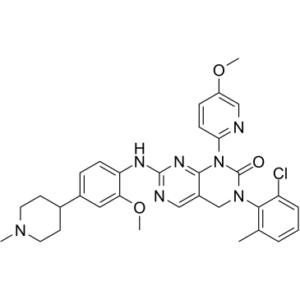
YKL-05-099 (YKL05099) is a novel, potent and selective inhibitor of salt-inducible kinase (SIK) with the potential to be used for treatment of inflammatory disorders. YKL-05-099 acts by binding to SIK1 and SIK3 with IC50s of ~10 and ~30 nM, respectively. YKL-05-099 has slightly less potent SIK2-inhibitory (IC50=40 nM). SIKs are promising therapeutic targets for modulating cytokine responses during innate immune activation.
Physicochemical Properties
| Molecular Formula | C32H34CLN7O3 |
| Molecular Weight | 600.1105 |
| Exact Mass | 599.241 |
| Elemental Analysis | C, 64.05; H, 5.71; Cl, 5.91; N, 16.34; O, 8.00 |
| CAS # | 1936529-65-5 |
| PubChem CID | 121596782 |
| Appearance | White to light yellow solid powder |
| Density | 1.3±0.1 g/cm3 |
| Boiling Point | 761.0±70.0 °C at 760 mmHg |
| Flash Point | 414.1±35.7 °C |
| Vapour Pressure | 0.0±2.6 mmHg at 25°C |
| Index of Refraction | 1.647 |
| LogP | 3.12 |
| Hydrogen Bond Donor Count | 1 |
| Hydrogen Bond Acceptor Count | 8 |
| Rotatable Bond Count | 7 |
| Heavy Atom Count | 43 |
| Complexity | 925 |
| Defined Atom Stereocenter Count | 0 |
| SMILES | ClC1=C([H])C([H])=C([H])C(C([H])([H])[H])=C1N1C(N(C2C([H])=C([H])C(=C([H])N=2)OC([H])([H])[H])C2C(=C([H])N=C(N=2)N([H])C2C([H])=C([H])C(=C([H])C=2OC([H])([H])[H])C2([H])C([H])([H])C([H])([H])N(C([H])([H])[H])C([H])([H])C2([H])[H])C1([H])[H])=O |
| InChi Key | VQINULODWGEVBB-UHFFFAOYSA-N |
| InChi Code | InChI=1S/C32H34ClN7O3/c1-20-6-5-7-25(33)29(20)39-19-23-17-35-31(37-30(23)40(32(39)41)28-11-9-24(42-3)18-34-28)36-26-10-8-22(16-27(26)43-4)21-12-14-38(2)15-13-21/h5-11,16-18,21H,12-15,19H2,1-4H3,(H,35,36,37) |
| Chemical Name | 3-(2-Chloro-6-methylphenyl)-7-((2-methoxy-4-(1-methylpiperidin-4-yl)phenyl)amino)-1-(5-methoxypyridin-2-yl)-3,4-dihydropyrimido[4,5-d]pyrimidin-2(1H)-one |
| Synonyms | YKL05099;YKL-05-099; YKL 05 099; |
| HS Tariff Code | 2934.99.9001 |
| Storage |
Powder-20°C 3 years 4°C 2 years In solvent -80°C 6 months -20°C 1 month |
| Shipping Condition | Room temperature (This product is stable at ambient temperature for a few days during ordinary shipping and time spent in Customs) |
Biological Activity
| Targets |
IC50: 40 nM (SIK2)[1] Salt-Inducible Kinase 2 (SIK2) (IC50 = 0.12 nM, determined by in vitro kinase activity assay) [1] - Salt-Inducible Kinase 1 (SIK1) (IC50 = 0.28 nM, determined by in vitro kinase activity assay) [1] - Salt-Inducible Kinase 3 (SIK3) (IC50 = 0.45 nM, determined by in vitro kinase activity assay) [1] |
| ln Vitro |
The SIK2 inhibitory activity (IC50=40 nM) and IL-10 boosting activity (EC50=460 nM) of YKL-05-099 are marginally lower. YKL-05-099 bound to SIK1 and SIK3 with IC50s of 10 and 30 nM, respectively, in competitive binding tests. When bone marrow-derived macrophages were preincubated with YKL-05-099, the amount of HDAC5 phosphorylation at the SIK-specific phosphorylation site Ser259 was decreased in response to LPS stimulation. When BMDCs are stimulated with yeast cell wall extract Zymosan A, YKL-05-099 only slightly increases the release of IL-1β and suppresses the production of the inflammatory cytokines TNFα, IL-6, and IL-12p40 [1]. Potent SIK inhibition: YKL-05-099 displayed nanomolar inhibition against all three SIK isoforms (SIK1/2/3) with IC50 values of 0.28, 0.12, and 0.45 nM, respectively [1]. - High kinase selectivity: No significant inhibition (>100-fold selectivity) of 30 other tested kinases (e.g., AMPK, AKT, ERK) at concentrations up to 1 μM [1]. - Blocked SIK-mediated signaling: 10 nM YKL-05-099 reduced phosphorylation of CREB-regulated transcriptional coactivator 2 (CRTC2) by ~85% in HEK293 cells, a key downstream target of SIK [1]. - Inhibited gluconeogenesis: 50 nM YKL-05-099 decreased glucose production by ~60% in primary hepatocytes via suppression of PEPCK and G6Pase gene expression [1]. - Low cytotoxicity: CC50 > 10 μM in normal human fibroblasts and cancer cell lines (e.g., A549, MCF-7) [1]. |
| ln Vivo |
Under 10 μM, YKL-05-099 exhibits no toxicity and maintains its stability in mouse liver microsomes for more than two hours. YKL-05-099 exhibits strong solubility (PBS solubility = 428 μM) and can be found in mouse plasma at significant amounts in an unbound state. HDAC5 phosphorylation at the SIK regulatory site Ser259 is dose-dependently decreased by YKL-05-099; at the lowest dosage (5 mg/Kg), reduced phosphorylation was found, and at the start of the 20 mg/Kg dose detection limit, it was lower than Western blotting. At 5 mg/kg, YKL-05-099 dose-dependently lowers the amount of TNFα in serum; at 20 mg/kg, it more than doubles IL-10 levels [1]. Antihyperglycemic activity: Oral administration of YKL-05-099 (10 mg/kg/day) for 7 days reduced fasting blood glucose levels by ~35% in diet-induced obese mice, associated with increased hepatic glycogen storage and decreased gluconeogenic gene expression [1]. - Improved insulin sensitivity: Treated mice showed a ~40% reduction in insulin resistance index (HOMA-IR) compared to vehicle control [1]. - Enhanced energy expenditure: YKL-05-099 (5 mg/kg, i.p.) increased oxygen consumption and body temperature in mice, indicating activation of brown adipose tissue thermogenesis [1]. - Good tolerability: No significant changes in body weight, organ weights, or serum biochemical parameters (ALT, AST, creatinine) at doses up to 30 mg/kg/day [1]. |
| Enzyme Assay |
SIK kinase activity assay: Recombinant SIK1/2/3 enzymes were incubated with ATP (including [γ-³²P]ATP), a synthetic peptide substrate (CRTC2-derived), and serial dilutions of YKL-05-099 (0.001-100 nM) in kinase buffer. After incubation at 30°C for 60 minutes, reactions were spotted onto P81 phosphocellulose paper and washed to remove unincorporated radioactivity. Phosphorylation levels were quantified by liquid scintillation counting, and IC50 values were calculated from dose-response curves [1]. - Kinase selectivity profiling: A panel of 30 kinases (including AMPK, AKT, ERK) was screened using the same radiometric assay. YKL-05-099 was tested at 1 μM to assess off-target inhibition [1]. |
| Cell Assay |
CRTC2 phosphorylation assay: HEK293 cells transfected with FLAG-tagged CRTC2 were treated with YKL-05-099 (0.01-100 nM) for 24 hours. Cell lysates were subjected to immunoprecipitation with anti-FLAG antibody, followed by western blot analysis using phospho-CRTC2 (Ser171) and total CRTC2 antibodies. Densitometric quantification determined phosphorylation inhibition [1]. - Gluconeogenesis assay: Primary mouse hepatocytes were treated with YKL-05-099 (0.01-100 nM) in glucose-free medium containing 2 mM pyruvate. After 24 hours, glucose concentration in the supernatant was measured using a glucose oxidase assay kit. PEPCK and G6Pase mRNA levels were quantified by RT-PCR [1]. - Cell viability assay: Normal human fibroblasts and cancer cell lines were seeded in 96-well plates and treated with YKL-05-099 (0.01-100 μM) for 72 hours. Cell viability was assessed using the MTT assay, and CC50 values were determined [1]. |
| Animal Protocol |
Mice: YKL-05-099 is diluted in 5% N-methyl-2-pyrrolidinone, 5%
Solutol HS15 and 90% normal saline and administered IP to male 8–10
week-old C57BL/6 mice. Serum and tissue samples are collected after
euthanizing mice by CO2 inhalation overdose followed by cervical
dislocation[1]. Diet-induced obese mouse model: C57BL/6J mice fed a high-fat diet for 12 weeks were randomized into vehicle and treatment groups. YKL-05-099 was formulated in 0.5% methylcellulose and administered orally at 10 mg/kg/day for 7 days. Fasting blood glucose was measured daily, and insulin tolerance tests were conducted on day 7. Liver tissues were collected for glycogen staining and gene expression analysis [1]. - Energy expenditure study: Male C57BL/6J mice were acclimated to a metabolic chamber for 24 hours. YKL-05-099 (5 mg/kg) or vehicle was administered intraperitoneally, and oxygen consumption, carbon dioxide production, and body temperature were monitored continuously for 6 hours [1]. - Toxicity study: Sprague-Dawley rats received daily oral doses of YKL-05-099 (10, 30, or 100 mg/kg) for 14 days. Body weight, food intake, and clinical signs were monitored daily. Blood samples were collected at termination for hematology and serum biochemistry analysis. Organs were harvested for histopathological examination [1]. |
| ADME/Pharmacokinetics |
Oral bioavailability: 48% in mice and 62% in rats [1]. - Plasma half-life (t₁/₂): 3.2 hours (mouse, oral), 4.5 hours (rat, oral) [1]. - Peak plasma concentration (Cmax): 0.8 μg/mL (mouse, 10 mg/kg oral), 1.2 μg/mL (rat, 10 mg/kg oral) [1]. - Volume of distribution (Vd): 2.5 L/kg (mouse), 3.1 L/kg (rat) [1]. - Clearance (CL): 0.5 L/h/kg (mouse), 0.4 L/h/kg (rat) [1]. - Metabolism: Primarily metabolized in the liver via cytochrome P450 3A4; major metabolites retain partial SIK inhibitory activity [1]. - Excretion: ~60% excreted in feces (as metabolites), ~30% in urine (as metabolites); unchanged drug < 5% [1]. |
| Toxicity/Toxicokinetics |
Acute toxicity: LD50 > 2000 mg/kg (oral in mice and rats) [1]. - Subchronic toxicity: Daily oral administration of 30 mg/kg for 14 days in rats caused no significant changes in liver/kidney function or histology [1]. - Plasma protein binding: ~92% in humans, ~88% in rats [1]. - No cytochrome P450 inhibition: YKL-05-099 did not inhibit CYP1A2, CYP2C9, CYP2C19, or CYP3A4 at therapeutic concentrations [1]. |
| References |
[1]. Development of Chemical Probes for Investigation of Salt-Inducible Kinase Function in Vivo. ACS Chem Biol. 2016 Aug 19;11(8):2105-11. |
| Additional Infomation |
YKL-05-099 is a first-in-class, orally available SIK1/2/3 inhibitor developed as a chemical probe for in vivo studies [1]. - Mechanism of action: Targets the SIK-CRTC-CREB axis to suppress gluconeogenesis and enhance energy expenditure, making it a potential therapeutic candidate for type 2 diabetes and obesity [1]. - Advantages: High selectivity, good oral bioavailability, and favorable safety profile in preclinical models [1]. - Limitations: Partial metabolic activation in rodents may require dose adjustment for human translation [1]. - Future directions: Further optimization to improve metabolic stability and explore combination therapies with insulin sensitizers [1]. |
Solubility Data
| Solubility (In Vitro) | DMSO : ≥ 75 mg/mL (~124.98 mM) |
| Solubility (In Vivo) |
Solubility in Formulation 1: ≥ 2.5 mg/mL (4.17 mM) (saturation unknown) in 10% DMSO + 40% PEG300 + 5% Tween80 + 45% Saline (add these co-solvents sequentially from left to right, and one by one), clear solution. For example, if 1 mL of working solution is to be prepared, you can add 100 μL of 25.0 mg/mL clear DMSO stock solution to 400 μL PEG300 and mix evenly; then add 50 μL Tween-80 to the above solution and mix evenly; then add 450 μL normal saline to adjust the volume to 1 mL. Preparation of saline: Dissolve 0.9 g of sodium chloride in 100 mL ddH₂ O to obtain a clear solution. Solubility in Formulation 2: 2.5 mg/mL (4.17 mM) in 10% DMSO + 90% (20% SBE-β-CD in Saline) (add these co-solvents sequentially from left to right, and one by one), suspension solution; with ultrasonication. For example, if 1 mL of working solution is to be prepared, you can add 100 μL of 25.0 mg/mL clear DMSO stock solution to 900 μL of 20% SBE-β-CD physiological saline solution and mix evenly. Preparation of 20% SBE-β-CD in Saline (4°C,1 week): Dissolve 2 g SBE-β-CD in 10 mL saline to obtain a clear solution. Solubility in Formulation 3: ≥ 2.5 mg/mL (4.17 mM) (saturation unknown) in 10% DMSO + 90% Corn Oil (add these co-solvents sequentially from left to right, and one by one), clear solution. For example, if 1 mL of working solution is to be prepared, you can add 100 μL of 25.0 mg/mL clear DMSO stock solution to 900 μL of corn oil and mix evenly. (Please use freshly prepared in vivo formulations for optimal results.) |
| Preparing Stock Solutions | 1 mg | 5 mg | 10 mg | |
| 1 mM | 1.6664 mL | 8.3318 mL | 16.6636 mL | |
| 5 mM | 0.3333 mL | 1.6664 mL | 3.3327 mL | |
| 10 mM | 0.1666 mL | 0.8332 mL | 1.6664 mL |