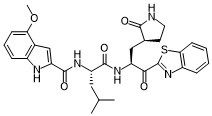
YH-53 (YH53) is a 3CL Protease Inhibitor with the potential for treating COVID-19. It has Ki values of 6.3 nM, 34.7 nM for SARS-CoV-1 3CLpro and SARS-CoV-2 3CLpro, respectively. 3CL protease (3CLpro) plays a pivotal role in the processing of viral polyproteins. YH-53 is a peptidomimetic compound with a unique benzothiazolyl ketone.
Physicochemical Properties
| Molecular Formula | C30H33N5O5S |
| Molecular Weight | 575.6785 |
| Exact Mass | 575.22 |
| CAS # | 1471484-62-4 |
| PubChem CID | 72708377 |
| Appearance | Light yellow to green yellow solid powder |
| LogP | 4.7 |
| Hydrogen Bond Donor Count | 4 |
| Hydrogen Bond Acceptor Count | 7 |
| Rotatable Bond Count | 11 |
| Heavy Atom Count | 41 |
| Complexity | 981 |
| Defined Atom Stereocenter Count | 3 |
| SMILES | S1C2=C([H])C([H])=C([H])C([H])=C2N=C1C([C@]([H])(C([H])([H])[C@@]1([H])C(N([H])C([H])([H])C1([H])[H])=O)N([H])C([C@]([H])(C([H])([H])C([H])(C([H])([H])[H])C([H])([H])[H])N([H])C(C1=C([H])C2C(=C([H])C([H])=C([H])C=2N1[H])OC([H])([H])[H])=O)=O)=O |
| InChi Key | JBLLRCOZJMVOAE-HSQYWUDLSA-N |
| InChi Code | InChI=1S/C30H33N5O5S/c1-16(2)13-22(34-29(39)23-15-18-19(32-23)8-6-9-24(18)40-3)28(38)33-21(14-17-11-12-31-27(17)37)26(36)30-35-20-7-4-5-10-25(20)41-30/h4-10,15-17,21-22,32H,11-14H2,1-3H3,(H,31,37)(H,33,38)(H,34,39)/t17-,21-,22-/m0/s1 |
| Chemical Name | N-[(2S)-1-[[(2S)-1-(1,3-benzothiazol-2-yl)-1-oxo-3-[(3S)-2-oxopyrrolidin-3-yl]propan-2-yl]amino]-4-methyl-1-oxopentan-2-yl]-4-methoxy-1H-indole-2-carboxamide |
| HS Tariff Code | 2934.99.9001 |
| Storage |
Powder-20°C 3 years 4°C 2 years In solvent -80°C 6 months -20°C 1 month |
| Shipping Condition | Room temperature (This product is stable at ambient temperature for a few days during ordinary shipping and time spent in Customs) |
Biological Activity
| ln Vitro | In VeroE6/TMPRSS2 cells, YH-53 (1-25 μM; for 24 hours) efficiently lowers the total RNA copy number as the concentration increases [1]. Cytopathic effect (CPE) in Vero cells was used to determine the extent to which YH-53 (1, 5, 10, 15, 20, 25 μM; for 48 hours) and 10 μM totally stopped viral proliferation against SARS-CoV-2 [1]. In vero cells, YH-53 (10, 100 μM) has a CC50 value greater than 100 μM and exhibits no cytotoxicity [1]. CYP1A2, CYP2D6, and CYP2C8 are moderately inhibited by YH-53 (10 μM) (26.6%, 38.0%, and 66.4%, respectively). CYP2C9 and CYP3A4 are not inhibited by YH-53 [1]. YH-53 exhibits an IC50 of 0.74 μM for inhibiting SARS-CoV 3CLpro. |
| ln Vivo | YH-53 (0.1 mg/kg; IV) has an AUC0-∞ of 19.7 ng and a T1/2 of 2.97 hours.h/mL, and in rats, a Kd of 3.51 L/kg [1]. The oral YH-53 dose of 0.5 mg/kg has an AUC0-∞ of 3.49 ng and a T1/2 of 9.64 hours.h/mL, and in rats, a Cmax of 1.08 ng/mL [1]. |
| Cell Assay |
RT-PCR[1] Cell Types: VeroE6/TMPRSS2 cells Tested Concentrations: 1, 5, 10, 15, 20, 25 μM Incubation Duration: 24 hrs (hours) Experimental Results: Efficiently decreased copies of total RNA. |
| Animal Protocol |
Animal/Disease Models: Rats[1] Doses: 0.1 mg/kg (pharmacokinetic/PK Analysis) Route of Administration: IV Experimental Results: Had a T1/2 of 2.97 hrs (hours), an AUC0–∞ of 19.7 ng·h/mL, a Vd of 3.51 L/kg . |
| References |
[1]. 3CL Protease Inhibitors with an Electrophilic Arylketone Moiety as Anti-SARS-CoV-2 Agents. J Med Chem. 2021 Jul27;acs.jmedchem.1c00665. [2]. Development of potent dipeptide-type SARS-CoV 3CL protease inhibitors with novel P3 scaffolds: design, synthesis, biological evaluation, and docking studies. Eur J Med Chem. 2013 Oct;68:372-84. |
Solubility Data
| Solubility (In Vitro) | DMSO : ~50 mg/mL (~86.85 mM) |
| Solubility (In Vivo) |
Solubility in Formulation 1: ≥ 2.08 mg/mL (3.61 mM) (saturation unknown) in 10% DMSO + 40% PEG300 + 5% Tween80 + 45% Saline (add these co-solvents sequentially from left to right, and one by one), clear solution. For example, if 1 mL of working solution is to be prepared, you can add 100 μL of 20.8 mg/mL clear DMSO stock solution to 400 μL PEG300 and mix evenly; then add 50 μL Tween-80 to the above solution and mix evenly; then add 450 μL normal saline to adjust the volume to 1 mL. Preparation of saline: Dissolve 0.9 g of sodium chloride in 100 mL ddH₂ O to obtain a clear solution. Solubility in Formulation 2: 2.08 mg/mL (3.61 mM) in 10% DMSO + 90% (20% SBE-β-CD in Saline) (add these co-solvents sequentially from left to right, and one by one), suspension solution; with ultrasonication. For example, if 1 mL of working solution is to be prepared, you can add 100 μL of 20.8 mg/mL clear DMSO stock solution to 900 μL of 20% SBE-β-CD physiological saline solution and mix evenly. Preparation of 20% SBE-β-CD in Saline (4°C,1 week): Dissolve 2 g SBE-β-CD in 10 mL saline to obtain a clear solution. Solubility in Formulation 3: ≥ 2.08 mg/mL (3.61 mM) (saturation unknown) in 10% DMSO + 90% Corn Oil (add these co-solvents sequentially from left to right, and one by one), clear solution. For example, if 1 mL of working solution is to be prepared, you can add 100 μL of 20.8 mg/mL clear DMSO stock solution to 900 μL of corn oil and mix evenly. (Please use freshly prepared in vivo formulations for optimal results.) |
| Preparing Stock Solutions | 1 mg | 5 mg | 10 mg | |
| 1 mM | 1.7371 mL | 8.6854 mL | 17.3708 mL | |
| 5 mM | 0.3474 mL | 1.7371 mL | 3.4742 mL | |
| 10 mM | 0.1737 mL | 0.8685 mL | 1.7371 mL |