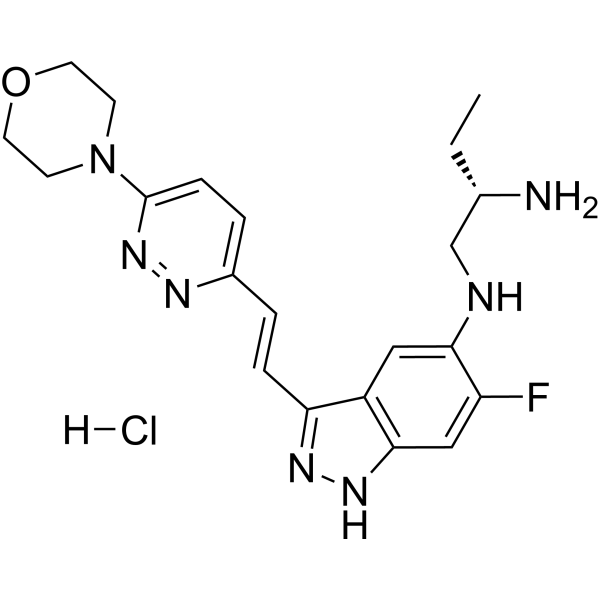
Physicochemical Properties
| Molecular Formula | C21H27CLFN7O |
| Molecular Weight | 447.94 |
| Appearance | Orange to red solid powder |
| HS Tariff Code | 2934.99.9001 |
| Storage |
Powder-20°C 3 years 4°C 2 years In solvent -80°C 6 months -20°C 1 month |
| Shipping Condition | Room temperature (This product is stable at ambient temperature for a few days during ordinary shipping and time spent in Customs) |
Biological Activity
| Targets | IRF5[1] |
| ln Vitro | In human PBMCs and mouse splenocytes, YE6144(1 or 3 μM; 30 min) suppresses the phosphorylation of IRF5[1]. In human HC PBMCs, YE6144(0–10 μM; 30 min) suppresses type I IFN production with an IC50 of roughly 0.09 μM[1]. |
| ln Vivo | The progression of systemic lupus erythematosus in mice is suppressed by YE6144 (40.0 mg/kg; sc; once)[1]. |
| Cell Assay |
Western Blot Analysis[1] Cell Types: Human HC PBMCs and mouse WT splenocytes Tested Concentrations: 1 μM(PBMCs) and 3 μM(splenocytes) Incubation Duration: 30 min Experimental Results: Inhibited the phosphorylation of IRF5. RT-PCR[1] Cell Types: Mouse WT splenocytes Tested Concentrations: 3 μM Incubation Duration: 30 min Experimental Results: Induction of type I IFN genes, Ifnb1 and Ifna stimulated by TLR7 ligands or TLR9 ligands was remarkably weakened. |
| Animal Protocol |
Animal/Disease Models: NZB/W F1 mouse model of systemic lupus erythematosus (SLE)[1] Doses: 40.0 mg/kg Route of Administration: subcutaneous (sc) injection, once Experimental Results: Suppressed the exacerbation of autoantibody production. Splenomegaly and renal dysfunction were also suppressed by the treatment after disease onset. |
| References |
[1]. Genetic and chemical inhibition of IRF5 suppresses pre-existing mouse lupus-like disease. Nat Commun. 2021 Jul 19;12(1):4379. |
Solubility Data
| Solubility (In Vitro) | DMSO :~100 mg/mL (~223.24 mM) |
| Solubility (In Vivo) |
Solubility in Formulation 1: ≥ 10 mg/mL (22.32 mM) (saturation unknown) in 10% DMSO + 40% PEG300 + 5% Tween80 + 45% Saline (add these co-solvents sequentially from left to right, and one by one), clear solution. For example, if 1 mL of working solution is to be prepared, you can add 100 μL of 100.0 mg/mL clear DMSO stock solution to 400 μL PEG300 and mix evenly; then add 50 μL Tween-80 to the above solution and mix evenly; then add 450 μL normal saline to adjust the volume to 1 mL. Preparation of saline: Dissolve 0.9 g of sodium chloride in 100 mL ddH₂ O to obtain a clear solution. Solubility in Formulation 2: ≥ 10 mg/mL (22.32 mM) (saturation unknown) in 10% DMSO + 90% (20% SBE-β-CD in Saline) (add these co-solvents sequentially from left to right, and one by one), clear solution. For example, if 1 mL of working solution is to be prepared, you can add 100 μL of 100.0 mg/mL clear DMSO stock solution to 900 μL of 20% SBE-β-CD physiological saline solution and mix evenly. Preparation of 20% SBE-β-CD in Saline (4°C,1 week): Dissolve 2 g SBE-β-CD in 10 mL saline to obtain a clear solution. Solubility in Formulation 3: ≥ 10 mg/mL (22.32 mM) (saturation unknown) in 10% DMSO + 90% Corn Oil (add these co-solvents sequentially from left to right, and one by one), clear solution. For example, if 1 mL of working solution is to be prepared, you can add 100 μL of 100.0 mg/mL clear DMSO stock solution to 900 μL of corn oil and mix evenly. (Please use freshly prepared in vivo formulations for optimal results.) |
| Preparing Stock Solutions | 1 mg | 5 mg | 10 mg | |
| 1 mM | 2.2324 mL | 11.1622 mL | 22.3244 mL | |
| 5 mM | 0.4465 mL | 2.2324 mL | 4.4649 mL | |
| 10 mM | 0.2232 mL | 1.1162 mL | 2.2324 mL |