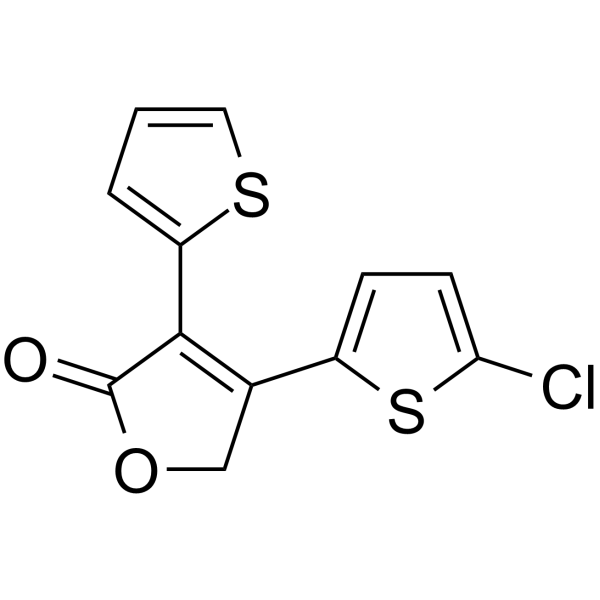
Physicochemical Properties
| Molecular Formula | C12H7CLO2S2 |
| Molecular Weight | 282.765779733658 |
| Exact Mass | 281.957 |
| CAS # | 748778-73-6 |
| PubChem CID | 2377702 |
| Appearance | White to yellow solid powder |
| Density | 1.5±0.1 g/cm3 |
| Boiling Point | 494.2±45.0 °C at 760 mmHg |
| Flash Point | 252.7±28.7 °C |
| Vapour Pressure | 0.0±1.3 mmHg at 25°C |
| Index of Refraction | 1.686 |
| LogP | 3.35 |
| Hydrogen Bond Donor Count | 0 |
| Hydrogen Bond Acceptor Count | 4 |
| Rotatable Bond Count | 2 |
| Heavy Atom Count | 17 |
| Complexity | 370 |
| Defined Atom Stereocenter Count | 0 |
| InChi Key | RCLLWMPOHNZNAO-UHFFFAOYSA-N |
| InChi Code | InChI=1S/C12H7ClO2S2/c13-10-4-3-8(17-10)7-6-15-12(14)11(7)9-2-1-5-16-9/h1-5H,6H2 |
| Chemical Name | 3-(5-chlorothiophen-2-yl)-4-thiophen-2-yl-2H-furan-5-one |
| HS Tariff Code | 2934.99.9001 |
| Storage |
Powder-20°C 3 years 4°C 2 years In solvent -80°C 6 months -20°C 1 month |
| Shipping Condition | Room temperature (This product is stable at ambient temperature for a few days during ordinary shipping and time spent in Customs) |
Biological Activity
| ln Vitro | YC-001 (0-100 µM) exhibits an efficacy of 150–310% and a potency activity of 8.7 µM[1]. P23H opsin mutants exhibit improved glycosylation properties when treated with YC-001 (0.5, 1, 5, 10, 20, 40 µM) [1]. Rod photoreceptor proteins are reversibly bound by YC-001 (0,-1.5 µM), with an EC50 of 0.98 µM[1]. In NIH3T3 cells, YC-001 (0.313, 0.625, 1.25, 2.5, 5, 10, 20, 80 µM) raises cAMP levels in a dose-dependent way [1]. |
| ln Vivo | Bright light-induced retinal degeneration in Abca4−/−Rdh8−/− mice is prevented by intraperitoneal injection of YC-001 (50, 200 mg/kg) [1]. After systemic administration, mice receive an intraperitoneal injection of YC-001 (200 mg/kg), which enters their eyes but does not stay there for very long [1]. YC-001 (intraperitoneal injection, 100 mg/kg, 200 mg/kg; once daily for 24 days) exhibited almost no acute toxicity [ |
| Cell Assay |
Western Blot Analysis[1] Cell Types: NIH3T3 Cell Tested Concentrations: 0.5, 1, 5, 10, 20, 40 µM Incubation Duration: Experimental Results: Improved glycosylation profile of P23H opsin. |
| Animal Protocol |
Animal/Disease Models: 6weeks old Abca4 −/−Rdh8−/− mice [1] Doses: 50, 200mg/kg Route of Administration: IP Experimental Results: Protection of Abca4−/−Rdh8−/− mice from strong light-induced Retinal degeneration. Animal/Disease Models: C57BL/6 mice [1] Doses: 200 mg/kg Route of Administration: IP Experimental Results: After systemic administration, it enters the eyes of mice but does not remain for a long time. Animal/Disease Models: C57BL/6 mice[1] Doses: 100 mg/kg, 200 mg/kg Route of Administration: intraperitoneal (ip) injection; one time/day for 24 days Experimental Results: No acute toxicity was shown. |
| References |
[1]. A novel small molecule chaperone of rod opsin and its potential therapy for retinal degeneration. Nat Commun. 2018 May 17;9(1):1976. |
Solubility Data
| Solubility (In Vitro) | DMSO : ~100 mg/mL (~353.64 mM) |
| Solubility (In Vivo) |
Solubility in Formulation 1: ≥ 2.5 mg/mL (8.84 mM) (saturation unknown) in 10% DMSO + 40% PEG300 + 5% Tween80 + 45% Saline (add these co-solvents sequentially from left to right, and one by one), clear solution. For example, if 1 mL of working solution is to be prepared, you can add 100 μL of 25.0 mg/mL clear DMSO stock solution to 400 μL PEG300 and mix evenly; then add 50 μL Tween-80 to the above solution and mix evenly; then add 450 μL normal saline to adjust the volume to 1 mL. Preparation of saline: Dissolve 0.9 g of sodium chloride in 100 mL ddH₂ O to obtain a clear solution. Solubility in Formulation 2: ≥ 2.5 mg/mL (8.84 mM) (saturation unknown) in 10% DMSO + 90% Corn Oil (add these co-solvents sequentially from left to right, and one by one), clear solution. For example, if 1 mL of working solution is to be prepared, you can add 100 μL of 25.0 mg/mL clear DMSO stock solution to 900 μL of corn oil and mix evenly. (Please use freshly prepared in vivo formulations for optimal results.) |
| Preparing Stock Solutions | 1 mg | 5 mg | 10 mg | |
| 1 mM | 3.5364 mL | 17.6822 mL | 35.3644 mL | |
| 5 mM | 0.7073 mL | 3.5364 mL | 7.0729 mL | |
| 10 mM | 0.3536 mL | 1.7682 mL | 3.5364 mL |