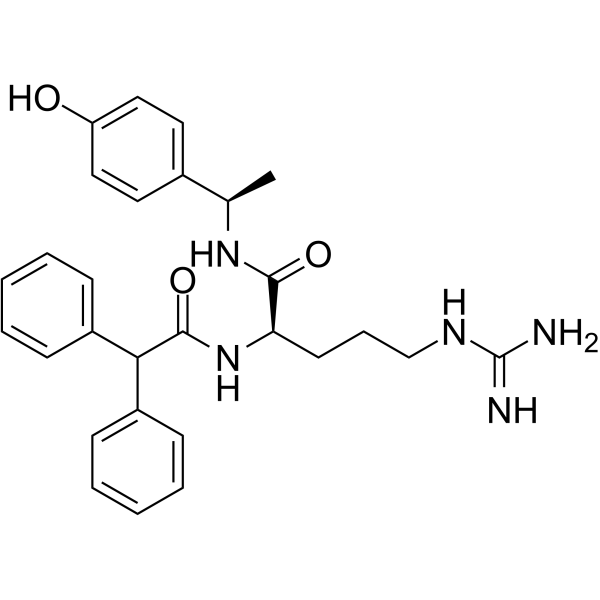
Physicochemical Properties
| Molecular Formula | C28H33N5O3 |
| Molecular Weight | 487.593326330185 |
| Exact Mass | 487.258 |
| CAS # | 221697-09-2 |
| PubChem CID | 5311439 |
| Appearance | White to off-white solid powder |
| LogP | 2.9 |
| Hydrogen Bond Donor Count | 5 |
| Hydrogen Bond Acceptor Count | 4 |
| Rotatable Bond Count | 11 |
| Heavy Atom Count | 36 |
| Complexity | 688 |
| Defined Atom Stereocenter Count | 2 |
| SMILES | O=C(N[C@@H](C(N[C@@H](C1=CC=C(O)C=C1)C)=O)CCCNC(N)=N)C(C2=CC=CC=C2)C3=CC=CC=C3 |
| InChi Key | AOUQZUZEYSDMEZ-NTKDMRAZSA-N |
| InChi Code | InChI=1S/C28H33N5O3/c1-19(20-14-16-23(34)17-15-20)32-26(35)24(13-8-18-31-28(29)30)33-27(36)25(21-9-4-2-5-10-21)22-11-6-3-7-12-22/h2-7,9-12,14-17,19,24-25,34H,8,13,18H2,1H3,(H,32,35)(H,33,36)(H4,29,30,31)/t19-,24-/m1/s1 |
| Chemical Name | (2R)-5-(diaminomethylideneamino)-2-[(2,2-diphenylacetyl)amino]-N-[(1R)-1-(4-hydroxyphenyl)ethyl]pentanamide |
| Synonyms | Y1 receptor antagonist 1; 221697-09-2; H-409/22; Ar-H040922 freebase; 7NCK567YKQ; (2R)-5-(diaminomethylideneamino)-2-[(2,2-diphenylacetyl)amino]-N-[(1R)-1-(4-hydroxyphenyl)ethyl]pentanamide; (2R)-2-((2,2-Diphenylacetyl)amino)-5-guanidino-N-((1R)-1-(4-hydroxyphenyl)ethyl)pentanamide; UNII-7NCK567YKQ; |
| HS Tariff Code | 2934.99.9001 |
| Storage |
Powder-20°C 3 years 4°C 2 years In solvent -80°C 6 months -20°C 1 month |
| Shipping Condition | Room temperature (This product is stable at ambient temperature for a few days during ordinary shipping and time spent in Customs) |
Biological Activity
| Targets | Neuropeptide Y1 receptor |
| ln Vitro |
Neuropeptide Y (NPY) is a potent vasoconstrictor released during sympathetic activation that may be involved in myocardial ischaemia. Researchers examined the effect of a Y1 receptor antagonist on haemodynamic and ischaemic responses to exercise in patients with coronary artery disease. [1] Plasma NPY levels increased during exercise both during AR-H040922 and placebo. The increase in plasma concentrations of NPY was significantly greater during exercise with AR-H040922, regardless of dose, than with placebo [1]. |
| ln Vivo | Eighty-two evaluable male patients were included in a randomized, double blind, two-way crossover study with a low dose (6.7 microg/kg/min; n=59)and a high dose (13.3 microg/kg/min; n=23) of the Y1 receptor antagonist AR-H040922 given as infusions for 2h or placebo. Myocardial ischaemia during a symptom-limited exercise test was monitored by conventional ST-segment analysis and heart rate (HR)-adjusted ST changes including the ST/HR slope and ST/HR recovery. Administration of the high dose AR-H040922 attenuated systolic blood pressure by 6-11 mmHg (p<0.05) during and after exercise without affecting HR. None of the two doses of AR-H040922 influenced any of the ischaemic parameters or duration of exercise, however. The maximal increase in NPY was higher during AR-H040922 (p<0.05) compared with placebo. Conclusions: Selective NPY Y1 receptor blockade attenuates the increase in blood pressure during exercise indicating a role for endogenous NPY in blood pressure regulation. Despite this effect, the Y1 receptor antagonist did not influence exercise-induced ischaemic parameters in patients with coronary artery disease [1]. |
| Cell Assay |
Blood sampling [1] Blood samples were drawn from an arm vein (contra-lateral to the arm in which the infusion was given) at rest before start of exercise, at 2 and 4min after start of exercise, at peak exercise, and after 4, 10 and 30min of recovery. Plasma was separated immediately and frozen at −70°C until analysed. NPY was assessed by radioimmunoassay.12The plasma concentration of AR-H040922 was measured by liquid chromatography with fluorescence detection.9The coefficients of intra-assay variation were 7.0% and 2.9% for NPY and AR-H040922, respectively. In addition routine biochemical analysis for safety reasons were performed at the pre-entry visit and at the follow-up visit 2–5 days after study day two. |
| Animal Protocol | The study was performed as a randomized, double blind, two-way crossover, and placebo-controlled study in two separate groups of patients. One group of patients (n=64) received a low dose of the NPY antagonist AR-H040922 at a dose rate of 6.7μg/kg/min or and placebo (NaCl) on two occasions. The other group (n=24) received a high dose of AR-H040922 at a rate of 13.3μg/kg/min and placebo. AR-H040922 and placebo were given as i.v. infusions for 120min. The washout period between the two occasions was at least 1 week. Exercise started 45min after start of the infusion. [1] |
| Toxicity/Toxicokinetics | Eleven patients reported some kind of side effects during the infusion. Three patients (one in the low dose group and two in the high dose group) developed hypotension during AR-H040922 requiring the infusions to be stopped. In one patient receiving the low dose, the infusion was stopped permanently in the recovery phase after exercise. In the other two patients the infusions were only stopped temporarily for 12 and 13min, respectively. Other side effects were of non-specific character and were equally distributed between active drug and placebo. [1] |
| References | [1]. The effect of a neuropeptide Y Y1 receptor antagonist in patients with angina pectoris. Eur Heart J. 2003 Jun;24(12):1120-7. |
| Additional Infomation |
A limitation of the present protocol is that AR-H040922 was administered as a single i.v. infusion. The rationale for this protocol was the fact that AR-H040922 has poor oral bioavailability and a short plasma half life. Despite this limitation, short term administration of the high dose AR-H040922 did result in a 7 mm Hg reduction of systolic blood pressure for up to 30min after end of exercise. It cannot be excluded, however, that prolonged and repeated administration of an orally active Y1 receptor antagonist may also have additional effects. It is not known whether ongoing medication may have interfered with the NPY receptor antagonist. The patients did not take their morning medication on the day of the exercise test. Thus, the plasma concentrations of concurrent medication are assumed to be low during the exercise tests. It has been described that metoprolol reduces the number and the affinity of NPY binding sites in vascular smooth muscle cells in hypertensive rats. It is not known, however, whether beta-blockers affect the binding of AR-H040922. The present study demonstrates that selective blockade of the Y1 receptor with high dose AR-H040922 significantly inhibits the increase in blood pressure during and after exercise, indicating a role for NPY in blood pressure regulation during and following sympathetic activation in patients with coronary artery disease. However, despite thiseffect AR-H040922 does not influence the degree of myocardial ischaemia during or after exercise. [1] |
Solubility Data
| Solubility (In Vitro) | May dissolve in DMSO (in most cases), if not, try other solvents such as H2O, Ethanol, or DMF with a minute amount of products to avoid loss of samples |
| Solubility (In Vivo) |
Note: Listed below are some common formulations that may be used to formulate products with low water solubility (e.g. < 1 mg/mL), you may test these formulations using a minute amount of products to avoid loss of samples. Injection Formulations (e.g. IP/IV/IM/SC) Injection Formulation 1: DMSO : Tween 80: Saline = 10 : 5 : 85 (i.e. 100 μL DMSO stock solution → 50 μL Tween 80 → 850 μL Saline) *Preparation of saline: Dissolve 0.9 g of sodium chloride in 100 mL ddH ₂ O to obtain a clear solution. Injection Formulation 2: DMSO : PEG300 :Tween 80 : Saline = 10 : 40 : 5 : 45 (i.e. 100 μL DMSO → 400 μLPEG300 → 50 μL Tween 80 → 450 μL Saline) Injection Formulation 3: DMSO : Corn oil = 10 : 90 (i.e. 100 μL DMSO → 900 μL Corn oil) Example: Take the Injection Formulation 3 (DMSO : Corn oil = 10 : 90) as an example, if 1 mL of 2.5 mg/mL working solution is to be prepared, you can take 100 μL 25 mg/mL DMSO stock solution and add to 900 μL corn oil, mix well to obtain a clear or suspension solution (2.5 mg/mL, ready for use in animals). Injection Formulation 4: DMSO : 20% SBE-β-CD in saline = 10 : 90 [i.e. 100 μL DMSO → 900 μL (20% SBE-β-CD in saline)] *Preparation of 20% SBE-β-CD in Saline (4°C,1 week): Dissolve 2 g SBE-β-CD in 10 mL saline to obtain a clear solution. Injection Formulation 5: 2-Hydroxypropyl-β-cyclodextrin : Saline = 50 : 50 (i.e. 500 μL 2-Hydroxypropyl-β-cyclodextrin → 500 μL Saline) Injection Formulation 6: DMSO : PEG300 : castor oil : Saline = 5 : 10 : 20 : 65 (i.e. 50 μL DMSO → 100 μLPEG300 → 200 μL castor oil → 650 μL Saline) Injection Formulation 7: Ethanol : Cremophor : Saline = 10: 10 : 80 (i.e. 100 μL Ethanol → 100 μL Cremophor → 800 μL Saline) Injection Formulation 8: Dissolve in Cremophor/Ethanol (50 : 50), then diluted by Saline Injection Formulation 9: EtOH : Corn oil = 10 : 90 (i.e. 100 μL EtOH → 900 μL Corn oil) Injection Formulation 10: EtOH : PEG300:Tween 80 : Saline = 10 : 40 : 5 : 45 (i.e. 100 μL EtOH → 400 μLPEG300 → 50 μL Tween 80 → 450 μL Saline) Oral Formulations Oral Formulation 1: Suspend in 0.5% CMC Na (carboxymethylcellulose sodium) Oral Formulation 2: Suspend in 0.5% Carboxymethyl cellulose Example: Take the Oral Formulation 1 (Suspend in 0.5% CMC Na) as an example, if 100 mL of 2.5 mg/mL working solution is to be prepared, you can first prepare 0.5% CMC Na solution by measuring 0.5 g CMC Na and dissolve it in 100 mL ddH2O to obtain a clear solution; then add 250 mg of the product to 100 mL 0.5% CMC Na solution, to make the suspension solution (2.5 mg/mL, ready for use in animals). Oral Formulation 3: Dissolved in PEG400 Oral Formulation 4: Suspend in 0.2% Carboxymethyl cellulose Oral Formulation 5: Dissolve in 0.25% Tween 80 and 0.5% Carboxymethyl cellulose Oral Formulation 6: Mixing with food powders Note: Please be aware that the above formulations are for reference only. InvivoChem strongly recommends customers to read literature methods/protocols carefully before determining which formulation you should use for in vivo studies, as different compounds have different solubility properties and have to be formulated differently. (Please use freshly prepared in vivo formulations for optimal results.) |
| Preparing Stock Solutions | 1 mg | 5 mg | 10 mg | |
| 1 mM | 2.0509 mL | 10.2545 mL | 20.5090 mL | |
| 5 mM | 0.4102 mL | 2.0509 mL | 4.1018 mL | |
| 10 mM | 0.2051 mL | 1.0255 mL | 2.0509 mL |