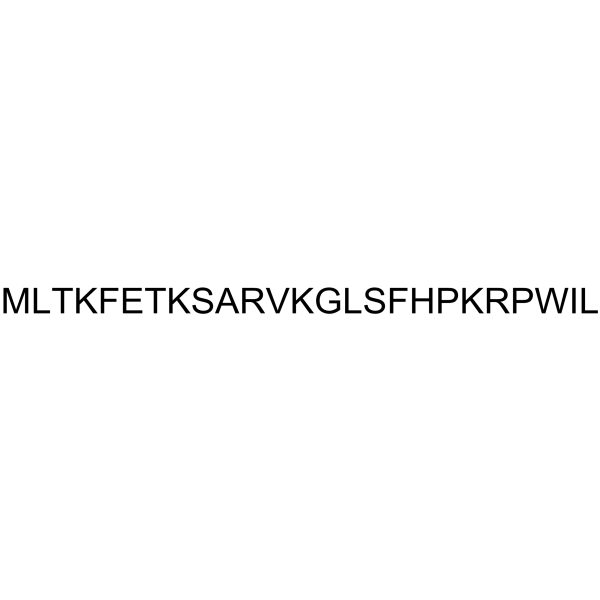
Physicochemical Properties
| Molecular Formula | C139H224N38O32S |
| Molecular Weight | 2971.56625999999 |
| Exact Mass | 2969.68 |
| CAS # | 144092-28-4 |
| PubChem CID | 16131039 |
| Appearance | White to off-white solid powder |
| LogP | 7.478 |
| Hydrogen Bond Donor Count | 41 |
| Hydrogen Bond Acceptor Count | 41 |
| Rotatable Bond Count | 100 |
| Heavy Atom Count | 210 |
| Complexity | 6510 |
| Defined Atom Stereocenter Count | 27 |
| SMILES | CC[C@H](C)[C@@H](C(=O)N[C@@H](CC(C)C)C(=O)O)NC(=O)[C@H](CC1=CNC2=CC=CC=C21)NC(=O)[C@@H]3CCCN3C(=O)[C@H](CCCNC(=N)N)NC(=O)[C@H](CCCCN)NC(=O)[C@@H]4CCCN4C(=O)[C@H](CC5=CN=CN5)NC(=O)[C@H](CC6=CC=CC=C6)NC(=O)[C@H](CO)NC(=O)[C@H](CC(C)C)NC(=O)CNC(=O)[C@H](CCCCN)NC(=O)[C@H](C(C)C)NC(=O)[C@H](CCCNC(=N)N)NC(=O)[C@H](C)NC(=O)[C@H](CO)NC(=O)[C@H](CCCCN)NC(=O)[C@H]([C@@H](C)O)NC(=O)[C@H](CCC(=O)O)NC(=O)[C@H](CC7=CC=CC=C7)NC(=O)[C@H](CCCCN)NC(=O)[C@H]([C@@H](C)O)NC(=O)[C@H](CC(C)C)NC(=O)[C@H](CCSC)N |
| InChi Key | IDHVLSACPFUBDY-QCDLPZBNSA-N |
| InChi Code | InChI=1S/C139H224N38O32S/c1-15-79(10)111(132(203)169-103(137(208)209)64-77(6)7)173-126(197)101(67-85-69-152-89-41-23-22-40-87(85)89)167-130(201)107-49-34-59-176(107)135(206)96(47-33-58-151-139(147)148)163-117(188)91(43-25-29-54-141)159-129(200)106-48-35-60-177(106)136(207)102(68-86-70-149-74-154-86)168-124(195)100(66-84-38-20-17-21-39-84)166-128(199)105(73-179)171-122(193)97(62-75(2)3)156-108(182)71-153-116(187)90(42-24-28-53-140)160-131(202)110(78(8)9)172-120(191)94(46-32-57-150-138(145)146)157-114(185)80(11)155-127(198)104(72-178)170-119(190)93(45-27-31-56-143)162-133(204)112(81(12)180)174-121(192)95(50-51-109(183)184)158-123(194)99(65-83-36-18-16-19-37-83)165-118(189)92(44-26-30-55-142)161-134(205)113(82(13)181)175-125(196)98(63-76(4)5)164-115(186)88(144)52-61-210-14/h16-23,36-41,69-70,74-82,88,90-107,110-113,152,178-181H,15,24-35,42-68,71-73,140-144H2,1-14H3,(H,149,154)(H,153,187)(H,155,198)(H,156,182)(H,157,185)(H,158,194)(H,159,200)(H,160,202)(H,161,205)(H,162,204)(H,163,188)(H,164,186)(H,165,189)(H,166,199)(H,167,201)(H,168,195)(H,169,203)(H,170,190)(H,171,193)(H,172,191)(H,173,197)(H,174,192)(H,175,196)(H,183,184)(H,208,209)(H4,145,146,150)(H4,147,148,151)/t79-,80-,81+,82+,88-,90-,91-,92-,93-,94-,95-,96-,97-,98-,99-,100-,101-,102-,103-,104-,105-,106-,107-,110-,111-,112-,113-/m0/s1 |
| Chemical Name | (2S)-2-[[(2S,3S)-2-[[(2S)-2-[[(2S)-1-[(2S)-2-[[(2S)-6-amino-2-[[(2S)-1-[(2S)-2-[[(2S)-2-[[(2S)-2-[[(2S)-2-[[2-[[(2S)-6-amino-2-[[(2S)-2-[[(2S)-2-[[(2S)-2-[[(2S)-2-[[(2S)-6-amino-2-[[(2S,3R)-2-[[(2S)-2-[[(2S)-2-[[(2S)-6-amino-2-[[(2S,3R)-2-[[(2S)-2-[[(2S)-2-amino-4-methylsulfanylbutanoyl]amino]-4-methylpentanoyl]amino]-3-hydroxybutanoyl]amino]hexanoyl]amino]-3-phenylpropanoyl]amino]-4-carboxybutanoyl]amino]-3-hydroxybutanoyl]amino]hexanoyl]amino]-3-hydroxypropanoyl]amino]propanoyl]amino]-5-carbamimidamidopentanoyl]amino]-3-methylbutanoyl]amino]hexanoyl]amino]acetyl]amino]-4-methylpentanoyl]amino]-3-hydroxypropanoyl]amino]-3-phenylpropanoyl]amino]-3-(1H-imidazol-5-yl)propanoyl]pyrrolidine-2-carbonyl]amino]hexanoyl]amino]-5-carbamimidamidopentanoyl]pyrrolidine-2-carbonyl]amino]-3-(1H-indol-3-yl)propanoyl]amino]-3-methylpentanoyl]amino]-4-methylpentanoic acid |
| HS Tariff Code | 2934.99.9001 |
| Storage |
Powder-20°C 3 years 4°C 2 years In solvent -80°C 6 months -20°C 1 month Note: Please store this product in a sealed and protected environment (e.g. under nitrogen), avoid exposure to moisture and light. |
| Shipping Condition | Room temperature (This product is stable at ambient temperature for a few days during ordinary shipping and time spent in Customs) |
Biological Activity
| ln Vitro | The mucosa of the stomach, duodenum, and jejunum express xenin in large amounts, but the pancreas expresses it at lesser quantities. Following a meal, xenin is released into the bloodstream, where it has been shown to impact gastrointestinal motility, suppress gastrin secretion, and increase pancreas endocrine and exocrine secretion. A strong homolog of neurotensin is xenin. There have been reports of comparable biological effects between neurotensin and xenin [1]. |
| ln Vivo | In wild-type mice, xenin administered intracerebroventricularly or intraperitoneally suppressed fasting-induced hyperphagia in a dose-dependent manner. In wild-type mice given an unlimited diet, Xenin administered intraperitoneally also decreased nighttime intake. When Xenin is injected intraperitoneally, Fos immunoreactivity is elevated in the paraventricular and arcuate nuclei of the hypothalamus. In agouti and ob/ob mice, xenin decreases food intake [2]. When Xenin-treated animals were compared to control mice treated with saline, the former's gastric emptying rates were almost 93% lower. Fos immunoreactive cells in the nucleus of the brainstem's solitary tract were markedly elevated by an intraperitoneal injection of Xenin, but not in the vagus nerve's posterior region or dorsal motor nucleus [3]. |
| References |
[1]. Peripheral and central administration of xenin and neurotensin suppress food intake in rodents. Obesity (Silver Spring). 2009 Jun;17(6):1135-43. [2]. Xenin, a gastrointestinal peptide, regulates feeding independent of the melanocortinsignaling pathway. Diabetes. 2009 Jan;58(1):87-94. [3]. Xenin delays gastric emptying rate and activates the brainstem in mice. Neurosci Lett. 2010 Aug 30;481(1):59-63. |
Solubility Data
| Solubility (In Vitro) | May dissolve in DMSO (in most cases), if not, try other solvents such as H2O, Ethanol, or DMF with a minute amount of products to avoid loss of samples |
| Solubility (In Vivo) |
Note: Listed below are some common formulations that may be used to formulate products with low water solubility (e.g. < 1 mg/mL), you may test these formulations using a minute amount of products to avoid loss of samples. Injection Formulations (e.g. IP/IV/IM/SC) Injection Formulation 1: DMSO : Tween 80: Saline = 10 : 5 : 85 (i.e. 100 μL DMSO stock solution → 50 μL Tween 80 → 850 μL Saline) *Preparation of saline: Dissolve 0.9 g of sodium chloride in 100 mL ddH ₂ O to obtain a clear solution. Injection Formulation 2: DMSO : PEG300 :Tween 80 : Saline = 10 : 40 : 5 : 45 (i.e. 100 μL DMSO → 400 μLPEG300 → 50 μL Tween 80 → 450 μL Saline) Injection Formulation 3: DMSO : Corn oil = 10 : 90 (i.e. 100 μL DMSO → 900 μL Corn oil) Example: Take the Injection Formulation 3 (DMSO : Corn oil = 10 : 90) as an example, if 1 mL of 2.5 mg/mL working solution is to be prepared, you can take 100 μL 25 mg/mL DMSO stock solution and add to 900 μL corn oil, mix well to obtain a clear or suspension solution (2.5 mg/mL, ready for use in animals). Injection Formulation 4: DMSO : 20% SBE-β-CD in saline = 10 : 90 [i.e. 100 μL DMSO → 900 μL (20% SBE-β-CD in saline)] *Preparation of 20% SBE-β-CD in Saline (4°C,1 week): Dissolve 2 g SBE-β-CD in 10 mL saline to obtain a clear solution. Injection Formulation 5: 2-Hydroxypropyl-β-cyclodextrin : Saline = 50 : 50 (i.e. 500 μL 2-Hydroxypropyl-β-cyclodextrin → 500 μL Saline) Injection Formulation 6: DMSO : PEG300 : castor oil : Saline = 5 : 10 : 20 : 65 (i.e. 50 μL DMSO → 100 μLPEG300 → 200 μL castor oil → 650 μL Saline) Injection Formulation 7: Ethanol : Cremophor : Saline = 10: 10 : 80 (i.e. 100 μL Ethanol → 100 μL Cremophor → 800 μL Saline) Injection Formulation 8: Dissolve in Cremophor/Ethanol (50 : 50), then diluted by Saline Injection Formulation 9: EtOH : Corn oil = 10 : 90 (i.e. 100 μL EtOH → 900 μL Corn oil) Injection Formulation 10: EtOH : PEG300:Tween 80 : Saline = 10 : 40 : 5 : 45 (i.e. 100 μL EtOH → 400 μLPEG300 → 50 μL Tween 80 → 450 μL Saline) Oral Formulations Oral Formulation 1: Suspend in 0.5% CMC Na (carboxymethylcellulose sodium) Oral Formulation 2: Suspend in 0.5% Carboxymethyl cellulose Example: Take the Oral Formulation 1 (Suspend in 0.5% CMC Na) as an example, if 100 mL of 2.5 mg/mL working solution is to be prepared, you can first prepare 0.5% CMC Na solution by measuring 0.5 g CMC Na and dissolve it in 100 mL ddH2O to obtain a clear solution; then add 250 mg of the product to 100 mL 0.5% CMC Na solution, to make the suspension solution (2.5 mg/mL, ready for use in animals). Oral Formulation 3: Dissolved in PEG400 Oral Formulation 4: Suspend in 0.2% Carboxymethyl cellulose Oral Formulation 5: Dissolve in 0.25% Tween 80 and 0.5% Carboxymethyl cellulose Oral Formulation 6: Mixing with food powders Note: Please be aware that the above formulations are for reference only. InvivoChem strongly recommends customers to read literature methods/protocols carefully before determining which formulation you should use for in vivo studies, as different compounds have different solubility properties and have to be formulated differently. (Please use freshly prepared in vivo formulations for optimal results.) |
| Preparing Stock Solutions | 1 mg | 5 mg | 10 mg | |
| 1 mM | 0.3365 mL | 1.6826 mL | 3.3652 mL | |
| 5 mM | 0.0673 mL | 0.3365 mL | 0.6730 mL | |
| 10 mM | 0.0337 mL | 0.1683 mL | 0.3365 mL |