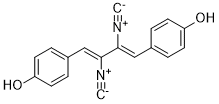
Xanthocillin (also known as xanthocillin X or ophthocillin) is a marine product isolated from Penicillium commune, it was reported to be able to induce autophagy through inhibition of the MEK/ERK pathway.
Physicochemical Properties
| Molecular Formula | C18H12N2O2 |
| Molecular Weight | 288.30008 |
| Exact Mass | 288.09 |
| CAS # | 580-74-5 |
| PubChem CID | 5378293 |
| Appearance | Typically exists as solid at room temperature |
| LogP | 2.779 |
| Hydrogen Bond Donor Count | 2 |
| Hydrogen Bond Acceptor Count | 4 |
| Rotatable Bond Count | 3 |
| Heavy Atom Count | 22 |
| Complexity | 480 |
| Defined Atom Stereocenter Count | 0 |
| SMILES | [C-]#[N+]C(=CC1=CC=C(C=C1)O)C(=CC2=CC=C(C=C2)O)[N+]#[C-] |
| InChi Key | YBMVKDUTYAGKEW-MJZABRMRSA-N |
| InChi Code | InChI=1S/C18H12N2O2/c1-19-17(11-13-3-7-15(21)8-4-13)18(20-2)12-14-5-9-16(22)10-6-14/h3-12,21-22H/b17-11-,18-12+ |
| Chemical Name | Ethylene isocyanide, bis(p-hydroxybenzylidene)- |
| Synonyms | NSC 179485; NSC 227183; BRN 3700094; NSC-179485; NSC-227183; BRN-3700094; NSC179485; NSC227183; BRN3700094. |
| HS Tariff Code | 2934.99.9001 |
| Storage |
Powder-20°C 3 years 4°C 2 years In solvent -80°C 6 months -20°C 1 month |
| Shipping Condition | Room temperature (This product is stable at ambient temperature for a few days during ordinary shipping and time spent in Customs) |
Biological Activity
| ln Vitro | Beclin 1 and LC3, two genes linked to autophagy, are expressed more when xantocilin (SD118-xanthocillin X (1)) (24.3 µM; 12-48 hours) is administered [1]. |
| Cell Assay |
Cell proliferation assay[1] Cell Types: HepG2 Cell Tested Concentrations: 6.9 µM, 13.89 µM, 27.78 µM, 55.56 µM Incubation Duration: 48 hrs (hours) Experimental Results: Concentration-dependent inhibition of cell growth of HepG2 cells, IC50 is 22.88 ± 4.76 µM . Western Blot Analysis[1] Cell Types: HepG2 Cell Tested Concentrations: 24.3 µM Incubation Duration: 12 hrs (hours), 24 hrs (hours), 48 hrs (hours) Experimental Results: Increased expression of autophagy-related genes LC3 and Beclin 1. |
| ADME/Pharmacokinetics |
Metabolism / Metabolites Cyanide is rapidly alsorbed through oral, inhalation, and dermal routes and distributed throughout the body. Cyanide is mainly metabolized into thiocyanate by either rhodanese or 3-mercaptopyruvate sulfur transferase. Cyanide metabolites are excreted in the urine. (L96) |
| Toxicity/Toxicokinetics |
Toxicity Summary Cyanide is an inhibitor of cytochrome c oxidase in the fourth complex of the electron transport chain (found in the membrane of the mitochondria of eukaryotic cells). It complexes with the ferric iron atom in this enzyme. The binding of cyanide to this cytochrome prevents transport of electrons from cytochrome c oxidase to oxygen. As a result, the electron transport chain is disrupted and the cell can no longer aerobically produce ATP for energy. Tissues that mainly depend on aerobic respiration, such as the central nervous system and the heart, are particularly affected. Cyanide is also known produce some of its toxic effects by binding to catalase, glutathione peroxidase, methemoglobin, hydroxocobalamin, phosphatase, tyrosinase, ascorbic acid oxidase, xanthine oxidase, succinic dehydrogenase, and Cu/Zn superoxide dismutase. Cyanide binds to the ferric ion of methemoglobin to form inactive cyanmethemoglobin. (L97) |
| References |
[1]. SD118-xanthocillin X (1), a novel marine agent extracted from Penicillium commune, induces autophagy through the inhibition of the MEK/ERK pathway. Mar Drugs. 2012 Jun;10(6):1345-59. |
| Additional Infomation |
Xantocillin has been reported in Penicillium italicum and Aspergillus cejpii with data available. Xantocillin is a chemical compound of cyanide. |
Solubility Data
| Solubility (In Vitro) | May dissolve in DMSO (in most cases), if not, try other solvents such as H2O, Ethanol, or DMF with a minute amount of products to avoid loss of samples |
| Solubility (In Vivo) |
Note: Listed below are some common formulations that may be used to formulate products with low water solubility (e.g. < 1 mg/mL), you may test these formulations using a minute amount of products to avoid loss of samples. Injection Formulations (e.g. IP/IV/IM/SC) Injection Formulation 1: DMSO : Tween 80: Saline = 10 : 5 : 85 (i.e. 100 μL DMSO stock solution → 50 μL Tween 80 → 850 μL Saline) *Preparation of saline: Dissolve 0.9 g of sodium chloride in 100 mL ddH ₂ O to obtain a clear solution. Injection Formulation 2: DMSO : PEG300 :Tween 80 : Saline = 10 : 40 : 5 : 45 (i.e. 100 μL DMSO → 400 μLPEG300 → 50 μL Tween 80 → 450 μL Saline) Injection Formulation 3: DMSO : Corn oil = 10 : 90 (i.e. 100 μL DMSO → 900 μL Corn oil) Example: Take the Injection Formulation 3 (DMSO : Corn oil = 10 : 90) as an example, if 1 mL of 2.5 mg/mL working solution is to be prepared, you can take 100 μL 25 mg/mL DMSO stock solution and add to 900 μL corn oil, mix well to obtain a clear or suspension solution (2.5 mg/mL, ready for use in animals). Injection Formulation 4: DMSO : 20% SBE-β-CD in saline = 10 : 90 [i.e. 100 μL DMSO → 900 μL (20% SBE-β-CD in saline)] *Preparation of 20% SBE-β-CD in Saline (4°C,1 week): Dissolve 2 g SBE-β-CD in 10 mL saline to obtain a clear solution. Injection Formulation 5: 2-Hydroxypropyl-β-cyclodextrin : Saline = 50 : 50 (i.e. 500 μL 2-Hydroxypropyl-β-cyclodextrin → 500 μL Saline) Injection Formulation 6: DMSO : PEG300 : castor oil : Saline = 5 : 10 : 20 : 65 (i.e. 50 μL DMSO → 100 μLPEG300 → 200 μL castor oil → 650 μL Saline) Injection Formulation 7: Ethanol : Cremophor : Saline = 10: 10 : 80 (i.e. 100 μL Ethanol → 100 μL Cremophor → 800 μL Saline) Injection Formulation 8: Dissolve in Cremophor/Ethanol (50 : 50), then diluted by Saline Injection Formulation 9: EtOH : Corn oil = 10 : 90 (i.e. 100 μL EtOH → 900 μL Corn oil) Injection Formulation 10: EtOH : PEG300:Tween 80 : Saline = 10 : 40 : 5 : 45 (i.e. 100 μL EtOH → 400 μLPEG300 → 50 μL Tween 80 → 450 μL Saline) Oral Formulations Oral Formulation 1: Suspend in 0.5% CMC Na (carboxymethylcellulose sodium) Oral Formulation 2: Suspend in 0.5% Carboxymethyl cellulose Example: Take the Oral Formulation 1 (Suspend in 0.5% CMC Na) as an example, if 100 mL of 2.5 mg/mL working solution is to be prepared, you can first prepare 0.5% CMC Na solution by measuring 0.5 g CMC Na and dissolve it in 100 mL ddH2O to obtain a clear solution; then add 250 mg of the product to 100 mL 0.5% CMC Na solution, to make the suspension solution (2.5 mg/mL, ready for use in animals). Oral Formulation 3: Dissolved in PEG400 Oral Formulation 4: Suspend in 0.2% Carboxymethyl cellulose Oral Formulation 5: Dissolve in 0.25% Tween 80 and 0.5% Carboxymethyl cellulose Oral Formulation 6: Mixing with food powders Note: Please be aware that the above formulations are for reference only. InvivoChem strongly recommends customers to read literature methods/protocols carefully before determining which formulation you should use for in vivo studies, as different compounds have different solubility properties and have to be formulated differently. (Please use freshly prepared in vivo formulations for optimal results.) |
| Preparing Stock Solutions | 1 mg | 5 mg | 10 mg | |
| 1 mM | 3.4686 mL | 17.3430 mL | 34.6861 mL | |
| 5 mM | 0.6937 mL | 3.4686 mL | 6.9372 mL | |
| 10 mM | 0.3469 mL | 1.7343 mL | 3.4686 mL |