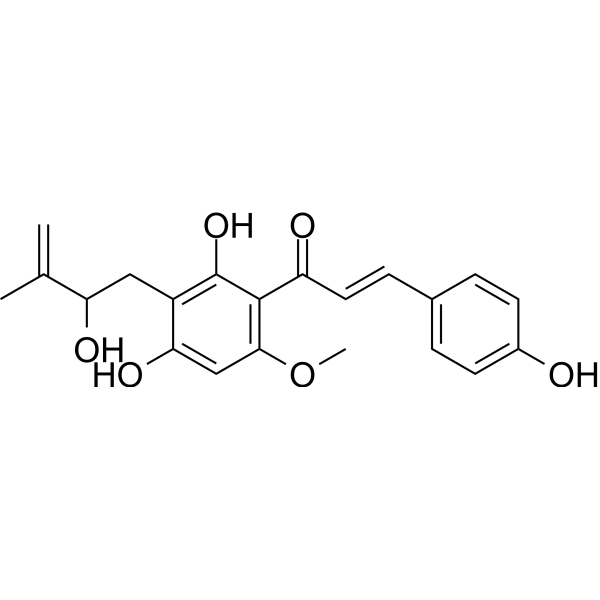
Physicochemical Properties
| Molecular Formula | C21H22O6 |
| Molecular Weight | 370.3958 |
| Exact Mass | 370.141 |
| CAS # | 274675-25-1 |
| PubChem CID | 10317069 |
| Appearance | Light yellow to green yellow solid powder |
| Density | 1.3±0.1 g/cm3 |
| Boiling Point | 624.2±55.0 °C at 760 mmHg |
| Flash Point | 220.9±25.0 °C |
| Vapour Pressure | 0.0±1.9 mmHg at 25°C |
| Index of Refraction | 1.652 |
| LogP | 3.54 |
| Hydrogen Bond Donor Count | 4 |
| Hydrogen Bond Acceptor Count | 6 |
| Rotatable Bond Count | 7 |
| Heavy Atom Count | 27 |
| Complexity | 537 |
| Defined Atom Stereocenter Count | 0 |
| SMILES | CC(=C)C(CC1=C(C(=C(C=C1O)OC)C(=O)/C=C/C2=CC=C(C=C2)O)O)O |
| InChi Key | IIWLGOCXDBSFCM-RMKNXTFCSA-N |
| InChi Code | InChI=1S/C21H22O6/c1-12(2)17(24)10-15-18(25)11-19(27-3)20(21(15)26)16(23)9-6-13-4-7-14(22)8-5-13/h4-9,11,17,22,24-26H,1,10H2,2-3H3/b9-6+ |
| Chemical Name | (E)-1-[2,4-dihydroxy-3-(2-hydroxy-3-methylbut-3-enyl)-6-methoxyphenyl]-3-(4-hydroxyphenyl)prop-2-en-1-one |
| HS Tariff Code | 2934.99.9001 |
| Storage |
Powder-20°C 3 years 4°C 2 years In solvent -80°C 6 months -20°C 1 month Note: This product requires protection from light (avoid light exposure) during transportation and storage. |
| Shipping Condition | Room temperature (This product is stable at ambient temperature for a few days during ordinary shipping and time spent in Customs) |
Biological Activity
| Targets |
- Quinone Reductase 2 (QR2) (IC50 = 5.2 ± 0.3 μM) [1] - Human cancer cell lines (A549: IC50 = 6.8 ± 0.5 μM; MCF-7: IC50 = 4.3 ± 0.4 μM; HepG2: IC50 = 7.1 ± 0.6 μM) [2] |
| ln Vitro |
- Xanthohumol D exhibited potent inhibitory activity against QR2. At concentrations of 2.5, 5, 10 μM, it inhibited QR2 enzyme activity by 32±3%, 58±4%, and 82±5%, respectively, with an IC50 of 5.2 ± 0.3 μM [1] - It showed dose-dependent antiproliferative activity against human cancer cells. For A549 (lung cancer), MCF-7 (breast cancer), and HepG2 (hepatocellular carcinoma) cells, the IC50 values were 6.8 ± 0.5 μM, 4.3 ± 0.4 μM, and 7.1 ± 0.6 μM, respectively (72-hour incubation) [2] - It induced early apoptosis in MCF-7 cells: 10 μM Xanthohumol D increased the apoptotic rate by 35±3% compared to the control group [2] |
| Enzyme Assay |
- QR2 inhibition assay by ultrafiltration LC-MS: Recombinant QR2 was dissolved in buffer and incubated with Xanthohumol D (0.1–20 μM) at 37°C for 1 hour. The mixture was ultrafiltered to remove unbound compounds, and the enzyme-bound fraction was analyzed by LC-MS to confirm binding. QR2 activity was measured using menadione as substrate, detecting the absorbance of reduced menadione at 340 nm to calculate inhibition efficiency and IC50 [1] |
| Cell Assay |
- Antiproliferation assay: Human cancer cells (A549, MCF-7, HepG2) were seeded in 96-well plates (5×10³ cells/well) and incubated overnight. Xanthohumol D (0.5–20 μM) was added, and cells were cultured for 72 hours. MTT reagent was added, and after 4 hours of incubation, the formazan crystals were dissolved. Absorbance was measured at 570 nm to calculate cell viability and IC50 values [2] - Apoptosis assay: MCF-7 cells were treated with Xanthohumol D (5, 10 μM) for 48 hours, stained with Annexin V-FITC and PI, and analyzed by flow cytometry to determine the early apoptotic rate [2] |
| References |
[1]. Screening natural products for inhibitors of quinone reductase-2 using ultrafiltration LC-MS. Anal Chem. 2011 Feb 1;83(3):1048-52. [2]. Fungal metabolites of xanthohumol with potent antiproliferative activity on human cancer cell lines in vitro. Bioorg Med Chem. 2013 Apr 1;21(7):2001-6. |
| Additional Infomation |
Xanthohumol D is a member of the class of chalcones that is trans-chalcone substituted by hydroxy groups at positions 4, 2' and 4', a methoxy group at position 6' and a 2-hydroxy-3-methylbut-3-en-1-yl group at position 3'. It has been isolated as a racemate from Humulus lupulus and has been shown to exhibit inhibitory activity against NO production. It has a role as a metabolite and an EC 1.14.13.39 (nitric oxide synthase) inhibitor. It is a member of chalcones, a polyphenol, an aromatic ether and a secondary alcohol. - Xanthohumol D is a fungal metabolite of xanthohumol, a natural flavonoid derived from Humulus lupulus (hops) [2] - Its biological activities include QR2 inhibition (potential role in regulating oxidative stress) and antiproliferation of cancer cells via inducing apoptosis [1][2] - It was identified as a QR2 inhibitor through ultrafiltration LC-MS-based high-throughput screening, showing high selectivity for QR2 over other reductases [1] |
Solubility Data
| Solubility (In Vitro) | DMSO : ~50 mg/mL (~134.99 mM) |
| Solubility (In Vivo) |
Note: Listed below are some common formulations that may be used to formulate products with low water solubility (e.g. < 1 mg/mL), you may test these formulations using a minute amount of products to avoid loss of samples. Injection Formulations (e.g. IP/IV/IM/SC) Injection Formulation 1: DMSO : Tween 80: Saline = 10 : 5 : 85 (i.e. 100 μL DMSO stock solution → 50 μL Tween 80 → 850 μL Saline) *Preparation of saline: Dissolve 0.9 g of sodium chloride in 100 mL ddH ₂ O to obtain a clear solution. Injection Formulation 2: DMSO : PEG300 :Tween 80 : Saline = 10 : 40 : 5 : 45 (i.e. 100 μL DMSO → 400 μLPEG300 → 50 μL Tween 80 → 450 μL Saline) Injection Formulation 3: DMSO : Corn oil = 10 : 90 (i.e. 100 μL DMSO → 900 μL Corn oil) Example: Take the Injection Formulation 3 (DMSO : Corn oil = 10 : 90) as an example, if 1 mL of 2.5 mg/mL working solution is to be prepared, you can take 100 μL 25 mg/mL DMSO stock solution and add to 900 μL corn oil, mix well to obtain a clear or suspension solution (2.5 mg/mL, ready for use in animals). Injection Formulation 4: DMSO : 20% SBE-β-CD in saline = 10 : 90 [i.e. 100 μL DMSO → 900 μL (20% SBE-β-CD in saline)] *Preparation of 20% SBE-β-CD in Saline (4°C,1 week): Dissolve 2 g SBE-β-CD in 10 mL saline to obtain a clear solution. Injection Formulation 5: 2-Hydroxypropyl-β-cyclodextrin : Saline = 50 : 50 (i.e. 500 μL 2-Hydroxypropyl-β-cyclodextrin → 500 μL Saline) Injection Formulation 6: DMSO : PEG300 : castor oil : Saline = 5 : 10 : 20 : 65 (i.e. 50 μL DMSO → 100 μLPEG300 → 200 μL castor oil → 650 μL Saline) Injection Formulation 7: Ethanol : Cremophor : Saline = 10: 10 : 80 (i.e. 100 μL Ethanol → 100 μL Cremophor → 800 μL Saline) Injection Formulation 8: Dissolve in Cremophor/Ethanol (50 : 50), then diluted by Saline Injection Formulation 9: EtOH : Corn oil = 10 : 90 (i.e. 100 μL EtOH → 900 μL Corn oil) Injection Formulation 10: EtOH : PEG300:Tween 80 : Saline = 10 : 40 : 5 : 45 (i.e. 100 μL EtOH → 400 μLPEG300 → 50 μL Tween 80 → 450 μL Saline) Oral Formulations Oral Formulation 1: Suspend in 0.5% CMC Na (carboxymethylcellulose sodium) Oral Formulation 2: Suspend in 0.5% Carboxymethyl cellulose Example: Take the Oral Formulation 1 (Suspend in 0.5% CMC Na) as an example, if 100 mL of 2.5 mg/mL working solution is to be prepared, you can first prepare 0.5% CMC Na solution by measuring 0.5 g CMC Na and dissolve it in 100 mL ddH2O to obtain a clear solution; then add 250 mg of the product to 100 mL 0.5% CMC Na solution, to make the suspension solution (2.5 mg/mL, ready for use in animals). Oral Formulation 3: Dissolved in PEG400 Oral Formulation 4: Suspend in 0.2% Carboxymethyl cellulose Oral Formulation 5: Dissolve in 0.25% Tween 80 and 0.5% Carboxymethyl cellulose Oral Formulation 6: Mixing with food powders Note: Please be aware that the above formulations are for reference only. InvivoChem strongly recommends customers to read literature methods/protocols carefully before determining which formulation you should use for in vivo studies, as different compounds have different solubility properties and have to be formulated differently. (Please use freshly prepared in vivo formulations for optimal results.) |
| Preparing Stock Solutions | 1 mg | 5 mg | 10 mg | |
| 1 mM | 2.6998 mL | 13.4989 mL | 26.9978 mL | |
| 5 mM | 0.5400 mL | 2.6998 mL | 5.3996 mL | |
| 10 mM | 0.2700 mL | 1.3499 mL | 2.6998 mL |