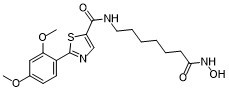
XP-5 is a selective HDAC6 inhibitor with potential anticancer and immunomodulatory activity. Compound XP5 was the most potent HDAC6 inhibitor with an IC50 of 31 nM and excellent HDAC6 selectivity (SI = 338 for HDAC6 over HDAC3). XP5 also displayed high antiproliferative activity against various cancer cell lines including the HDACi-resistant YCC3/7 gastric cancer cells (IC50 = 0.16-2.31 μM), better than CAY10603. Further, XP5 (50 mg/kg) exhibited significant antitumor efficacy in a melanoma tumor model with a tumor growth inhibition (TGI) of 63% without apparent toxicity. Moreover, XP5 efficiently enhanced the in vivo antitumor immune response when combined with a small-molecule PD-L1 inhibitor, as demonstrated by the increased tumor-infiltrating lymphocytes and reduced PD-L1 expression levels. Taken together, the above results suggest that XP5 is a promising HDAC6 inhibitor deserving further investigation.
Physicochemical Properties
| CAS # | 2760511-91-7 |
| Appearance | Typically exists as solid at room temperature |
| HS Tariff Code | 2934.99.9001 |
| Storage |
Powder-20°C 3 years 4°C 2 years In solvent -80°C 6 months -20°C 1 month |
| Shipping Condition | Room temperature (This product is stable at ambient temperature for a few days during ordinary shipping and time spent in Customs) |
Biological Activity
| Targets | Tubulin |
| ln Vitro | A series of 2-phenylthiazole analogues were designed and synthesized as potential histone deacetylase 6 (HDAC6) inhibitors based on compound 12c (an HDAC6/tubulin dual inhibitor discovered by us recently) and CAY10603 (a known HDAC6 inhibitor). Among them, compound XP5 was the most potent HDAC6 inhibitor with an IC50 of 31 nM and excellent HDAC6 selectivity (SI = 338 for HDAC6 over HDAC3). XP5 also displayed high antiproliferative activity against various cancer cell lines including the HDACi-resistant YCC3/7 gastric cancer cells (IC50 = 0.16-2.31 μM), better than CAY10603. |
| ln Vivo | XP5 (50 mg/kg) exhibited significant antitumor efficacy in a melanoma tumor model with a tumor growth inhibition (TGI) of 63% without apparent toxicity. Moreover, XP5 efficiently enhanced the in vivo antitumor immune response when combined with a small-molecule PD-L1 inhibitor, as demonstrated by the increased tumor-infiltrating lymphocytes and reduced PD-L1 expression levels. Taken together, the above results suggest that XP5 is a promising HDAC6 inhibitor deserving further investigation. |
| References |
[1]. Discovery of Novel Histone Deacetylase 6 (HDAC6) Inhibitors with Enhanced Antitumor Immunity of Anti-PD-L1 Immunotherapy in Melanoma. J Med Chem. 2022;65(3):2434-2457. |
Solubility Data
| Solubility (In Vitro) | May dissolve in DMSO (in most cases), if not, try other solvents such as H2O, Ethanol, or DMF with a minute amount of products to avoid loss of samples |
| Solubility (In Vivo) |
Note: Listed below are some common formulations that may be used to formulate products with low water solubility (e.g. < 1 mg/mL), you may test these formulations using a minute amount of products to avoid loss of samples. Injection Formulations (e.g. IP/IV/IM/SC) Injection Formulation 1: DMSO : Tween 80: Saline = 10 : 5 : 85 (i.e. 100 μL DMSO stock solution → 50 μL Tween 80 → 850 μL Saline) *Preparation of saline: Dissolve 0.9 g of sodium chloride in 100 mL ddH ₂ O to obtain a clear solution. Injection Formulation 2: DMSO : PEG300 :Tween 80 : Saline = 10 : 40 : 5 : 45 (i.e. 100 μL DMSO → 400 μLPEG300 → 50 μL Tween 80 → 450 μL Saline) Injection Formulation 3: DMSO : Corn oil = 10 : 90 (i.e. 100 μL DMSO → 900 μL Corn oil) Example: Take the Injection Formulation 3 (DMSO : Corn oil = 10 : 90) as an example, if 1 mL of 2.5 mg/mL working solution is to be prepared, you can take 100 μL 25 mg/mL DMSO stock solution and add to 900 μL corn oil, mix well to obtain a clear or suspension solution (2.5 mg/mL, ready for use in animals). Injection Formulation 4: DMSO : 20% SBE-β-CD in saline = 10 : 90 [i.e. 100 μL DMSO → 900 μL (20% SBE-β-CD in saline)] *Preparation of 20% SBE-β-CD in Saline (4°C,1 week): Dissolve 2 g SBE-β-CD in 10 mL saline to obtain a clear solution. Injection Formulation 5: 2-Hydroxypropyl-β-cyclodextrin : Saline = 50 : 50 (i.e. 500 μL 2-Hydroxypropyl-β-cyclodextrin → 500 μL Saline) Injection Formulation 6: DMSO : PEG300 : castor oil : Saline = 5 : 10 : 20 : 65 (i.e. 50 μL DMSO → 100 μLPEG300 → 200 μL castor oil → 650 μL Saline) Injection Formulation 7: Ethanol : Cremophor : Saline = 10: 10 : 80 (i.e. 100 μL Ethanol → 100 μL Cremophor → 800 μL Saline) Injection Formulation 8: Dissolve in Cremophor/Ethanol (50 : 50), then diluted by Saline Injection Formulation 9: EtOH : Corn oil = 10 : 90 (i.e. 100 μL EtOH → 900 μL Corn oil) Injection Formulation 10: EtOH : PEG300:Tween 80 : Saline = 10 : 40 : 5 : 45 (i.e. 100 μL EtOH → 400 μLPEG300 → 50 μL Tween 80 → 450 μL Saline) Oral Formulations Oral Formulation 1: Suspend in 0.5% CMC Na (carboxymethylcellulose sodium) Oral Formulation 2: Suspend in 0.5% Carboxymethyl cellulose Example: Take the Oral Formulation 1 (Suspend in 0.5% CMC Na) as an example, if 100 mL of 2.5 mg/mL working solution is to be prepared, you can first prepare 0.5% CMC Na solution by measuring 0.5 g CMC Na and dissolve it in 100 mL ddH2O to obtain a clear solution; then add 250 mg of the product to 100 mL 0.5% CMC Na solution, to make the suspension solution (2.5 mg/mL, ready for use in animals). Oral Formulation 3: Dissolved in PEG400 Oral Formulation 4: Suspend in 0.2% Carboxymethyl cellulose Oral Formulation 5: Dissolve in 0.25% Tween 80 and 0.5% Carboxymethyl cellulose Oral Formulation 6: Mixing with food powders Note: Please be aware that the above formulations are for reference only. InvivoChem strongly recommends customers to read literature methods/protocols carefully before determining which formulation you should use for in vivo studies, as different compounds have different solubility properties and have to be formulated differently. (Please use freshly prepared in vivo formulations for optimal results.) |