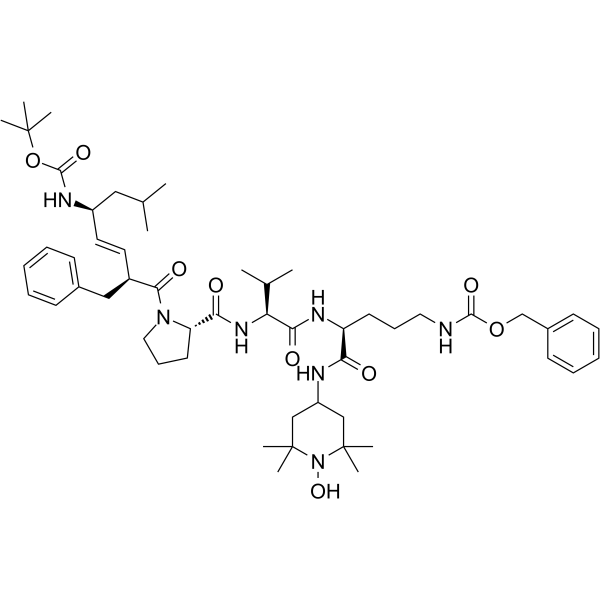
Physicochemical Properties
| Molecular Formula | C53H80N7O9 |
| Molecular Weight | 959.24 |
| Exact Mass | 959.609 |
| CAS # | 866404-31-1 |
| PubChem CID | 89059932 |
| Appearance | White to off-white solid powder |
| LogP | 7.8 |
| Hydrogen Bond Donor Count | 6 |
| Hydrogen Bond Acceptor Count | 10 |
| Rotatable Bond Count | 24 |
| Heavy Atom Count | 69 |
| Complexity | 1700 |
| Defined Atom Stereocenter Count | 5 |
| SMILES | C1CC[C@@H](C(=O)N[C@H](C(N[C@@H](CCCNC(=O)OCC2=CC=CC=C2)C(NC2CC(C)(C)N([O-])C(C2)(C)C)=O)=O)C(C)C)N1C(=O)[C@H](/C=C/[C@H](CC(C)C)NC(=O)OC(C)(C)C)CC1C=CC=CC=1 |
| InChi Key | VTYPGEHUYSBZTQ-VQPCLXHQSA-N |
| InChi Code | InChI=1S/C53H81N7O9/c1-35(2)30-40(56-50(66)69-51(5,6)7)27-26-39(31-37-20-14-12-15-21-37)48(64)59-29-19-25-43(59)46(62)58-44(36(3)4)47(63)57-42(24-18-28-54-49(65)68-34-38-22-16-13-17-23-38)45(61)55-41-32-52(8,9)60(67)53(10,11)33-41/h12-17,20-23,26-27,35-36,39-44,67H,18-19,24-25,28-34H2,1-11H3,(H,54,65)(H,55,61)(H,56,66)(H,57,63)(H,58,62)/b27-26+/t39-,40-,42+,43+,44+/m1/s1 |
| Chemical Name | tert-butyl N-[(E,4S,7S)-7-benzyl-8-[(2S)-2-[[(2S)-1-[[(2S)-1-[(1-hydroxy-2,2,6,6-tetramethylpiperidin-4-yl)amino]-1-oxo-5-(phenylmethoxycarbonylamino)pentan-2-yl]amino]-3-methyl-1-oxobutan-2-yl]carbamoyl]pyrrolidin-1-yl]-2-methyl-8-oxooct-5-en-4-yl]carbamate |
| HS Tariff Code | 2934.99.9001 |
| Storage |
Powder-20°C 3 years 4°C 2 years In solvent -80°C 6 months -20°C 1 month |
| Shipping Condition | Room temperature (This product is stable at ambient temperature for a few days during ordinary shipping and time spent in Customs) |
Biological Activity
| ln Vitro | Additionally, XJB-5-131 enhances the activation of caspases 3 and 7, two proapoptotic enzymes, in the ileal mucosa when hemorrhagic shock (HS) is applied [1]. In vitro, XJB-5-131 enhances cell survival and decreases apoptosis in mouse embryonic cells [2]. A radioprotectant for colony-forming units granulocyte macrophages (CFU-GM) is XJB-5-131. When applied after radiation, XJB-5-131 functions as an efficient moderator [3]. |
| ln Vivo | In rats suffering from hemorrhagic shock (HS), XJB-5-131 enhances the peroxidation of cardiolipin and mitochondrial phospholipids in ileal mucosal samples[1]. Even though only a little amount of crystalloid solution (2.8 mL/kg) and no blood transfusion were given, rats with severe blood loss had a much longer survival rate (33.5 mL/kg) after receiving an intravenous injection of XJB-5-131 (2 μMol/kg)[1]. XJB-5-131 promotes mitochondrial function, prevents weight loss and oxidative damage to mitochondrial DNA, preserves the number of copies of mitochondrial DNA, increases neuronal survival, and improves exercise capacity. In a mouse model of Huntington's disease (HD), XJB-5-131 dramatically suppresses the disease phenotype and enhances mitochondrial function[2]. In HD mice models, XJB-5-131 (1 mg/kg; intraperitoneal injection; three times per week for up to 57 weeks) prevents weight loss and the deterioration of motor function[2]. |
| Cell Assay |
Cell Viability Assay[3] Cell Types: Low density mononuclear cells (MNC) Tested Concentrations: 10 μM Incubation Duration:Added to cells one hour before irradiation or immediately after irradiation Experimental Results: Was a protector when given before irradiation as shown by an increase in the D0 to 1.93±0.13 for CFU-GM with XJB-5-131. |
| Animal Protocol |
Animal/Disease Models: Male specific pathogen-free SD (Sprague-Dawley) rats, weighing 150 to 250 g[1] Doses: 2 μmol/kg Route of Administration: Administered intravenously (iv) using a syringe pump Experimental Results: The rats treated with XJB-5-131 survived Dramatically longer ( P < 0.01). Three of six survived for longer than 3 hrs (hours) after completion of the hemorrhage protocol and one rat survived for the whole 6 hrs (hours) postbleeding observation period. Animal/Disease Models: HD150KI mice[2] Doses: 1 mg/kg Route of Administration: intraperitoneally (ip) injected; three times a week up to 57 weeks Experimental Results: Chronic treatment suppressed weight loss. Increased the average body mass by 22%. |
| References |
[1]. Treatment with a novel hemigramicidin-TEMPO conjugate prolongs survival in a rat model of lethal hemorrhagic shock. Ann Surg. 2007 Feb;245(2):305-14. [2]. Targeting of XJB-5-131 to mitochondria suppresses oxidative DNA damage and motor decline in a mouse model of Huntington's disease. Cell Rep. 2012 Nov 29;2(5):1137-42. [3]. Evaluation of potential ionizing irradiation protectors and mitigators using clonogenic survival of human umbilical cord blood hematopoietic progenitor cells. Exp Hematol. 2013 Nov;41(11):957-66. |
| Additional Infomation | See also: Xjb-5-131 (annotation moved to). |
Solubility Data
| Solubility (In Vitro) | DMSO: 125 mg/mL (130.17 mM) |
| Solubility (In Vivo) |
Solubility in Formulation 1: ≥ 2.08 mg/mL (2.17 mM) (saturation unknown) in 10% DMSO + 40% PEG300 + 5% Tween80 + 45% Saline (add these co-solvents sequentially from left to right, and one by one), clear solution. For example, if 1 mL of working solution is to be prepared, you can add 100 μL of 20.8 mg/mL clear DMSO stock solution to 400 μL PEG300 and mix evenly; then add 50 μL Tween-80 to the above solution and mix evenly; then add 450 μL normal saline to adjust the volume to 1 mL. Preparation of saline: Dissolve 0.9 g of sodium chloride in 100 mL ddH₂ O to obtain a clear solution. Solubility in Formulation 2: ≥ 2.08 mg/mL (2.17 mM) (saturation unknown) in 10% DMSO + 90% Corn Oil (add these co-solvents sequentially from left to right, and one by one), clear solution. For example, if 1 mL of working solution is to be prepared, you can add 100 μL of 20.8 mg/mL clear DMSO stock solution to 900 μL of corn oil and mix evenly. (Please use freshly prepared in vivo formulations for optimal results.) |
| Preparing Stock Solutions | 1 mg | 5 mg | 10 mg | |
| 1 mM | 1.0425 mL | 5.2125 mL | 10.4249 mL | |
| 5 mM | 0.2085 mL | 1.0425 mL | 2.0850 mL | |
| 10 mM | 0.1042 mL | 0.5212 mL | 1.0425 mL |