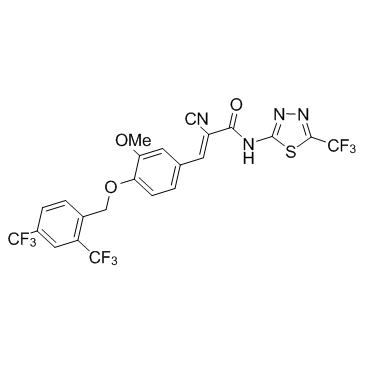
XCT790 is a selective ERRα antagonist/inverse agonist (IC50 = ~400 nM). At concentrations below 10 μM, XCT790 does not demonstrate any antagonist activity at ERRγ or ERα. It disrupts the signaling that is dependent on the PPARγ coactivator-1α (PGC-1α) and Errα.
Physicochemical Properties
| Molecular Formula | C23H13F9N4O3S |
| Molecular Weight | 596.43 |
| Exact Mass | 596.056 |
| Elemental Analysis | C, 46.32; H, 2.20; F, 28.67; N, 9.39; O, 8.05; S, 5.38 |
| CAS # | 725247-18-7 |
| Related CAS # | 725247-18-7 |
| PubChem CID | 6918788 |
| Appearance | Light yellow to yellow solid powder |
| Density | 1.544g/cm3 |
| Index of Refraction | 1.55 |
| LogP | 6.8 |
| Hydrogen Bond Donor Count | 1 |
| Hydrogen Bond Acceptor Count | 16 |
| Rotatable Bond Count | 7 |
| Heavy Atom Count | 40 |
| Complexity | 966 |
| Defined Atom Stereocenter Count | 0 |
| SMILES | O=C(NC1=NN=C(C(F)(F)F)S1)/C(C#N)=C/C2=CC=C(OCC3=C(C(F)(F)F)C=C(C(F)(F)F)C=C3)C(OC)=C2 |
| InChi Key | HQFNFOOGGLSBBT-AWNIVKPZSA-N |
| InChi Code | InChI=1S/C23H13F9N4O3S/c1-38-17-7-11(6-13(9-33)18(37)34-20-36-35-19(40-20)23(30,31)32)2-5-16(17)39-10-12-3-4-14(21(24,25)26)8-15(12)22(27,28)29/h2-8H,10H2,1H3,(H,34,36,37)/b13-6+ |
| Chemical Name | (E)-3-[4-[[2,4-bis(trifluoromethyl)phenyl]methoxy]-3-methoxyphenyl]-2-cyano-N-[5-(trifluoromethyl)-1,3,4-thiadiazol-2-yl]prop-2-enamide |
| Synonyms | XCT790; XCT-790; XCT 790 |
| HS Tariff Code | 2934.99.9001 |
| Storage |
Powder-20°C 3 years 4°C 2 years In solvent -80°C 6 months -20°C 1 month |
| Shipping Condition | Room temperature (This product is stable at ambient temperature for a few days during ordinary shipping and time spent in Customs) |
Biological Activity
| Targets | ERα (IC50 = 0.37 μM) |
| ln Vitro |
XCT-790 (0-40 μM; 48 hours and 72 hours) has a dose-dependent effect on MES-SA, MES-SA/DX5, and HepG2 cell viability[1]. XCT-790 (10 μM; 24 hours and 48 hours) reduces the the ERRα protein levels in HepG2 and R-HepG2 cell lines within 24 hours and keeps them there for 48 hours[1]. XCT-790 (10 μM; 48 hours) provokes apoptosis in both cell lines, HepG2 being more sensitive than R-HepG2[1]. |
| ln Vivo | XCT-790 (XCT790; 4 mg/kg; intravenous injection; every three days; for 3 weeks; BALB/c mice) induces apoptosis in xenograft models without causing a decrease in body weight and significantly inhibits tumor growth and angiogenesis[3]. |
| Animal Protocol |
Female BALB/c mice (4 weeks of age) with HEC-1A xenograft[3] 4 mg/kg Intravenous injection; every three days; for 3 weeks |
| References |
[1]. Estrogen-related receptor alpha (ERRalpha) inverse agonist XCT-790 induces cell death in chemotherapeutic resistant cancer cells. Chem Biol Interact. 2009 Oct 7;181(2):236-42. [2]. Antitumor effect of XCT790, an ERRα inverse agonist, on ERα-negative endometrial cancer cells. Cell Oncol (Dordr). 2019 Apr;42(2):223-235. [3]. Identification of a selective inverse agonist for the orphan nuclear receptor estrogen-related receptor alpha. J Med Chem. 2004 Nov 4;47(23):5593-6. |
| Additional Infomation | XCT 790 is a member of cinnamamides. |
Solubility Data
| Solubility (In Vitro) | DMSO: 8~16.7 mg/mL (13.4~28 mM) |
| Solubility (In Vivo) |
Solubility in Formulation 1: 1.67 mg/mL (2.80 mM) in 10% DMSO + 40% PEG300 +5% Tween-80 + 45% Saline (add these co-solvents sequentially from left to right, and one by one), suspension solution; with sonication. For example, if 1 mL of working solution is to be prepared, you can add 100 μL of 16.7 mg/mL clear DMSO stock solution to 400 μL PEG300 and mix evenly; then add 50 μL Tween-80 + to the above solution and mix evenly; then add 450 μL normal saline to adjust the volume to 1 mL. Preparation of saline: Dissolve 0.9 g of sodium chloride in 100 mL ddH₂ O to obtain a clear solution. (Please use freshly prepared in vivo formulations for optimal results.) |
| Preparing Stock Solutions | 1 mg | 5 mg | 10 mg | |
| 1 mM | 1.6766 mL | 8.3832 mL | 16.7664 mL | |
| 5 mM | 0.3353 mL | 1.6766 mL | 3.3533 mL | |
| 10 mM | 0.1677 mL | 0.8383 mL | 1.6766 mL |