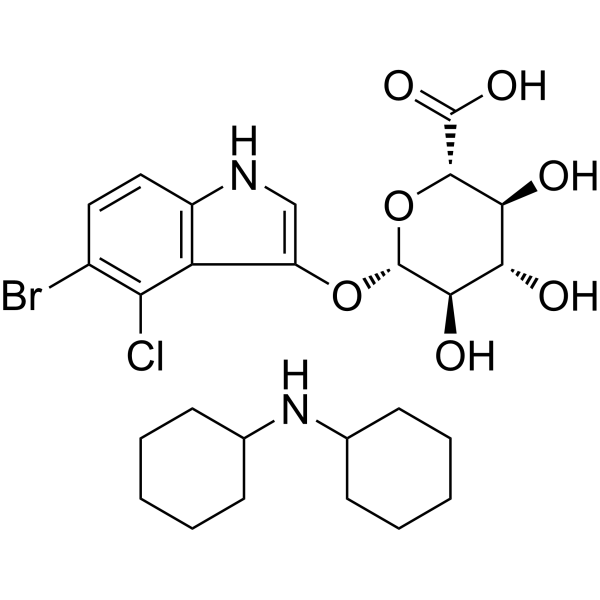
Physicochemical Properties
| Molecular Formula | C14H14NO7BR.C6H13N |
| Molecular Weight | 487.34158 |
| CAS # | 18656-96-7 |
| Related CAS # | X-Gluc cyclohexanamine;114162-64-0;X-Gluc sodium;129541-41-9 |
| Appearance | White to off-white solid powder |
| Boiling Point | 736.7ºC at 760mmHg |
| Melting Point | 249 °C |
| Flash Point | 399.3ºC |
| Vapour Pressure | 8.69E-23mmHg at 25°C |
| LogP | 0.081 |
| HS Tariff Code | 2934.99.9001 |
| Storage |
Powder-20°C 3 years 4°C 2 years In solvent -80°C 6 months -20°C 1 month Note: Please store this product in a sealed and protected environment (e.g. under nitrogen), avoid exposure to moisture and light. |
| Shipping Condition | Room temperature (This product is stable at ambient temperature for a few days during ordinary shipping and time spent in Customs) |
Biological Activity
| ln Vitro |
Advice (This is our suggested protocol, which should be adjusted to suit your particular circumstances as it simply offers guidance). 1. 20 mg of X-Gluc dicyclohexylamine should be dissolved in 1 mL of dimethylformamide (DMF) to create the X-Gluc master mix. 2. Fill the agar medium plate with the prepared X-Gluc solution. 50 μg/mL is the final concentration. Sterilization is not necessary. 3. When using plates for organism inoculation, let them air dry. 4. After inoculation, incubate the plate for 16–24 hours at 35°C. X-GLUC was evaluated as a chromogenic substrate for detecting β-glucuronidase activity, which is a marker for Escherichia coli. When incorporated at a concentration of 50 μg/mL into Peptone-Tergitol Agar (PTA) medium, it allowed for the direct enumeration of E. coli colonies after 24 hours of incubation at 35°C. β-Glucuronidase-positive E. coli colonies hydrolyze X-GLUC to produce an insoluble blue precipitate (indigo derivative), localizing the color within the colony. In recovery tests using artificially inoculated raw minced chicken, the enumeration of two E. coli strains on PTX agar (containing X-GLUC) was comparable to that on PTG agar (containing the fluorogenic substrate MUG) and to counts on non-selective Plate Count Agar. The substrate showed no discernible inhibitory effect on colony size or number at the tested concentration. However, X-GLUC was found to be unsuitable as an indicator in liquid broth media (e.g., Lauryl Sulfate Broth) due to insufficient color development within 24 hours. [1] |
| References |
[1]. Evaluation of the β-Glucuronidase Substrate 5-Bromo-4-Chloro-3-Indolyl-β-D-Glucuronide (X-GLUC) in a 24-Hour Direct Plating Method for Escherichia coli. J Food Prot. 1988 May;51(5):402-404. |
| Additional Infomation |
5-Bromo-4-chloro-3-indolyl-β-D-glucuronide (X-GLUC) is a chromogenic substrate used to detect the enzyme β-glucuronidase. In this study, it was evaluated as a potential replacement for the fluorogenic substrate 4-methylumbelliferyl-β-D-glucuronide (MUG) in a 24-hour direct plating method for Escherichia coli. The principal advantages of X-GLUC over MUG are: (a) colony enumeration does not require ultraviolet light illumination, and (b) the blue color reaction remains localized to positive colonies, avoiding the diffusion of fluorescence that can complicate colony differentiation with MUG. A major disadvantage is its high cost (approximately 25 times the cost of MUG), limiting its practicality for routine use in plating media. The substrate is prepared by dissolving in dimethylformamide (DMF) before adding to tempered agar. The study concludes that X-GLUC at 50 μg/mL in an agar medium is as effective as MUG for recovering E. coli from artificially inoculated food samples under the tested conditions. [1] |
Solubility Data
| Solubility (In Vitro) | DMSO : ≥ 30 mg/mL (~49.67 mM) |
| Solubility (In Vivo) |
Solubility in Formulation 1: ≥ 2.5 mg/mL (4.14 mM) (saturation unknown) in 10% DMSO + 40% PEG300 + 5% Tween80 + 45% Saline (add these co-solvents sequentially from left to right, and one by one), clear solution. For example, if 1 mL of working solution is to be prepared, you can add 100 μL of 25.0 mg/mL clear DMSO stock solution to 400 μL PEG300 and mix evenly; then add 50 μL Tween-80 to the above solution and mix evenly; then add 450 μL normal saline to adjust the volume to 1 mL. Preparation of saline: Dissolve 0.9 g of sodium chloride in 100 mL ddH₂ O to obtain a clear solution. Solubility in Formulation 2: ≥ 2.5 mg/mL (4.14 mM) (saturation unknown) in 10% DMSO + 90% (20% SBE-β-CD in Saline) (add these co-solvents sequentially from left to right, and one by one), clear solution. For example, if 1 mL of working solution is to be prepared, you can add 100 μL of 25.0 mg/mL clear DMSO stock solution to 900 μL of 20% SBE-β-CD physiological saline solution and mix evenly. Preparation of 20% SBE-β-CD in Saline (4°C,1 week): Dissolve 2 g SBE-β-CD in 10 mL saline to obtain a clear solution. Solubility in Formulation 3: ≥ 2.5 mg/mL (4.14 mM) (saturation unknown) in 10% DMSO + 90% Corn Oil (add these co-solvents sequentially from left to right, and one by one), clear solution. For example, if 1 mL of working solution is to be prepared, you can add 100 μL of 25.0 mg/mL clear DMSO stock solution to 900 μL of corn oil and mix evenly. (Please use freshly prepared in vivo formulations for optimal results.) |
| Preparing Stock Solutions | 1 mg | 5 mg | 10 mg | |
| 1 mM | 2.0520 mL | 10.2598 mL | 20.5196 mL | |
| 5 mM | 0.4104 mL | 2.0520 mL | 4.1039 mL | |
| 10 mM | 0.2052 mL | 1.0260 mL | 2.0520 mL |