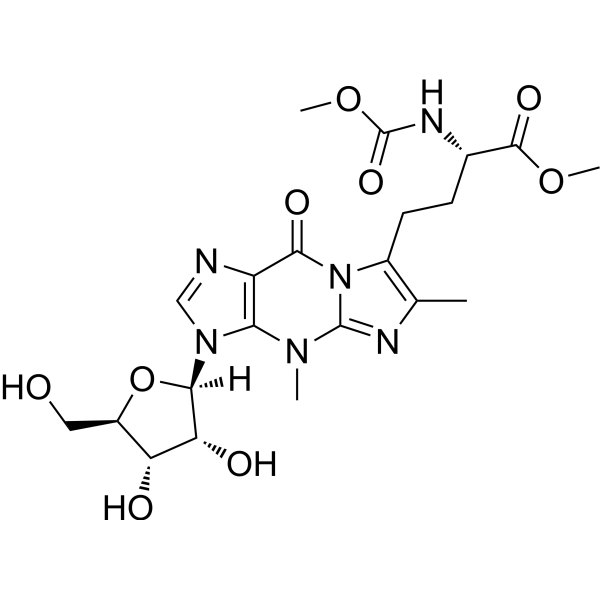
Physicochemical Properties
| Molecular Formula | C21H28N6O9 |
| Molecular Weight | 508.48 |
| Exact Mass | 508.192 |
| Elemental Analysis | C, 49.60; H, 5.55; N, 16.53; O, 28.32 |
| CAS # | 55196-46-8 |
| PubChem CID | 14135916 |
| Appearance | Typically exists as solid at room temperature |
| LogP | -0.5 |
| Hydrogen Bond Donor Count | 4 |
| Hydrogen Bond Acceptor Count | 12 |
| Rotatable Bond Count | 9 |
| Heavy Atom Count | 36 |
| Complexity | 851 |
| Defined Atom Stereocenter Count | 5 |
| SMILES | O1[C@]([H])(C([H])([H])O[H])[C@]([H])([C@]([H])([C@]1([H])N1C([H])=NC2C(N3C(=C(C([H])([H])[H])N=C3N(C([H])([H])[H])C1=2)C([H])([H])C([H])([H])[C@@]([H])(C(=O)OC([H])([H])[H])N([H])C(=O)OC([H])([H])[H])=O)O[H])O[H] |
| InChi Key | QAOHCFGKCWTBGC-QHOAOGIMSA-N |
| InChi Code | InChI=1S/C21H28N6O9/c1-9-11(6-5-10(19(32)34-3)24-21(33)35-4)27-17(31)13-16(25(2)20(27)23-9)26(8-22-13)18-15(30)14(29)12(7-28)36-18/h8,10,12,14-15,18,28-30H,5-7H2,1-4H3,(H,24,33)/t10-,12+,14+,15+,18+/m0/s1 |
| Chemical Name | methyl (2S)-4-[3-[(2R,3R,4S,5R)-3,4-dihydroxy-5-(hydroxymethyl)oxolan-2-yl]-4,6-dimethyl-9-oxoimidazo[1,2-a]purin-7-yl]-2-(methoxycarbonylamino)butanoate |
| Synonyms | WYBUTOSINE; 55196-46-8; Nucleoside Y; 5PCY5AS87Q; CHEBI:46574; Nucleoside Y, from saccharomycescerevisiae; 7-{(3S)-4-methoxy-3-[(methoxycarbonyl)amino]-4-oxobutyl}-4,6-dimethyl-3-(beta-D-ribofuranosyl)-3,4-dihydro-9H-imidazo[1,2-a]purin-9-one; (S)-Methyl 4-(3-((2R,3R,4S,5R)-3,4-dihydroxy-5-(hydroxymethyl)tetrahydrofuran-2-yl)-4,6-dimethyl-9-oxo-4,9-dihydro-3H-imidazo[1,2-a]purin-7-yl)-2-((methoxycarbonyl)amino)butanoate; |
| HS Tariff Code | 2934.99.9001 |
| Storage |
Powder-20°C 3 years 4°C 2 years In solvent -80°C 6 months -20°C 1 month |
| Shipping Condition | Room temperature (This product is stable at ambient temperature for a few days during ordinary shipping and time spent in Customs) |
Biological Activity
| Targets | tRNA precursor |
| ln Vitro | The retrograde movement of tRNAs from the cytoplasm to the nucleus occurs constitutively in eukaryotic cells but its functional significance remains unclear. We show evidence suggesting that in Saccharomyces cerevisiae, a spliced tRNA precursor must be imported into the nucleus before the biogenesis of a modified base can occur. Wybutosine (yW) is a modified base adjacent to the anticodon of tRNA(Phe) and is required for accurate decoding. Glucose starvation or overexpression of the nuclear tRNA binding protein Trz1p both caused nuclear retention of cytoplasmic tRNAs, impaired the yW synthesis, and induced the accumulation of its intermediate, N(1)-methylgunanosine (m(1)G), showing that the postspliced tRNA(Phe) is imported to the nucleus, where m(1)G is formed by Trm5p, after which it is reexported to the cytoplasm, where the yW synthesis is completed by cytoplasmic enzymes.[1] |
| Enzyme Assay | To test this, researchers focused on the biogenesis of Wybutosine (yW) in S. cerevisiae. The yW nucleoside is a bulky, modified guanosine at position 37 of the phenylalanine tRNA (tRNAPhe) that consists of a tricyclic base with a large side chain (Fig. 1B). It plays a critical role in maintaining the reading frame by stabilizing codon-anticodon pairing on the ribosome. The biosynthesis of yW on tRNAPhe is achieved by sequential enzymatic reactions mediated by five modification enzymes (Fig. 1B). First, G37 is N1-methylated by Trm5p, which is mainly localized in the nucleus (Fig. S1). This yields m1G, which is then subjected to the remaining yW-synthetic steps that are catalyzed by the four cytoplasmic enzymes Tyw1p, Tyw2p, Tyw3p, and Tyw4p (Fig. 1B). Thus, yW formation requires the export of pre-tRNAPhe from the nucleus into the cytoplasm. However, pre-tRNAPhe has an intron (Fig. 1A) and the in vitro synthesis of yW has revealed that the substrate of Trm5p and the Tyw-proteins is the spliced tRNAPhe molecule. Thus, the intron in pre-tRNAPhe must be removed before yW can be formed. Supporting this is a study on a yeast temperature-sensitive strain of rna1, which means that the nuclear export of proteins is blocked at the nonpermissive temperature. Biochemical analyses of the intron-bearing pre-tRNAPhe accumulated in the nucleus at the nonpermissive temperature have shown that the G37 position is not modified along with three other positions (G10, C32, and G34), although all ten of the other positions are modified (Fig. 1A). These observations suggest strongly that the intron-bearing pre-tRNAPhe is first exported from the nucleus into the cytoplasm to undergo splicing, after which it returns to the nucleus to be modified by Trm5p; thereafter, it is again exported to the cytoplasm to undergo the other yW-biosynthesizing steps.[1] |
| References | [1]. Ohira T, et al. Retrograde nuclear import of tRNA precursors is required for modified base biogenesis in yeast. Proc Natl Acad Sci U S A. 2011;108(26):10502-10507. |
| Additional Infomation | Wybutosine is a nucleoside analogue having methyl (2S)-4-(4,6-dimethyl-9-oxo-4,9-dihydro-3H-imidazo[1,2-a]purin-7-yl)-2-[(methoxycarbonyl)amino]butanoate as the modified nucleobase. It is a nucleoside analogue, a methyl ester and a carbamate ester. It is functionally related to a guanosine. |
Solubility Data
| Solubility (In Vitro) | May dissolve in DMSO (in most cases), if not, try other solvents such as H2O, Ethanol, or DMF with a minute amount of products to avoid loss of samples |
| Solubility (In Vivo) |
Note: Listed below are some common formulations that may be used to formulate products with low water solubility (e.g. < 1 mg/mL), you may test these formulations using a minute amount of products to avoid loss of samples. Injection Formulations (e.g. IP/IV/IM/SC) Injection Formulation 1: DMSO : Tween 80: Saline = 10 : 5 : 85 (i.e. 100 μL DMSO stock solution → 50 μL Tween 80 → 850 μL Saline) *Preparation of saline: Dissolve 0.9 g of sodium chloride in 100 mL ddH ₂ O to obtain a clear solution. Injection Formulation 2: DMSO : PEG300 :Tween 80 : Saline = 10 : 40 : 5 : 45 (i.e. 100 μL DMSO → 400 μLPEG300 → 50 μL Tween 80 → 450 μL Saline) Injection Formulation 3: DMSO : Corn oil = 10 : 90 (i.e. 100 μL DMSO → 900 μL Corn oil) Example: Take the Injection Formulation 3 (DMSO : Corn oil = 10 : 90) as an example, if 1 mL of 2.5 mg/mL working solution is to be prepared, you can take 100 μL 25 mg/mL DMSO stock solution and add to 900 μL corn oil, mix well to obtain a clear or suspension solution (2.5 mg/mL, ready for use in animals). Injection Formulation 4: DMSO : 20% SBE-β-CD in saline = 10 : 90 [i.e. 100 μL DMSO → 900 μL (20% SBE-β-CD in saline)] *Preparation of 20% SBE-β-CD in Saline (4°C,1 week): Dissolve 2 g SBE-β-CD in 10 mL saline to obtain a clear solution. Injection Formulation 5: 2-Hydroxypropyl-β-cyclodextrin : Saline = 50 : 50 (i.e. 500 μL 2-Hydroxypropyl-β-cyclodextrin → 500 μL Saline) Injection Formulation 6: DMSO : PEG300 : castor oil : Saline = 5 : 10 : 20 : 65 (i.e. 50 μL DMSO → 100 μLPEG300 → 200 μL castor oil → 650 μL Saline) Injection Formulation 7: Ethanol : Cremophor : Saline = 10: 10 : 80 (i.e. 100 μL Ethanol → 100 μL Cremophor → 800 μL Saline) Injection Formulation 8: Dissolve in Cremophor/Ethanol (50 : 50), then diluted by Saline Injection Formulation 9: EtOH : Corn oil = 10 : 90 (i.e. 100 μL EtOH → 900 μL Corn oil) Injection Formulation 10: EtOH : PEG300:Tween 80 : Saline = 10 : 40 : 5 : 45 (i.e. 100 μL EtOH → 400 μLPEG300 → 50 μL Tween 80 → 450 μL Saline) Oral Formulations Oral Formulation 1: Suspend in 0.5% CMC Na (carboxymethylcellulose sodium) Oral Formulation 2: Suspend in 0.5% Carboxymethyl cellulose Example: Take the Oral Formulation 1 (Suspend in 0.5% CMC Na) as an example, if 100 mL of 2.5 mg/mL working solution is to be prepared, you can first prepare 0.5% CMC Na solution by measuring 0.5 g CMC Na and dissolve it in 100 mL ddH2O to obtain a clear solution; then add 250 mg of the product to 100 mL 0.5% CMC Na solution, to make the suspension solution (2.5 mg/mL, ready for use in animals). Oral Formulation 3: Dissolved in PEG400 Oral Formulation 4: Suspend in 0.2% Carboxymethyl cellulose Oral Formulation 5: Dissolve in 0.25% Tween 80 and 0.5% Carboxymethyl cellulose Oral Formulation 6: Mixing with food powders Note: Please be aware that the above formulations are for reference only. InvivoChem strongly recommends customers to read literature methods/protocols carefully before determining which formulation you should use for in vivo studies, as different compounds have different solubility properties and have to be formulated differently. (Please use freshly prepared in vivo formulations for optimal results.) |
| Preparing Stock Solutions | 1 mg | 5 mg | 10 mg | |
| 1 mM | 1.9666 mL | 9.8332 mL | 19.6665 mL | |
| 5 mM | 0.3933 mL | 1.9666 mL | 3.9333 mL | |
| 10 mM | 0.1967 mL | 0.9833 mL | 1.9666 mL |