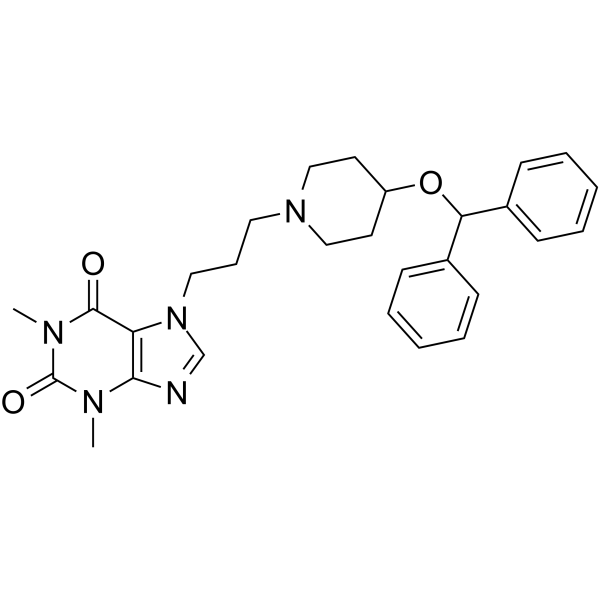
Physicochemical Properties
| Molecular Formula | C28H33N5O3 |
| Molecular Weight | 487.593326330185 |
| Exact Mass | 487.258 |
| CAS # | 113418-56-7 |
| PubChem CID | 6918138 |
| Appearance | Light yellow to yellow solid powder |
| LogP | 3.5 |
| Hydrogen Bond Donor Count | 0 |
| Hydrogen Bond Acceptor Count | 5 |
| Rotatable Bond Count | 8 |
| Heavy Atom Count | 36 |
| Complexity | 728 |
| Defined Atom Stereocenter Count | 0 |
| SMILES | O(C(C1C=CC=CC=1)C1C=CC=CC=1)C1CCN(CCCN2C=NC3=C2C(N(C)C(N3C)=O)=O)CC1 |
| InChi Key | YNDYDETWRDHMLW-UHFFFAOYSA-N |
| InChi Code | InChI=1S/C28H33N5O3/c1-30-26-24(27(34)31(2)28(30)35)33(20-29-26)17-9-16-32-18-14-23(15-19-32)36-25(21-10-5-3-6-11-21)22-12-7-4-8-13-22/h3-8,10-13,20,23,25H,9,14-19H2,1-2H3 |
| Chemical Name | 7-[3-(4-benzhydryloxypiperidin-1-yl)propyl]-1,3-dimethylpurine-2,6-dione |
| HS Tariff Code | 2934.99.9001 |
| Storage |
Powder-20°C 3 years 4°C 2 years In solvent -80°C 6 months -20°C 1 month |
| Shipping Condition | Room temperature (This product is stable at ambient temperature for a few days during ordinary shipping and time spent in Customs) |
Biological Activity
| Targets |
\(H_1\) receptor (IC50 = 44 nM, 95% CI 26-68) \(\alpha_1\) receptor (IC50 = 8 nM, 95% CI 6-10) \(M_1\) receptor (IC50 = 46 ± 12 nM) \(M_2\) receptor (IC50 = 7300 ± 2900 nM) 5-HT₁A receptor (40% inhibition at 1 μM) \(D_2\) receptor (41% inhibition at 1 μM) [1] |
| ln Vitro |
At a dosage of 100 nM, Wy 49051 exhibits a 92% reduction of histamine-induced ileal contraction in guinea pigs, demonstrating its strong inhibitory activity on H1. The most potent substance was Wy 49051, which had a potency 700 times more than astemizole and 470 times greater than chlorpheniramine. With an IC50 of 8 nM, Wy 49051 likewise exhibits significant affinity for α1 receptors[1]. At a concentration of \(1 × 10^{-7}\) M, WY-49051 competitively antagonized the histamine-induced contractile response of the isolated guinea pig ileum with 92% inhibition, showing a \(pA_2\) value of 11, confirming it as a competitive \(H_1\)-antagonist [1] It is more potent than reference antihistamines: 700 times more potent than astemizole, 470 times more potent than chlorpheniramine, 840 times more potent than compound 17, and more potent than ebastine (\(pA_2=7.4\)) and terfenadine (\(pA_2=7.5\)) [1] It exhibits potent affinity for \(H_1\)-receptors and weak affinity for dopamine and 5-HT₁A receptors [1] Despite high affinity for the \(\alpha_1\) receptor, it does not induce adverse cardiovascular effects in spontaneously hypertensive rats (SHR) at doses exceeding its \(H_1\)-antagonist effective dose [1] |
| ln Vivo |
In guinea pigs, Wy 49051 exhibited strong antihistamine-induced fatal action, with an ED50 of 1.91 mg/kg orally, 0.70 mg/kg intraperitoneally, and 0.01 mg/kg intravenously administered. Additionally, the 24-hour duration of action is advantageous because oral efficacy does not decline for up to 18 hours following therapy [1]. In the guinea pig histamine-induced lethality test, WY-49051 shows dose-dependent protective effects: ED50 = 1.91 mg/kg (95% CI 1.20-3.02) via oral (PO) administration, 0.70 mg/kg (95% CI 0.22-2.23) via intraperitoneal (ip) administration, and 0.01 mg/kg (95% CI 0.00-0.10) via intravenous (iv) administration at 1 hour post-treatment [1] Oral efficacy remains unchanged for up to 18 hours post-administration, demonstrating a long duration of action [1] In the guinea pig histamine-induced skin wheal formation test, it antagonizes cutaneous vascular permeability: ED50 = 0.42 mg/kg (no CI) at 2 hours and 1.14 mg/kg (95% CI 1.02-1.40) at 18 hours post oral administration, with potency comparable to chlorpheniramine [1] Onset of action is faster than astemizole and terfenadine but slower than ebastine; duration of action exceeds 18 hours; efficacy is comparable to 17, astemizole, and ebastine at 8 hours, slightly more efficacious than 17 and ebastine (but less than astemizole) at 18 hours [1] |
| Enzyme Assay |
In vitro neuroreceptor binding assays: Measure the ability of WY-49051 to displace radioligands from various receptors (H₁, \(\alpha_1\), \(M_1\), \(M_2\), 5-HT₁A, \(D_2\)); experiments are repeated 3-4 times, with IC50 values calculated (95% CI for single determinations or ±SEM for multiple determinations); for receptors without full inhibition curves, percentage inhibition at 1 μM is recorded [1] Guinea pig ileum histamine-induced contraction assay: Use a modified method of Van Neuten and Janssen; treat isolated guinea pig ileum with histamine, observe the inhibitory effect of WY-49051 on contractile responses, calculate inhibition rate at \(1 × 10^{-7}\) M, and determine \(pA_2\) value to assess antagonism type and potency [1] |
| Animal Protocol |
Histamine-induced lethality test in guinea pigs: Administer WY-49051 and reference antihistamines at 1 mg/kg PO, challenge with histamine (1.25 mg/kg iv) at different time intervals to evaluate duration of action; for ED50 determination, administer WY-49051 via PO/ip/iv routes, challenge with histamine at 1 hour post-administration, and record protective effects [1] Histamine-induced skin wheal formation test in guinea pigs: Orally administer WY-49051, challenge with histamine at 2 hours and 18 hours post-administration, measure wheal formation, and calculate ED50 values [1] Spontaneous motor activity test in rats: Treat male rats with vehicle (0.25% Tween 80) or WY-49051 via ip at various doses; after 15-minute acclimation in a motor activity chamber, assess rearing activity for 15-minute intervals over 1 hour to detect sedative effects [1] Rotorod test in rats: Administer WY-49051 at 20 mg/kg ip, observe for sedative/ataxic effects [1] Adverse cardiovascular effect test in SHR: Administer WY-49051 at doses higher than its \(H_1\)-antagonist effective dose, monitor cardiovascular parameters to evaluate potential adverse effects [1] |
| ADME/Pharmacokinetics |
Octanol-water partition coefficient (log P) = 1.77, significantly less lipophilic than terfenadine (log P=2.35) and ebastine (log P=2.74) [1] Orally active; unlike ebastine, its \(H_1\)-antagonist activity does not depend on active metabolite formation, as evidenced by potent activity after iv administration [1] Long duration of action, with oral efficacy maintained for up to 18 hours post-treatment [1] |
| Toxicity/Toxicokinetics |
In confinement motor activity tests, WY-49051 does not induce significant sedative effects (unlike terfenadine, which causes sedation at 1-10 mg/kg ip) [1] Sedative/ataxic effects are not observed in rotorod tests at 20 mg/kg ip [1] No adverse cardiovascular effects are observed in SHR at doses exceeding its \(H_1\)-antagonist effective dose [1] |
| References |
[1]. New antihistamines: substituted piperazine and piperidine derivatives as novel H1-antagonists. J Med Chem. 1995 Sep 29;38(20):4026-32. |
| Additional Infomation |
WY-49051 (compound 24) is a novel xanthinyl-substituted piperidinyl derivative synthesized by substituting a xanthinyl moiety for the polycyclic imide group of compound 8, eliminating undesirable antidopaminergic activity while retaining potent \(H_1\)-antagonist properties [1] It is a potent, orally active \(H_1\)-antagonist with a favorable central nervous system profile and is available for worldwide outlicensing [1] Further CNS testing and broad receptor screening are required to clarify potential CNS effects and \(\alpha_1\)-receptor-related activities [1] |
Solubility Data
| Solubility (In Vitro) | May dissolve in DMSO (in most cases), if not, try other solvents such as H2O, Ethanol, or DMF with a minute amount of products to avoid loss of samples |
| Solubility (In Vivo) |
Note: Listed below are some common formulations that may be used to formulate products with low water solubility (e.g. < 1 mg/mL), you may test these formulations using a minute amount of products to avoid loss of samples. Injection Formulations (e.g. IP/IV/IM/SC) Injection Formulation 1: DMSO : Tween 80: Saline = 10 : 5 : 85 (i.e. 100 μL DMSO stock solution → 50 μL Tween 80 → 850 μL Saline) *Preparation of saline: Dissolve 0.9 g of sodium chloride in 100 mL ddH ₂ O to obtain a clear solution. Injection Formulation 2: DMSO : PEG300 :Tween 80 : Saline = 10 : 40 : 5 : 45 (i.e. 100 μL DMSO → 400 μLPEG300 → 50 μL Tween 80 → 450 μL Saline) Injection Formulation 3: DMSO : Corn oil = 10 : 90 (i.e. 100 μL DMSO → 900 μL Corn oil) Example: Take the Injection Formulation 3 (DMSO : Corn oil = 10 : 90) as an example, if 1 mL of 2.5 mg/mL working solution is to be prepared, you can take 100 μL 25 mg/mL DMSO stock solution and add to 900 μL corn oil, mix well to obtain a clear or suspension solution (2.5 mg/mL, ready for use in animals). Injection Formulation 4: DMSO : 20% SBE-β-CD in saline = 10 : 90 [i.e. 100 μL DMSO → 900 μL (20% SBE-β-CD in saline)] *Preparation of 20% SBE-β-CD in Saline (4°C,1 week): Dissolve 2 g SBE-β-CD in 10 mL saline to obtain a clear solution. Injection Formulation 5: 2-Hydroxypropyl-β-cyclodextrin : Saline = 50 : 50 (i.e. 500 μL 2-Hydroxypropyl-β-cyclodextrin → 500 μL Saline) Injection Formulation 6: DMSO : PEG300 : castor oil : Saline = 5 : 10 : 20 : 65 (i.e. 50 μL DMSO → 100 μLPEG300 → 200 μL castor oil → 650 μL Saline) Injection Formulation 7: Ethanol : Cremophor : Saline = 10: 10 : 80 (i.e. 100 μL Ethanol → 100 μL Cremophor → 800 μL Saline) Injection Formulation 8: Dissolve in Cremophor/Ethanol (50 : 50), then diluted by Saline Injection Formulation 9: EtOH : Corn oil = 10 : 90 (i.e. 100 μL EtOH → 900 μL Corn oil) Injection Formulation 10: EtOH : PEG300:Tween 80 : Saline = 10 : 40 : 5 : 45 (i.e. 100 μL EtOH → 400 μLPEG300 → 50 μL Tween 80 → 450 μL Saline) Oral Formulations Oral Formulation 1: Suspend in 0.5% CMC Na (carboxymethylcellulose sodium) Oral Formulation 2: Suspend in 0.5% Carboxymethyl cellulose Example: Take the Oral Formulation 1 (Suspend in 0.5% CMC Na) as an example, if 100 mL of 2.5 mg/mL working solution is to be prepared, you can first prepare 0.5% CMC Na solution by measuring 0.5 g CMC Na and dissolve it in 100 mL ddH2O to obtain a clear solution; then add 250 mg of the product to 100 mL 0.5% CMC Na solution, to make the suspension solution (2.5 mg/mL, ready for use in animals). Oral Formulation 3: Dissolved in PEG400 Oral Formulation 4: Suspend in 0.2% Carboxymethyl cellulose Oral Formulation 5: Dissolve in 0.25% Tween 80 and 0.5% Carboxymethyl cellulose Oral Formulation 6: Mixing with food powders Note: Please be aware that the above formulations are for reference only. InvivoChem strongly recommends customers to read literature methods/protocols carefully before determining which formulation you should use for in vivo studies, as different compounds have different solubility properties and have to be formulated differently. (Please use freshly prepared in vivo formulations for optimal results.) |
| Preparing Stock Solutions | 1 mg | 5 mg | 10 mg | |
| 1 mM | 2.0509 mL | 10.2545 mL | 20.5090 mL | |
| 5 mM | 0.4102 mL | 2.0509 mL | 4.1018 mL | |
| 10 mM | 0.2051 mL | 1.0255 mL | 2.0509 mL |