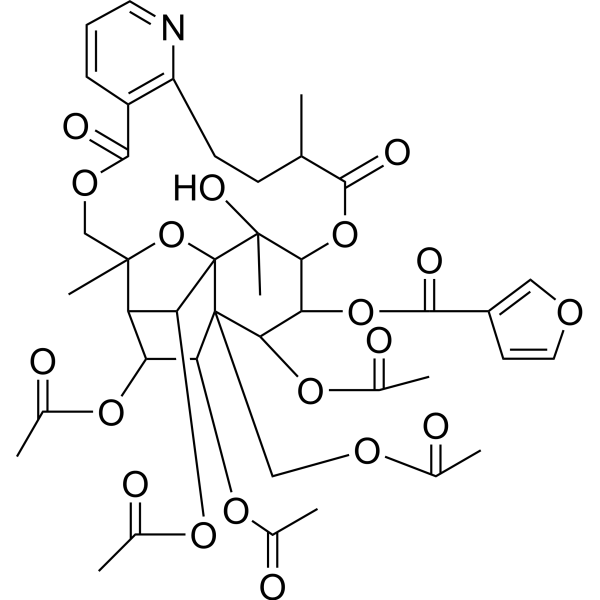
Physicochemical Properties
| Molecular Formula | C41H47NO19 |
| Molecular Weight | 857.8072 |
| Exact Mass | 857.274 |
| CAS # | 37239-47-7 |
| PubChem CID | 124030 |
| Appearance | White to off-white solid powder |
| Density | 1.4±0.1 g/cm3 |
| Boiling Point | 859.9±65.0 °C at 760 mmHg |
| Melting Point | 211℃ |
| Flash Point | 473.8±34.3 °C |
| Vapour Pressure | 0.0±0.3 mmHg at 25°C |
| Index of Refraction | 1.583 |
| LogP | 5.32 |
| Hydrogen Bond Donor Count | 1 |
| Hydrogen Bond Acceptor Count | 20 |
| Rotatable Bond Count | 14 |
| Heavy Atom Count | 61 |
| Complexity | 1790 |
| Defined Atom Stereocenter Count | 10 |
| SMILES | CC1CCC2=C(C=CC=N2)C(=O)OC[C@]3([C@@H]4[C@H]([C@H]([C@@]5([C@H]([C@H]([C@@H](C([C@]5([C@@H]4OC(=O)C)O3)(C)O)OC1=O)OC(=O)C6=COC=C6)OC(=O)C)COC(=O)C)OC(=O)C)OC(=O)C)C |
| InChi Key | QFIYSPKZWOALMZ-YHQLYFKISA-N |
| InChi Code | InChI=1S/C41H47NO19/c1-19-11-12-27-26(10-9-14-42-27)37(50)54-17-38(7)28-29(55-21(3)44)33(57-23(5)46)40(18-53-20(2)43)34(58-24(6)47)30(59-36(49)25-13-15-52-16-25)32(60-35(19)48)39(8,51)41(40,61-38)31(28)56-22(4)45/h9-10,13-16,19,28-34,51H,11-12,17-18H2,1-8H3/t19?,28-,29-,30+,31-,32+,33-,34+,38+,39?,40-,41+/m1/s1 |
| Chemical Name | [(1S,3R,18S,19R,20R,21R,22S,23R,24R,25R)-20,22,23,25-tetraacetyloxy-21-(acetyloxymethyl)-26-hydroxy-3,15,26-trimethyl-6,16-dioxo-2,5,17-trioxa-11-azapentacyclo[16.7.1.01,21.03,24.07,12]hexacosa-7(12),8,10-trien-19-yl] furan-3-carboxylate |
| HS Tariff Code | 2934.99.9001 |
| Storage |
Powder-20°C 3 years 4°C 2 years In solvent -80°C 6 months -20°C 1 month Note: This product requires protection from light (avoid light exposure) during transportation and storage. |
| Shipping Condition | Room temperature (This product is stable at ambient temperature for a few days during ordinary shipping and time spent in Customs) |
Biological Activity
| ln Vivo |
- Insecticidal activity against Mythimna separata 3rd-instar larvae: Wilforgine caused toxic effects, with 65% larval mortality at 20 μg/mL after 48 hours (vs. 20% in control). Surviving larvae had 40% reduced body weight vs. control. It damaged muscle microstructure (disrupted fiber arrangement) and ultrastructure (swollen mitochondria, broken myofibrils, increased vacuolation) [2] |
| Animal Protocol |
- Mythimna separata treatment: 3rd-instar larvae were reared at 25±1°C (16L:8D, 70±5% RH). Wilforgine was dissolved in distilled water to 5/10/20 μg/mL; maize leaves were soaked in solutions for 30s, air-dried, and fed to larvae (10 larvae/group, 3 replicates; control: distilled water-soaked leaves). Mortality and body weight were recorded at 24/48h. Thoracic muscle from survivors was fixed, dehydrated, embedded, sectioned, stained, and observed via light/transmission electron microscope [2] |
| References |
[1]. Simultaneous determination of four sesquiterpene alkaloids in Tripterygium wilfordii Hook. F. extracts by high-performance liquid chromatography. Phytochem Anal. 2007 Jul-Aug;18(4):320-5. [2]. Comparative studies on muscle microstructure and ultrastructure of Mythimna separata Walker treated with wilforgine and chlorantraniliprole. Ecotoxicol Environ Saf. 2018 Jan;147:1023-1034. [3]. Wilforine, the Q-marker and PK-maker of Tripterygium glycosides tablet: Based on preparation quantitative analysis and PK-PD study. Phytomedicine. 2019 Feb 15;54:357-364. |
| Additional Infomation |
Wilforgine has been reported in Tripterygium wilfordii and Tripterygium hypoglaucum with data available. - Wilforgine is a sesquiterpene alkaloid from Tripterygium wilfordii Hook. F. [1] - HPLC quantification in Tripterygium extracts: C18 column, mobile phase methanol-water (75:25, v/v), flow rate 1.0 mL/min, detection wavelength 220 nm, column temperature 30°C. Linear range: 0.05–2.0 μg (r=0.9998) [1] |
Solubility Data
| Solubility (In Vitro) | DMSO : ~100 mg/mL (~116.58 mM) |
| Solubility (In Vivo) |
Solubility in Formulation 1: ≥ 2.5 mg/mL (2.91 mM) (saturation unknown) in 10% DMSO + 40% PEG300 + 5% Tween80 + 45% Saline (add these co-solvents sequentially from left to right, and one by one), clear solution. For example, if 1 mL of working solution is to be prepared, you can add 100 μL of 25.0 mg/mL clear DMSO stock solution to 400 μL PEG300 and mix evenly; then add 50 μL Tween-80 to the above solution and mix evenly; then add 450 μL normal saline to adjust the volume to 1 mL. Preparation of saline: Dissolve 0.9 g of sodium chloride in 100 mL ddH₂ O to obtain a clear solution. Solubility in Formulation 2: ≥ 2.5 mg/mL (2.91 mM) (saturation unknown) in 10% DMSO + 90% Corn Oil (add these co-solvents sequentially from left to right, and one by one), clear solution. For example, if 1 mL of working solution is to be prepared, you can add 100 μL of 25.0 mg/mL clear DMSO stock solution to 900 μL of corn oil and mix evenly. (Please use freshly prepared in vivo formulations for optimal results.) |
| Preparing Stock Solutions | 1 mg | 5 mg | 10 mg | |
| 1 mM | 1.1658 mL | 5.8288 mL | 11.6576 mL | |
| 5 mM | 0.2332 mL | 1.1658 mL | 2.3315 mL | |
| 10 mM | 0.1166 mL | 0.5829 mL | 1.1658 mL |