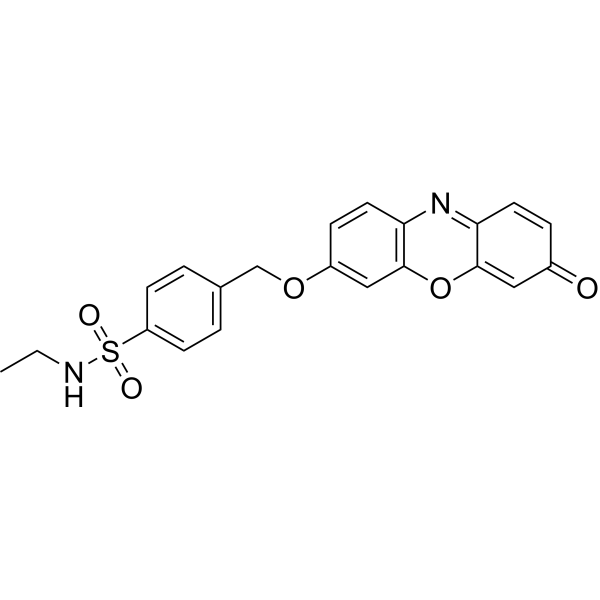
Physicochemical Properties
| Molecular Formula | C21H18N2O5S |
| Molecular Weight | 410.443024158478 |
| Exact Mass | 410.093 |
| CAS # | 1913291-02-7 |
| PubChem CID | 139035038 |
| Appearance | Pink to red solid powder |
| LogP | 2.3 |
| Hydrogen Bond Donor Count | 1 |
| Hydrogen Bond Acceptor Count | 7 |
| Rotatable Bond Count | 6 |
| Heavy Atom Count | 29 |
| Complexity | 819 |
| Defined Atom Stereocenter Count | 0 |
| SMILES | S(C1C=CC(=CC=1)COC1C=CC2=C(C=1)OC1=CC(C=CC1=N2)=O)(NCC)(=O)=O |
| InChi Key | AARVTLIQNGAELZ-UHFFFAOYSA-N |
| InChi Code | InChI=1S/C21H18N2O5S/c1-2-22-29(25,26)17-7-3-14(4-8-17)13-27-16-6-10-19-21(12-16)28-20-11-15(24)5-9-18(20)23-19/h3-12,22H,2,13H2,1H3 |
| Chemical Name | N-ethyl-4-[(7-oxophenoxazin-3-yl)oxymethyl]benzenesulfonamide |
| HS Tariff Code | 2934.99.9001 |
| Storage |
Powder-20°C 3 years 4°C 2 years In solvent -80°C 6 months -20°C 1 month |
| Shipping Condition | Room temperature (This product is stable at ambient temperature for a few days during ordinary shipping and time spent in Customs) |
Biological Activity
| ln Vitro | WRG-28 (1, 2 μM; 4 hours) fragments collagen I-mediated tyrosine phosphorylation of DDR2 and (1 μM; 7) ERK activation and SNAIL1 protein stability in HEK293 cells expressing DDR2 ( WRG -28 (1 μM; 48 hours) inhibits tumor cell wavelength and migration by inhibiting DDR2 in BT549 and 4T1 breast cancer cells [1]. WRG-28 (1 μM; 4). WRG-28 (0.5, 1 μM ; 4 h) Maintain varied inhibitory impact of acquired DDR2 on TKIs [1]. |
| ln Vivo | In breast cancers, WRG-28 (10 mg/kg; IV; single dose) internally turns off DDR2's molecular signaling [1]. The WRG-28 (10 mg/kg; iv; single dose) administered once daily for 7 days and WRG-28 (10 mg/kg; iv; administered once daily for 21 days) is used to treat arthritis-induced inflammation (CAIA) and spinal cord damage [2]. |
| Cell Assay |
Cell viability assay [1] Cell Types: Day) Inhibit the tumor-promoting effect of CAF [1]. HEK293 cells (transfected with DDR2-Flag) Tested Concentrations: 0.25, 0.5, 1, 2 µM Incubation Duration: 4 hrs (hours) Experimental Results: 1 or 2 µM Dramatically inhibited collagen I-mediated DDR2 tyrosine phosphorylation, IC>sub >50 is 286 nm. Cell viability assay [1] Cell Types: HEK293 cells (transfected with DDR2-Flag) Tested Concentrations: 1 µM Incubation Duration: 7 hrs (hours) Experimental Results: Inhibition of collagen I-mediated ERK activation and SNAIL1 protein stabilization (IC50=286 nM). Cell viability assay [1] Cell Types: BT549 and 4T1 breast cancer cells (expressing endogenous DDR2) Tested Concentrations: 1 μM Incubation Duration: 48 h Experimental Results: Inhibition of DDR2-induced tumor cell invasion and migration. Cell viability assay[1] Cell Types: CAF cells (containing tumor organoids) Tested Concentrations: 1 μM Incubation Duration: 4 days Experimental Results: Inhibition of DDR2 activity that supports invasion of primary tumor organoids in CAF. Cell viability assay [1] Cell Types: HEK2 |
| Animal Protocol |
Animal/Disease Models: Female BALB/cJ mouse (8 weeks old; 4T1-Snail-CBG tumor-bearing mouse model) [1]. Doses: 10 mg/kg Route of Administration: intravenous (iv) (iv)injection, single dose. Experimental Results: SNAIL1-clic beetle green (SNAIL1.CBG) levels in mouse tumors were diminished by 60%. Animal/Disease Models: Female BALB/cJ mice (8 weeks old; injected with 4T1 GFP-luc expressing cells) [1]. Doses: 10 mg/kg Route of Administration: intravenous (iv) (iv)injection, one time/day for 7 days. Experimental Results: Lung colonization was diminished to levels comparable to shDDR2-depleted cells. Animal/Disease Models: Male DBA/1 mice (8 weeks old; CAIA model) [2]. Doses: 10 mg/kg Route of Administration: intravenously (iv) (iv)(iv), one time/day for 21 days. Experimental Results: The mice's arthritis Dramatically improved (the production of IL-15 and Dkk-1 was diminished), and the mice's hind paw thickness was also diminished. Inhibits inflammatory cell infiltration and cartilage destruction in mouse ankle joints and serum. Dramatically reduces bone destruction, reduces joint space enlargement and bo |
| References |
[1]. Inhibition of tumor-microenvironment interaction and tumor invasion by small-molecule allosteric inhibitor of DDR2 extracellular domain. Proc Natl Acad Sci U S A. 2018 Aug 14;115(33):E7786-E7794. [2]. Blockade of Discoidin Domain Receptor 2 as a Strategy for Reducing Inflammation and Joint Destruction in Rheumatoid Arthritis Via Altered Interleukin-15 and Dkk-1 Signaling in Fibroblast-Like Synoviocytes. Arthritis Rheumatol. 2020 Jun;72(6):943-956. |
Solubility Data
| Solubility (In Vitro) | DMSO : ~15.62 mg/mL (~38.06 mM) |
| Solubility (In Vivo) |
Solubility in Formulation 1: ≥ 1.56 mg/mL (3.80 mM) (saturation unknown) in 10% DMSO + 40% PEG300 +5% Tween-80 + 45% Saline (add these co-solvents sequentially from left to right, and one by one), clear solution. For example, if 1 mL of working solution is to be prepared, you can add 100 μL of 15.6 mg/mL clear DMSO stock solution to 400 μL PEG300 and mix evenly; then add 50 μL Tween-80 + to the above solution and mix evenly; then add 450 μL normal saline to adjust the volume to 1 mL. Preparation of saline: Dissolve 0.9 g of sodium chloride in 100 mL ddH₂ O to obtain a clear solution. (Please use freshly prepared in vivo formulations for optimal results.) |
| Preparing Stock Solutions | 1 mg | 5 mg | 10 mg | |
| 1 mM | 2.4364 mL | 12.1820 mL | 24.3641 mL | |
| 5 mM | 0.4873 mL | 2.4364 mL | 4.8728 mL | |
| 10 mM | 0.2436 mL | 1.2182 mL | 2.4364 mL |