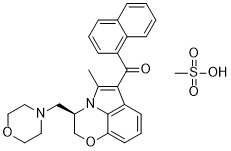
WIN 55,212-2 Mesylate is a novel and potent aminoalkylindole cannabinoid (CB) receptor agonist with Kis of 62.3 and 3.3 nM for human recombinant CB1 and CB2 receptors, respectively. WIN 55212-2 inhibits contextual fear conditioning by activating cannabinoid receptors on the CB1 subtype. In a sham autoimmune encephalomyelitis model, win 55212-2 reduces leukocyte/endothelial interactions. In airway tissues, WIN 55212-2 inhibits neurogenic inflammations.
Physicochemical Properties
| Molecular Weight | 522.6126 |
| Exact Mass | 522.182 |
| Elemental Analysis | C, 64.35; H, 5.79; N, 5.36; O, 18.37; S, 6.13 |
| CAS # | 131543-23-2 |
| Related CAS # | 131543-23-2 (mesylate); 131543-22-1 |
| PubChem CID | 6604176 |
| Appearance | White to off-white crystalline powder |
| Boiling Point | 627.7ºC at 760 mmHg |
| Flash Point | 333.4ºC |
| Vapour Pressure | 1.14E-15mmHg at 25°C |
| LogP | 5.122 |
| Hydrogen Bond Donor Count | 1 |
| Hydrogen Bond Acceptor Count | 7 |
| Rotatable Bond Count | 4 |
| Heavy Atom Count | 37 |
| Complexity | 772 |
| Defined Atom Stereocenter Count | 1 |
| SMILES | O=C(C1=C2C=CC=CC2=CC=C1)C3=C(N4[C@@H](COC5=C4C3=CC=C5)CN6CCOCC6)C.CS(=O)(O)=O |
| InChi Key | FSGCSTPOPBJYSX-VEIFNGETSA-N |
| InChi Code | InChI=1S/C27H26N2O3.CH4O3S/c1-18-25(27(30)22-9-4-7-19-6-2-3-8-21(19)22)23-10-5-11-24-26(23)29(18)20(17-32-24)16-28-12-14-31-15-13-28;1-5(2,3)4/h2-11,20H,12-17H2,1H3;1H3,(H,2,3,4)/t20-;/m1./s1 |
| Chemical Name | methanesulfonic acid;[(11R)-2-methyl-11-(morpholin-4-ylmethyl)-9-oxa-1-azatricyclo[6.3.1.04,12]dodeca-2,4(12),5,7-tetraen-3-yl]-naphthalen-1-ylmethanone |
| Synonyms | (R)-(+)-WIN 55212; WIN 55212-2; WIN55212-2; 131543-23-2; WIN 55212-2 mesylate; WIN 55,212-2 MESYLATE; WIN-55212-2 Mesylate; (R)-(5-Methyl-3-(morpholinomethyl)-2,3-dihydro-[1,4]oxazino[2,3,4-hi]indol-6-yl)(naphthalen-1-yl)methanone methanesulfonate; (R)-(+)-WIN 55212; WIN-55212-2 mesilate; (R)-(+)-Win 55212-2 mesylate; WIN-55212-2; WIN 552122; WIN552122; WIN-552122; WIN 55,212-2 mesylate |
| HS Tariff Code | 2934.99.9001 |
| Storage |
Powder-20°C 3 years 4°C 2 years In solvent -80°C 6 months -20°C 1 month |
| Shipping Condition | Room temperature (This product is stable at ambient temperature for a few days during ordinary shipping and time spent in Customs) |
Biological Activity
| Targets | CB1/cannabinoid receptor 1 |
| ln Vivo |
Cannabinoid and PPAR receptors show well established interactions in a set of physiological effects. Regarding the seizure-modulating properties of both classes of receptors, the present study aimed to evaluate the roles of the PPAR-gamma, PPAR-alpha and CB1 receptors on the anticonvulsant effects of WIN 55,212-2 (WIN, a non selective cannabinoid agonist). The clonic seizure thresholds after intravenous administration of pentylenetetrazole (PTZ) were assessed in mice weighing 23-30 g. WIN increased the seizure threshold dose dependently. Pretreatment with pioglitazone, as a PPARγ agonist, potentiated the anticonvulsant effects of WIN, while PPARγ antagonist inhibited these anticonvulsant effects partially. On the other hand PPARα antagonist reduced the anticonvulsant effects of WIN significantly. Finally the combination of CB1 antagonist and PPARα antagonist could completely block the anticonvulsant properties of WIN. Taken together, these results show for the first time that a functional interaction exists between cannabinoid and PPAR receptors in the modulation of seizure susceptibility [1].
Background: In the absence of pathology, cannabinoid-induced depression of gastrointestinal (GI) motility is thought to be mediated primarily by CB1 receptors, whereas the role of CB2 receptors is still unclear. The aim of this work was to radiographically analyze the acute effect of the mixed cannabinoid agonist WIN 55,212-2 (WIN) on GI motor function in the rat, focusing on the involvement of CB1 and CB2 receptors. Methods: Male Wistar rats received different doses of WIN and both psychoactivity (cannabinoid tetrad) and GI motility (radiographic analysis) were tested. The duration of WIN effect on GI motility was also radiographically analyzed. Finally, the involvement of the different cannabinoid receptors on WIN-induced alterations of GI motility was analyzed by the previous administration of selective CB1 (AM251) and CB2 (SR144528 or AM630) antagonists. After administration of contrast medium, alterations in GI motility were quantitatively evaluated in serial radiographs by assigning a compounded value to each region of the GI tract. Key results: Low, analgesic doses of WIN delayed intestinal transit, but high, psychoactive doses were required to delay gastric emptying. Acute WIN effects on GI motility were confined to the first few hours after administration. AM251 partially counteracted the effect of WIN on GI motility. Surprisingly, SR144528 (but not AM630) enhanced WIN-induced delayed gastric emptying. Conclusions & inferences: X-ray analyses confirm that cannabinoids inhibit GI motility via CB1 receptors; in addition, cannabinoids could influence motility through interaction with a SR144528-sensitive site. Further studies are needed to verify if such site of action is the CB2 receptor[2]. |
| Animal Protocol |
Central effects of WIN 55,212-2 (cannabinoid tetrad) [2] The classical cannabinoid tetrad consists of the combination of four tests that evaluate temperature, antinociception, catalepsy, and motility in the same animal after cannabinoid administration,20 and was used to identify non-psychoactive and psychoactive doses of WIN. The test values were recorded by an observer unaware of the treatments, as previously reported.17 Heat-antinociception was tested 20 min after drug administration using a 37370 plantar test apparatus (Ugo Basile, Comerio VA, Italy). The withdrawal latency from a focused beam of radiant heat applied to the mid plantar surface of the hindpaws was recorded. The intensity of the light was adjusted at the beginning of the experiment so that the control average baseline latencies were about 8 s and a cut-off latency of 25 s was imposed. The withdrawal latency of each paw was measured during three trials separated by 2 min intervals, and the mean of the three readings was used for data analysis. To measure catalepsy, the rats were hung by their front paws from a rubber-coated metal ring (12 cm diameter) fixed horizontally at a height that allowed their hindpaws to just touch the bench. The time taken for the rat to move off the ring was measured with a cut-off limit of 30 s. Latencies were measured 25 min after drug or vehicle administration. Rectal temperature was recorded 30 min after drug administration using a P6 thermometer and a lubricated rectal probe (Cibertec S.A., Madrid, Spain) inserted into the rectum to a constant depth of 5 cm. Spontaneous locomotor activity was evaluated using individual photocell activity chambers (Cibertec S.A.). Rats were placed in the recording chambers (55 × 40 cm, with a 3-cm spacing between beams) 40 min after drug administration; the number of interruptions of photocell beams was recorded over a 10-min period. The mean number of crossings of the photocell beams was used for comparison. |
| References |
[1]. Involvement of PPAR receptors in the anticonvulsant effects of a cannabinoid agonist, WIN 55,212-2. Prog Neuropsychopharmacol Biol Psychiatry. 2015 Mar 3:57:140-5. [2]. The cannabinoid antagonist SR144528 enhances the acute effect of WIN 55,212-2 on gastrointestinal motility in the rat. Neurogastroenterol Motil. 2010 Jun;22(6):694-e206. |
| Additional Infomation | Non-invasive radiographic techniques were used to analyze the acute effect of the cannabinoid agonist WIN 55,212-2 on GI motility in the rat. It was confirmed that: low (although analgesic) doses are capable of reducing intestinal transit, whereas gastric emptying is delayed by higher (psychoactive) doses; acute WIN administration does not exert long-lasting effects on GI motility or in the cannabinoid tetrad; the CB1 receptor is involved in reducing GI motility. Interestingly, the CB2 receptor antagonist SR144528 did not block but enhanced WIN-induced delayed gastric emptying, suggesting that not only CB1 receptors but also a SR144528-sensitive site (CB2 receptors?) might be involved in this effect, with differential roles. Thus, this SR144528-sensitive site might function as a brake to the delaying effect of CB1 activation. [2] |
Solubility Data
| Solubility (In Vitro) | May dissolve in DMSO (in most cases), if not, try other solvents such as H2O, Ethanol, or DMF with a minute amount of products to avoid loss of samples |
| Solubility (In Vivo) |
Note: Listed below are some common formulations that may be used to formulate products with low water solubility (e.g. < 1 mg/mL), you may test these formulations using a minute amount of products to avoid loss of samples. Injection Formulations (e.g. IP/IV/IM/SC) Injection Formulation 1: DMSO : Tween 80: Saline = 10 : 5 : 85 (i.e. 100 μL DMSO stock solution → 50 μL Tween 80 → 850 μL Saline) *Preparation of saline: Dissolve 0.9 g of sodium chloride in 100 mL ddH ₂ O to obtain a clear solution. Injection Formulation 2: DMSO : PEG300 :Tween 80 : Saline = 10 : 40 : 5 : 45 (i.e. 100 μL DMSO → 400 μLPEG300 → 50 μL Tween 80 → 450 μL Saline) Injection Formulation 3: DMSO : Corn oil = 10 : 90 (i.e. 100 μL DMSO → 900 μL Corn oil) Example: Take the Injection Formulation 3 (DMSO : Corn oil = 10 : 90) as an example, if 1 mL of 2.5 mg/mL working solution is to be prepared, you can take 100 μL 25 mg/mL DMSO stock solution and add to 900 μL corn oil, mix well to obtain a clear or suspension solution (2.5 mg/mL, ready for use in animals). Injection Formulation 4: DMSO : 20% SBE-β-CD in saline = 10 : 90 [i.e. 100 μL DMSO → 900 μL (20% SBE-β-CD in saline)] *Preparation of 20% SBE-β-CD in Saline (4°C,1 week): Dissolve 2 g SBE-β-CD in 10 mL saline to obtain a clear solution. Injection Formulation 5: 2-Hydroxypropyl-β-cyclodextrin : Saline = 50 : 50 (i.e. 500 μL 2-Hydroxypropyl-β-cyclodextrin → 500 μL Saline) Injection Formulation 6: DMSO : PEG300 : castor oil : Saline = 5 : 10 : 20 : 65 (i.e. 50 μL DMSO → 100 μLPEG300 → 200 μL castor oil → 650 μL Saline) Injection Formulation 7: Ethanol : Cremophor : Saline = 10: 10 : 80 (i.e. 100 μL Ethanol → 100 μL Cremophor → 800 μL Saline) Injection Formulation 8: Dissolve in Cremophor/Ethanol (50 : 50), then diluted by Saline Injection Formulation 9: EtOH : Corn oil = 10 : 90 (i.e. 100 μL EtOH → 900 μL Corn oil) Injection Formulation 10: EtOH : PEG300:Tween 80 : Saline = 10 : 40 : 5 : 45 (i.e. 100 μL EtOH → 400 μLPEG300 → 50 μL Tween 80 → 450 μL Saline) Oral Formulations Oral Formulation 1: Suspend in 0.5% CMC Na (carboxymethylcellulose sodium) Oral Formulation 2: Suspend in 0.5% Carboxymethyl cellulose Example: Take the Oral Formulation 1 (Suspend in 0.5% CMC Na) as an example, if 100 mL of 2.5 mg/mL working solution is to be prepared, you can first prepare 0.5% CMC Na solution by measuring 0.5 g CMC Na and dissolve it in 100 mL ddH2O to obtain a clear solution; then add 250 mg of the product to 100 mL 0.5% CMC Na solution, to make the suspension solution (2.5 mg/mL, ready for use in animals). Oral Formulation 3: Dissolved in PEG400 Oral Formulation 4: Suspend in 0.2% Carboxymethyl cellulose Oral Formulation 5: Dissolve in 0.25% Tween 80 and 0.5% Carboxymethyl cellulose Oral Formulation 6: Mixing with food powders Note: Please be aware that the above formulations are for reference only. InvivoChem strongly recommends customers to read literature methods/protocols carefully before determining which formulation you should use for in vivo studies, as different compounds have different solubility properties and have to be formulated differently. (Please use freshly prepared in vivo formulations for optimal results.) |
| Preparing Stock Solutions | 1 mg | 5 mg | 10 mg | |
| 1 mM | 1.9135 mL | 9.5674 mL | 19.1347 mL | |
| 5 mM | 0.3827 mL | 1.9135 mL | 3.8269 mL | |
| 10 mM | 0.1913 mL | 0.9567 mL | 1.9135 mL |