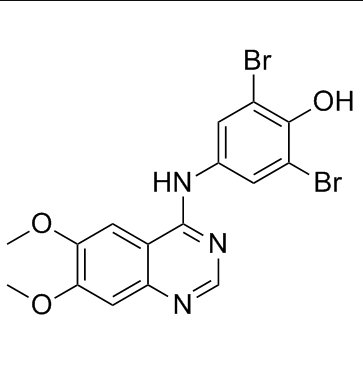
WHI-P97 is a novel, rationally designed, and potent inhibitor of Janus kinase (JAK)-3 with an estimated Ki value of 0.09 μM in modeling studies and a measured IC50 value of 2.5 μM in EGFR kinase inhibition assays. Treatment of mast cells with WHI-P97 inhibited the translocation of 5-lipoxygenase (5-LO) from the nucleoplasm to the nuclear membrane and consequently 5-LO-dependent leukotriene (LT) synthesis after IgE receptor/FcepsilonRI crosslinking by >90% at low micromolar concentrations. WHI-P97 did not directly inhibit the enzymatic activity of 5-LO, but prevented its translocation to the nuclear membrane without affecting the requisite calcium signal. WHI-P97 was very well tolerated in mice, with no signs of toxicity at dose levels ranging from 5 microg/kg to 50 mg/kg, and LD(10) was not reached at a 50 mg/kg dose level when administered as a single i. p. or i.v. bolus dose. Therapeutic WHI-P97 concentrations, which inhibit mast cell leukotriene synthesis in vitro, could easily be achieved in vivo after the i.v. or i.p. administration of a single nontoxic 40 mg/kg bolus dose of WHI-P97. Notably, WHI-P97 showed promising biological activity in a mouse model of allergic asthma at nontoxic dose levels. Treatment of ovalbumin-sensitized mice with WHI-P97 prevented the development of airway hyper-responsiveness to methacholine in a dose-dependent fashion. Furthermore, WHI-P97 inhibited the eosinophil recruitment to the airway lumen after the ovalbumin challenge in a dose-dependent fashion. Further development of WHI-P97 may therefore provide the basis for new and effective treatment as well as prevention programs for allergic asthma in clinical settings
Physicochemical Properties
| Molecular Formula | C16H13BR2N3O3 | |
| Molecular Weight | 455.11 | |
| Exact Mass | 452.932 | |
| CAS # | 211555-05-4 | |
| Related CAS # |
|
|
| PubChem CID | 3796 | |
| Appearance | White to gray solid powder | |
| Density | 1.785 | |
| LogP | 4.694 | |
| Hydrogen Bond Donor Count | 2 | |
| Hydrogen Bond Acceptor Count | 6 | |
| Rotatable Bond Count | 4 | |
| Heavy Atom Count | 24 | |
| Complexity | 408 | |
| Defined Atom Stereocenter Count | 0 | |
| InChi Key | YVCXQRVVNQMZEI-UHFFFAOYSA-N | |
| InChi Code | InChI=1S/C16H13Br2N3O3/c1-23-13-5-9-12(6-14(13)24-2)19-7-20-16(9)21-8-3-10(17)15(22)11(18)4-8/h3-7,22H,1-2H3,(H,19,20,21) | |
| Chemical Name |
|
|
| Synonyms |
|
|
| HS Tariff Code | 2934.99.9001 | |
| Storage |
Powder-20°C 3 years 4°C 2 years In solvent -80°C 6 months -20°C 1 month |
|
| Shipping Condition | Room temperature (This product is stable at ambient temperature for a few days during ordinary shipping and time spent in Customs) |
Biological Activity
| ln Vitro | At low micromolar doses, WHI-P97 prevents >90% of 5-lipoxygenase (5-LO) translocation from the nucleoplasm to the nuclear membrane, which in turn prevents 5-LO-dependent leukotriene (LT) generation following IgE receptor/FcεRI crosslinking[1]. Significantly lessening the IgE/antigen-induced LTC4 release from mast cells is WHI-P97 (30 μM)[1]. |
| ln Vivo | When provided as a single ip or iv bolus dosage, WHI-P97 is very well tolerated in mice, showing no symptoms of toxicity at dose levels ranging from 5 μg/kg to 50 mg/kg. Additionally, when LD10 is reached at a 50 mg/kg dose level, it is not achieved[1]. WHI-P97 (i.v. injection; 40 mg/kg; single dose) in CD-1 mice has a 58.9-minute elimination half-life (t1/2) and a systemic clearance (CL) of 891 ml/h/kg; in BALB/c mice, the t1/2 is 84.2 minutes and the CL is 1513 ml/h/kg. In CD-1 mice, the AUC and Cmax values are 107.3 μM and 296.7 μM, respectively. Furthermore, in BALB/c mice, the IC50 values are 212.7 μM and 58.4 μM, respectively. In CD-1 mice, the huge volume of distribution is 322 ml/kg, but in BALB/c mice, it is 415 ml/kg [1]. In a dose-dependent manner, WHI-P97 (intraperitoneal injection; 40 mg/kg; 24 days) protects ovalbumin-sensitized mice from developing airway hyperresponsiveness to methacholine. In a dose-dependent manner, WHI-P97 prevents eosinophil recruitment to the airway lumen following the ovalbumin challenge[1]. |
| Animal Protocol |
Animal/Disease Models: BALB/c mouse model of allergic asthma[1] Doses: 40 mg/kg Route of Administration: intraperitoneal (ip)injection; 24 days Experimental Results: demonstrated promising biological activity in a mouse model of allergic asthma at nontoxic dose levels. |
| References |
[1]. Treatment of allergic asthma by targeting janus kinase 3-dependent leukotriene synthesis in mast cells with 4-(3', 5'-dibromo-4'-hydroxyphenyl)amino-6,7-dimethoxyquinazoline (WHI-P97). J Pharmacol Exp Ther. 2000 Dec;295(3):912-26. |
| Additional Infomation | 2,6-dibromo-4-[(6,7-dimethoxy-4-quinazolinyl)amino]phenol is a member of quinazolines. |
Solubility Data
| Solubility (In Vitro) |
|
|||
| Solubility (In Vivo) |
Solubility in Formulation 1: ≥ 0.59 mg/mL (1.30 mM) (saturation unknown) in 10% DMSO + 40% PEG300 + 5% Tween80 + 45% Saline (add these co-solvents sequentially from left to right, and one by one), clear solution. For example, if 1 mL of working solution is to be prepared, you can add 100 μL of 5.9 mg/mL clear DMSO stock solution to 400 μL of PEG300 and mix evenly; then add 50 μL of Tween-80 to the above solution and mix evenly; then add 450 μL of normal saline to adjust the volume to 1 mL. Preparation of saline: Dissolve 0.9 g of sodium chloride in 100 mL ddH₂ O to obtain a clear solution. Solubility in Formulation 2: ≥ 0.59 mg/mL (1.30 mM) (saturation unknown) in 10% DMSO + 90% Corn Oil (add these co-solvents sequentially from left to right, and one by one), clear solution. For example, if 1 mL of working solution is to be prepared, you can add 100 μL of 5.9 mg/mL clear DMSO stock solution to 900 μL of corn oil and mix evenly. (Please use freshly prepared in vivo formulations for optimal results.) |
| Preparing Stock Solutions | 1 mg | 5 mg | 10 mg | |
| 1 mM | 2.1973 mL | 10.9864 mL | 21.9727 mL | |
| 5 mM | 0.4395 mL | 2.1973 mL | 4.3945 mL | |
| 10 mM | 0.2197 mL | 1.0986 mL | 2.1973 mL |