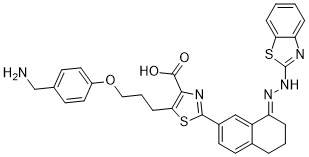
WEHI-539 has an IC50 value of 1.1 nM and is a powerful and selective inhibitor of BCL-XL. Increased activity of caspase 3/7, PARP cleavage, and annexin V labeling are caused by carboplatin when WEHI-539 is used. In Ovcar-4 (5 μM in Ovcar-4) and Ovsaho (1 μM in Ovsaho) cells, WEHI-539 results in observable PARP cleavage when used alone. In addition to inducing a slow dissociation rate and extremely strong BCL-XL binding with IC50 and KD values close to or below 1 nM, WEHI-539 also triggers apoptotic reactions that are dependent on BAX, BAK, or both. Additionally, because elevated levels of MCL-1, BCL-2, and BCL-W confer significant resistance, its biological activity is correlated with its binding profile. Additionally, its capacity to destroy platelets is a recognized indicator of on-target BCL-XL inhibition.
Physicochemical Properties
| Molecular Formula | C31H29N5O3S2 | |
| Molecular Weight | 583.72 | |
| Exact Mass | 583.171 | |
| Elemental Analysis | C, 63.79; H, 5.01; N, 12.00; O, 8.22; S, 10.98 | |
| CAS # | 1431866-33-9 | |
| Related CAS # | WEHI-539 hydrochloride;2070018-33-4 | |
| PubChem CID | 71297207 | |
| Appearance | Solid powder | |
| Density | 1.4±0.1 g/cm3 | |
| Boiling Point | 827.6±75.0 °C at 760 mmHg | |
| Flash Point | 454.3±37.1 °C | |
| Vapour Pressure | 0.0±3.2 mmHg at 25°C | |
| Index of Refraction | 1.737 | |
| LogP | 6.85 | |
| Hydrogen Bond Donor Count | 3 | |
| Hydrogen Bond Acceptor Count | 10 | |
| Rotatable Bond Count | 10 | |
| Heavy Atom Count | 41 | |
| Complexity | 903 | |
| Defined Atom Stereocenter Count | 0 | |
| SMILES | OC(C1=C(CCCOC2=CC=C(CN)C=C2)SC(C3=CC4=C(CCC/C4=N\NC5=NC(C=CC=C6)=C6S5)C=C3)=N1)=O |
|
| InChi Key | JKMWZKPAXZBYEH-JWHWKPFMSA-N | |
| InChi Code | InChI=1S/C31H29N5O3S2/c32-18-19-10-14-22(15-11-19)39-16-4-9-27-28(30(37)38)34-29(40-27)21-13-12-20-5-3-7-24(23(20)17-21)35-36-31-33-25-6-1-2-8-26(25)41-31/h1-2,6,8,10-15,17H,3-5,7,9,16,18,32H2,(H,33,36)(H,37,38)/b35-24+ | |
| Chemical Name | 5-[3-[4-(aminomethyl)phenoxy]propyl]-2-[(8E)-8-(1,3-benzothiazol-2-ylhydrazinylidene)-6,7-dihydro-5H-naphthalen-2-yl]-1,3-thiazole-4-carboxylic acid | |
| Synonyms |
|
|
| HS Tariff Code | 2934.99.9001 | |
| Storage |
Powder-20°C 3 years 4°C 2 years In solvent -80°C 6 months -20°C 1 month |
|
| Shipping Condition | Room temperature (This product is stable at ambient temperature for a few days during ordinary shipping and time spent in Customs) |
Biological Activity
| Targets | Bcl-xL (IC50 = 1.1 nM) | ||
| ln Vitro |
|
||
| ln Vivo |
|
||
| Enzyme Assay |
The assay buffer (stock 50 mM HEPES and 100 mM NaCl, pH 7.5) is prepared fresh daily and adjusted to 5 mM DTT, casein (0.1 mg/mL sodium salt; aliquots stored at -20 °C) and Tween 20. The prosurvival BCL-2 family protein BCL-X(L) is often overexpressed in solid tumors and renders malignant tumor cells resistant to anticancer therapeutics. Enhancing apoptotic responses by inhibiting BCL-X(L) will most likely have widespread utility in cancer treatment and, instead of inhibiting multiple prosurvival BCL-2 family members, a BCL-X(L)-selective inhibitor would be expected to minimize the toxicity to normal tissues. We describe the use of a high-throughput screen to discover a new series of small molecules targeting BCL-X(L) and their structure-guided development by medicinal chemistry. The optimized compound, WEHI-539 (7), has high affinity (subnanomolar) and selectivity for BCL-X(L) and potently kills cells by selectively antagonizing its prosurvival activity. WEHI-539 will be an invaluable tool for distinguishing the roles of BCL-X(L) from those of its prosurvival relatives, both in normal cells and notably in malignant tumor cells, many of which may prove to rely upon BCL-X(L) for their sustained growth.[1] |
||
| Cell Assay | Wild-type (WT), mcl-1−/−, bcl-2−/− or bcl-x−/− MEFs were treated with 10 μM WEHI-539 or ABT-737 for 1 h and fractionated into mitochondrial-enriched (pellet) and cytosolic (soluble) fractions, which were subjected to SDS-PAGE and immunoblotted with antibody against cytochrome c (anti-cyt c); HSP70 was used as a loading control. | ||
| Animal Protocol |
|
||
| References |
[1]. Structure-guided design of a selective BCL-X(L) inhibitor. Nat Chem Biol. 2013 Jun;9(6):390-7. [2]. Antagonism of Bcl-XL is necessary for synergy between carboplatin and BH3 mimetics in ovarian cancer cells. J Ovarian Res. 2016 Apr 14;9:25. |
||
| Additional Infomation | Background: BH3 mimetics are a class of drugs that antagonize the Bcl-2 family of apoptosis inhibitors. We have previously shown that these compounds can potentiate the activity of carboplatin against several ovarian cancer cell lines. However, recent clinical studies have highlighted that BH3 mimetics which antagonise Bcl-XL are associated with significant thrombocytopenia. This has led to the development of ABT-199 which specifically inhibits Bcl-2. Unfortunately, Bcl-XL appears to be more frequently deregulated in ovarian cancer than Bcl-2. We therefore compared the ability of ABT-199, and the Bcl-XL selective compound WEHI-539, to potentiate the activity of carboplatin in ovarian cancer cell lines. Methods: WEHI-539, ABT-737 and ABT-199 were tested in combination with carboplatin using a panel of 6 ovarian cancer cell lines. The activity of the drugs was evaluated using cell growth assays, staining with trypan bue and measurement of apoptosis by measuring caspase 3/7 activity, PARP cleavage and annexin-V/propidium iodide staining. Results: We found that WEHI-539 and ABT-737, but not ABT-199, were synergistic with carboplatin in cell growth assays and potentiated cell death when assessed by trypan blue staining. Furthermore, WEHI-539 and ABT-737 augmented carboplatin induced caspase 3/7 activity, PARP cleavage and annexin V labelling, but ABT-199 failed to do so. Conclusions: These observations suggest that compounds which target Bcl-XL are necessary if BH3 mimetics are to be successfully used to treat patients with ovarian cancer and this highlights the need to develop strategies to minimize thrombocytopenia induced by such compounds.[2] |
Solubility Data
| Solubility (In Vitro) |
|
|||
| Solubility (In Vivo) |
Note: Listed below are some common formulations that may be used to formulate products with low water solubility (e.g. < 1 mg/mL), you may test these formulations using a minute amount of products to avoid loss of samples. Injection Formulations (e.g. IP/IV/IM/SC) Injection Formulation 1: DMSO : Tween 80: Saline = 10 : 5 : 85 (i.e. 100 μL DMSO stock solution → 50 μL Tween 80 → 850 μL Saline) *Preparation of saline: Dissolve 0.9 g of sodium chloride in 100 mL ddH ₂ O to obtain a clear solution. Injection Formulation 2: DMSO : PEG300 :Tween 80 : Saline = 10 : 40 : 5 : 45 (i.e. 100 μL DMSO → 400 μLPEG300 → 50 μL Tween 80 → 450 μL Saline) Injection Formulation 3: DMSO : Corn oil = 10 : 90 (i.e. 100 μL DMSO → 900 μL Corn oil) Example: Take the Injection Formulation 3 (DMSO : Corn oil = 10 : 90) as an example, if 1 mL of 2.5 mg/mL working solution is to be prepared, you can take 100 μL 25 mg/mL DMSO stock solution and add to 900 μL corn oil, mix well to obtain a clear or suspension solution (2.5 mg/mL, ready for use in animals). Injection Formulation 4: DMSO : 20% SBE-β-CD in saline = 10 : 90 [i.e. 100 μL DMSO → 900 μL (20% SBE-β-CD in saline)] *Preparation of 20% SBE-β-CD in Saline (4°C,1 week): Dissolve 2 g SBE-β-CD in 10 mL saline to obtain a clear solution. Injection Formulation 5: 2-Hydroxypropyl-β-cyclodextrin : Saline = 50 : 50 (i.e. 500 μL 2-Hydroxypropyl-β-cyclodextrin → 500 μL Saline) Injection Formulation 6: DMSO : PEG300 : castor oil : Saline = 5 : 10 : 20 : 65 (i.e. 50 μL DMSO → 100 μLPEG300 → 200 μL castor oil → 650 μL Saline) Injection Formulation 7: Ethanol : Cremophor : Saline = 10: 10 : 80 (i.e. 100 μL Ethanol → 100 μL Cremophor → 800 μL Saline) Injection Formulation 8: Dissolve in Cremophor/Ethanol (50 : 50), then diluted by Saline Injection Formulation 9: EtOH : Corn oil = 10 : 90 (i.e. 100 μL EtOH → 900 μL Corn oil) Injection Formulation 10: EtOH : PEG300:Tween 80 : Saline = 10 : 40 : 5 : 45 (i.e. 100 μL EtOH → 400 μLPEG300 → 50 μL Tween 80 → 450 μL Saline) Oral Formulations Oral Formulation 1: Suspend in 0.5% CMC Na (carboxymethylcellulose sodium) Oral Formulation 2: Suspend in 0.5% Carboxymethyl cellulose Example: Take the Oral Formulation 1 (Suspend in 0.5% CMC Na) as an example, if 100 mL of 2.5 mg/mL working solution is to be prepared, you can first prepare 0.5% CMC Na solution by measuring 0.5 g CMC Na and dissolve it in 100 mL ddH2O to obtain a clear solution; then add 250 mg of the product to 100 mL 0.5% CMC Na solution, to make the suspension solution (2.5 mg/mL, ready for use in animals). Oral Formulation 3: Dissolved in PEG400 Oral Formulation 4: Suspend in 0.2% Carboxymethyl cellulose Oral Formulation 5: Dissolve in 0.25% Tween 80 and 0.5% Carboxymethyl cellulose Oral Formulation 6: Mixing with food powders Note: Please be aware that the above formulations are for reference only. InvivoChem strongly recommends customers to read literature methods/protocols carefully before determining which formulation you should use for in vivo studies, as different compounds have different solubility properties and have to be formulated differently. (Please use freshly prepared in vivo formulations for optimal results.) |
| Preparing Stock Solutions | 1 mg | 5 mg | 10 mg | |
| 1 mM | 1.7132 mL | 8.5658 mL | 17.1315 mL | |
| 5 mM | 0.3426 mL | 1.7132 mL | 3.4263 mL | |
| 10 mM | 0.1713 mL | 0.8566 mL | 1.7132 mL |