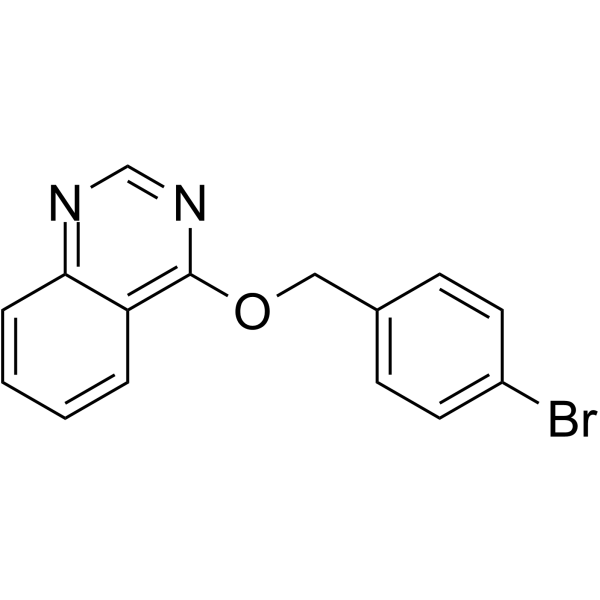
Physicochemical Properties
| Molecular Formula | C15H11BRN2O |
| Molecular Weight | 315.16 |
| Exact Mass | 314.00548 |
| Elemental Analysis | C, 57.16; H, 3.52; Br, 25.35; N, 8.89; O, 5.08 |
| CAS # | 737818-56-3 |
| PubChem CID | 2368291 |
| Appearance | White to off-white solid powder |
| LogP | 4.2 |
| Hydrogen Bond Donor Count | 0 |
| Hydrogen Bond Acceptor Count | 3 |
| Rotatable Bond Count | 3 |
| Heavy Atom Count | 19 |
| Complexity | 281 |
| Defined Atom Stereocenter Count | 0 |
| SMILES | N1=C2C(C=CC=C2)=C(OCC2=CC=C(Br)C=C2)N=C1 |
| InChi Key | DADJIQURPZZXBT-UHFFFAOYSA-N |
| InChi Code | InChI=1S/C15H11BrN2O/c16-12-7-5-11(6-8-12)9-19-15-13-3-1-2-4-14(13)17-10-18-15/h1-8,10H,9H2 |
| Chemical Name | 4-[(4-bromophenyl)methoxy]quinazoline |
| Synonyms | WAY-340935; WAY340935; WAY 340935; VEGFR2-IN-2; MLS000516729; CHEMBL1605411 |
| HS Tariff Code | 2934.99.9001 |
| Storage |
Powder-20°C 3 years 4°C 2 years In solvent -80°C 6 months -20°C 1 month |
| Shipping Condition | Room temperature (This product is stable at ambient temperature for a few days during ordinary shipping and time spent in Customs) |
Biological Activity
| Targets | VEGFR2 (IC50 = 19.32 nM) |
| ln Vitro | A series of novel 4-alkoxyquinazoline derivatives were prepared and synthesized and their biological activities were evaluated as potential inhibitors of vascular endothelial growth factor receptor 2 (VEGFR2). Of these compounds, compound 3j demonstrated the most potent inhibitory activities against VEGFR2 tyrosine kinase and cell proliferation, the IC50 values of this compound reaching up to 2.72 nM and 0.35 μM, respectively, compared with Tivozanib (3.40 nM and 0.38 μM). The obtained results, along with a 3D-QSAR study and molecular docking that was used for investigating the probable binding mode, could provide an important basis for further optimization of compound 3j as a potential tyrosine kinase inhibitor[1]. |
| References |
[1]. Design, synthesis, biological evaluation, and molecular modeling study of 4-alkoxyquinazoline derivatives as potential VEGFR2 kinase inhibitors. Org Biomol Chem. 2013 Nov 28;11(44):7676-86. |
Solubility Data
| Solubility (In Vitro) | DMSO : ~100 mg/mL (~317.30 mM) |
| Solubility (In Vivo) |
Solubility in Formulation 1: ≥ 2.5 mg/mL (7.93 mM) (saturation unknown) in 10% DMSO + 40% PEG300 + 5% Tween80 + 45% Saline (add these co-solvents sequentially from left to right, and one by one), clear solution. For example, if 1 mL of working solution is to be prepared, you can add 100 μL of 25.0 mg/mL clear DMSO stock solution to 400 μL PEG300 and mix evenly; then add 50 μL Tween-80 to the above solution and mix evenly; then add 450 μL normal saline to adjust the volume to 1 mL. Preparation of saline: Dissolve 0.9 g of sodium chloride in 100 mL ddH₂ O to obtain a clear solution. Solubility in Formulation 2: ≥ 2.5 mg/mL (7.93 mM) (saturation unknown) in 10% DMSO + 90% Corn Oil (add these co-solvents sequentially from left to right, and one by one), clear solution. For example, if 1 mL of working solution is to be prepared, you can add 100 μL of 25.0 mg/mL clear DMSO stock solution to 900 μL of corn oil and mix evenly. (Please use freshly prepared in vivo formulations for optimal results.) |
| Preparing Stock Solutions | 1 mg | 5 mg | 10 mg | |
| 1 mM | 3.1730 mL | 15.8650 mL | 31.7299 mL | |
| 5 mM | 0.6346 mL | 3.1730 mL | 6.3460 mL | |
| 10 mM | 0.3173 mL | 1.5865 mL | 3.1730 mL |