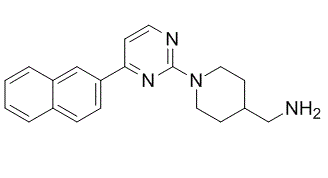
WAY-262611 (WAY262611) is a novel agonist of the wingless β-Catenin pathway with the potential for the treatment of bone disorders. It increases bone formation rate with EC50 of 0.63 uM in TCF-Luciferase assay. WAY-262611 has excellent pharmacokinetic properties and showed a dose dependent increase in the trabecular bone formation rate in ovariectomized rats following oral administration. WAY-262611 acts via the Wnt β-catenin pathway and most likely through inhibition of Dkk-1. WAY-262611 has excellent pharmacokinetic properties and showed a dose dependent increase in the trabecular bone formation rate in ovariectomized rats following oral administration. WAY-262611 was discovered from a high-throughput screening (HTS) campaign to discover small molecule leads for the treatment of bone disorders concluded with the discovery of a compound with a 2-aminopyrimidine template that targeted the Wnt beta-catenin cellular messaging system. Hit-to-lead in vitro optimization for target activity and molecular properties led to the discovery of (1-(4-(naphthalen-2-yl)pyrimidin-2-yl)piperidin-4-yl)methanamine (5, WAY-262611).
Physicochemical Properties
| Molecular Formula | C20H22N4 | |
| Molecular Weight | 318.42 | |
| Exact Mass | 318.184 | |
| CAS # | 1123231-07-1 | |
| Related CAS # |
|
|
| PubChem CID | 25199517 | |
| Appearance | Light yellow to yellow solid powder | |
| Density | 1.2±0.1 g/cm3 | |
| Boiling Point | 544.8±42.0 °C at 760 mmHg | |
| Flash Point | 283.3±27.9 °C | |
| Vapour Pressure | 0.0±1.5 mmHg at 25°C | |
| Index of Refraction | 1.638 | |
| LogP | 4.09 | |
| Hydrogen Bond Donor Count | 1 | |
| Hydrogen Bond Acceptor Count | 4 | |
| Rotatable Bond Count | 3 | |
| Heavy Atom Count | 24 | |
| Complexity | 393 | |
| Defined Atom Stereocenter Count | 0 | |
| InChi Key | QHLITPHIARVDJI-UHFFFAOYSA-N | |
| InChi Code | InChI=1S/C20H22N4/c21-14-15-8-11-24(12-9-15)20-22-10-7-19(23-20)18-6-5-16-3-1-2-4-17(16)13-18/h1-7,10,13,15H,8-9,11-12,14,21H2 | |
| Chemical Name | [1-(4-naphthalen-2-ylpyrimidin-2-yl)piperidin-4-yl]methanamine | |
| Synonyms |
|
|
| HS Tariff Code | 2934.99.9001 | |
| Storage |
Powder-20°C 3 years 4°C 2 years In solvent -80°C 6 months -20°C 1 month |
|
| Shipping Condition | Room temperature (This product is stable at ambient temperature for a few days during ordinary shipping and time spent in Customs) |
Biological Activity
| Targets |
WAY-262611 targets the wingless/β-catenin signaling pathway as an agonist [1] |
| ln Vitro |
With its modest kinase inhibition potential, high solubility, and most powerful activity in the primary assay, WAY-262611 stands out[1]. WAY-262611 activated the canonical Wnt/β-catenin signaling pathway in osteoblastic cells, as demonstrated by increased nuclear accumulation of β-catenin and upregulation of Wnt target genes (e.g., Axin2, Runx2) at the mRNA and protein levels [1] - WAY-262611 enhanced osteoblast differentiation and mineralization in primary murine calvarial osteoblasts and MC3T3-E1 cells, evidenced by increased alkaline phosphatase (ALP) activity (a marker of early osteoblast differentiation) and matrix mineralization (assessed by alizarin red staining) [1] |
| ln Vivo |
After oral administration, WAY-262611 exhibits dose-dependent increase in the trabecular bone formation rate in ovariectomized rats and excellent pharmacokinetic properties. Calvariae from WAY-262611-treated wt mice exhibit statistically higher BFR, whereas similarly treated KO animals do not differ from the control group. This suggests that WAY-262611 is likely inhibiting Dkk-1 and acting through the Wnt β-catenin pathway[1]. Daily oral administration of WAY-262611 (dose not specified) to adult mice for 28 days significantly increased the bone formation rate (assessed by calcein double labeling) in the trabecular bone of the distal femur; it also increased trabecular bone volume fraction (BV/TV), trabecular thickness (Tb.Th), and trabecular number (Tb.N), while decreasing trabecular separation (Tb.Sp) [1] - WAY-262611 treatment did not affect bone resorption markers (e.g., serum CTX-1 levels) or body weight in mice, indicating a specific effect on bone formation without overt systemic side effects [1] |
| Enzyme Assay |
WAY-262611 is a novel agonist of the wingless β-Catenin pathway that increases bone formation rate with EC50 of 0.63 uM in TCF-Luciferase assay. WAY-262611 has the most potent activity in the primary assay, low kinase inhibition potential, and high solubility. Wnt/β-catenin signaling activation assay: Osteoblastic cells (MC3T3-E1 or primary murine calvarial osteoblasts) were treated with serial concentrations of WAY-262611 (or vehicle control) for 24–72 h; nuclear and cytoplasmic fractions were isolated to detect β-catenin localization via Western blotting; quantitative real-time PCR (qRT-PCR) was performed to measure the mRNA expression of Wnt target genes (Axin2, Runx2), and Western blotting was used to verify protein levels of these genes [1] |
| Cell Assay |
Osteoblast differentiation assay: Primary murine calvarial osteoblasts and MC3T3-E1 cells were seeded in culture plates and treated with WAY-262611 (or DMSO as vehicle) at different concentrations; alkaline phosphatase (ALP) activity was measured at day 7 (early differentiation stage) using a colorimetric assay; matrix mineralization was evaluated at day 21 by alizarin red staining, and the stained mineralized nodules were quantified via spectrophotometry after solubilization [1] |
| Animal Protocol |
Rats: WAY-262611 is dissolved in DMSO and diluted with saline for iv (Rats). WAY-262611 is prepared in 0.5% methylcellulose/2% Tween-80 for po OVX rats14 are treated orally with 5 (po, vehicle=0.5% methylcellulose/2% Tween-80, qd, 28 days) at four doses. Trabecular bone formation rate (BFR) in the tibia is established in all dose groups at the end of the in-life portion of the study. A clear dose response and activity as low as 0.3 mg/kg/day are observed;
Mice: To confirm activity via the Wnt pathway, the calvariae of wild type (wt) and Dkk-1 knockout (KO) mice are treated with 5 once a day for 7 days (DMSO solution, sc injection). The KO animals are not expected to respond because of the inherent inability to inhibit a missing target protein, while wild type animals with fully expressed Dkk-1 are expected to show a pharmacological response. Ovariectomized rats and mice Bone formation assessment in adult mice: Adult mice were randomly divided into treatment and control groups; the treatment group received daily oral gavage of WAY-262611 for 28 consecutive days, while the control group received vehicle alone; calcein double labeling was performed (calcein injected intraperitoneally at day 7 and day 1 before sacrifice) to assess bone formation rate; at the end of the treatment period, mice were euthanized, distal femurs were harvested, and bone histomorphometric analysis (BV/TV, Tb.Th, Tb.N, Tb.Sp) was conducted on undecalcified bone sections; serum samples were collected to measure CTX-1 levels (a bone resorption marker) via ELISA, and body weight was monitored weekly [1] |
| Toxicity/Toxicokinetics |
WAY-262611 showed no overt systemic toxicity in mice during 28-day oral administration, with no significant changes in body weight compared to control mice [1] |
| References |
[1]. (1-(4-(Naphthalen-2-yl)pyrimidin-2-yl)piperidin-4-yl)methanamine: a wingless beta-catenin agonist that increases bone formation rate. J Med Chem. 2009 Nov 26;52(22):6962-5. [2]. GDF5 reduces MMP13 expression in human chondrocytes via DKK1 mediated canonical Wnt signaling inhibition. Osteoarthritis Cartilage. 2014 Apr;22(4):566-77. |
| Additional Infomation |
[1-[4-(2-naphthalenyl)-2-pyrimidinyl]-4-piperidinyl]methanamine is a member of naphthalenes. WAY-262611 (chemical name: (1-(4-(naphthalen-2-yl)pyrimidin-2-yl)piperidin-4-yl)methanamine) is a small-molecule agonist of the wingless/β-catenin signaling pathway, specifically designed to enhance bone formation [1] - The canonical Wnt/β-catenin signaling pathway plays a central role in regulating osteoblast differentiation and bone formation; activation of this pathway by WAY-262611 promotes osteoblast maturation and mineralization, leading to increased trabecular bone mass in vivo [1] - WAY-262611 is a potential therapeutic agent for the treatment of osteoporosis and other bone loss disorders due to its ability to selectively increase bone formation without affecting bone resorption [1] |
Solubility Data
| Solubility (In Vitro) |
DMSO: ~64 mg/mL ( 200.99 mM) Water: <10 mg/mL Ethanol: <10 mg/mL |
| Solubility (In Vivo) |
Solubility in Formulation 1: ≥ 1.67 mg/mL (5.24 mM) (saturation unknown) in 10% DMSO + 40% PEG300 + 5% Tween80 + 45% Saline (add these co-solvents sequentially from left to right, and one by one), clear solution. For example, if 1 mL of working solution is to be prepared, you can add 100 μL of 16.7 mg/mL clear DMSO stock solution to 400 μL PEG300 and mix evenly; then add 50 μL Tween-80 to the above solution and mix evenly; then add 450 μL normal saline to adjust the volume to 1 mL. Preparation of saline: Dissolve 0.9 g of sodium chloride in 100 mL ddH₂ O to obtain a clear solution. Solubility in Formulation 2: ≥ 1.67 mg/mL (5.24 mM) (saturation unknown) in 10% DMSO + 90% (20% SBE-β-CD in Saline) (add these co-solvents sequentially from left to right, and one by one), clear solution. For example, if 1 mL of working solution is to be prepared, you can add 100 μL of 16.7 mg/mL clear DMSO stock solution to 900 μL of 20% SBE-β-CD physiological saline solution and mix evenly. Preparation of 20% SBE-β-CD in Saline (4°C,1 week): Dissolve 2 g SBE-β-CD in 10 mL saline to obtain a clear solution. Solubility in Formulation 3: ≥ 1.67 mg/mL (5.24 mM) (saturation unknown) in 10% DMSO + 90% Corn Oil (add these co-solvents sequentially from left to right, and one by one), clear solution. For example, if 1 mL of working solution is to be prepared, you can add 100 μL of 16.7 mg/mL clear DMSO stock solution to 900 μL of corn oil and mix evenly. (Please use freshly prepared in vivo formulations for optimal results.) |
| Preparing Stock Solutions | 1 mg | 5 mg | 10 mg | |
| 1 mM | 3.1405 mL | 15.7025 mL | 31.4051 mL | |
| 5 mM | 0.6281 mL | 3.1405 mL | 6.2810 mL | |
| 10 mM | 0.3141 mL | 1.5703 mL | 3.1405 mL |