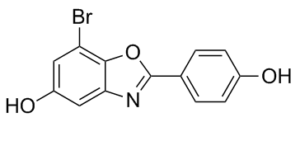
WAY-200070 (WAY200070) is a novel and selective agonist of the estrogen receptor β (ERRβ) with antidepressant effects. With an IC50 of 2.3 nM, it activates ERRβ. In animal models, estrogen has been shown in recent studies to have effects similar to those of antidepressants. WAY-200070, an ERRβ agonist, has been demonstrated in several in vivo mouse models to exhibit anxiolytic and antidepressant properties. WAY-200070 (30 mg/kg s.c.) caused striatal ER beta receptors from the cytosol to move into the nucleus after administration. In addition, WAY-200070 enhanced CFS activation four hours after administration, but not fifteen minutes later. It is evident that WAY-200070 has attached to estrogen receptors and initiated downstream processes by its effects on nuclear translocation and c-fos induction. This confirms that WAY-200070 was specifically targeting ER beta in the ER beta KO mice. Dopamine levels in the striatum of wild type mice increased by about 50% after receiving WAY-200070 (30 mg/kg s.c.).
Physicochemical Properties
| Molecular Formula | C13H8BRNO3 | |
| Molecular Weight | 306.12 | |
| Exact Mass | 304.969 | |
| Elemental Analysis | C, 51.01; H, 2.63; Br, 26.10; N, 4.58; O, 15.68 | |
| CAS # | 440122-66-7 | |
| Related CAS # |
|
|
| PubChem CID | 135418373 | |
| Appearance | White to beige solid powder | |
| LogP | 3.668 | |
| Hydrogen Bond Donor Count | 2 | |
| Hydrogen Bond Acceptor Count | 4 | |
| Rotatable Bond Count | 1 | |
| Heavy Atom Count | 18 | |
| Complexity | 296 | |
| Defined Atom Stereocenter Count | 0 | |
| SMILES | BrC1=C([H])C(=C([H])C2=C1OC(C1C([H])=C([H])C(=C([H])C=1[H])O[H])=N2)O[H] |
|
| InChi Key | BAAILVWEAXFTSF-UHFFFAOYSA-N | |
| InChi Code | InChI=1S/C13H8BrNO3/c14-10-5-9(17)6-11-12(10)18-13(15-11)7-1-3-8(16)4-2-7/h1-6,16-17H | |
| Chemical Name | 7-bromo-2-(4-hydroxyphenyl)-1,3-benzoxazol-5-ol | |
| Synonyms |
|
|
| HS Tariff Code | 2934.99.9001 | |
| Storage |
Powder-20°C 3 years 4°C 2 years In solvent -80°C 6 months -20°C 1 month |
|
| Shipping Condition | Room temperature (This product is stable at ambient temperature for a few days during ordinary shipping and time spent in Customs) |
Biological Activity
| Targets |
ERRβ (IC50 = 2.3 nM); ERRα (IC50 = 155 nM)
The target of WAY-200070 is estrogen receptor beta (ERβ), acting as a selective agonist of ERβ. [1] - WAY-200070 specifically targets estrogen receptor beta (ERβ) as an agonist. [2] - The specific target of WAY-200070 is estrogen receptor beta (ERβ), functioning as a selective agonist. [3] - WAY-200070 is a selective agonist of estrogen receptor beta (ERβ), with ERβ as its target. [4] |
| ln Vitro |
WAY 200070 is a novel and selective agonist that has antidepressant properties for the estrogen receptor β (ERRβ). With an IC50 of 2.3 nM, it activates ERRβ. In animal models, estrogen has been shown in recent studies to have effects similar to those of antidepressants. WAY-200070, an ERRβ agonist, has been demonstrated in several in vivo mouse models to exhibit anxiolytic and antidepressant properties. WAY-200070 (30 mg/kg s.c.) caused striatal ER beta receptors from the cytosol to move into the nucleus after administration. Moreover, four hours after administration, WAY-200070 raised c-fos activation, but not fifteen minutes later. WAY-200070 has bound to estrogen receptors and triggered downstream events, as evidenced by its nuclear translocation and c-fos induction effects. The fact that these effects are absent in ER beta KO mice indicates that WAY-200070 was specifically targeting ER beta. The striatum of wild type mice showed a delayed, roughly 50% increase in dopamine following the administration of WAY-200070 (30 mg/kg s.c.). In vitro binding studies using recombinant rat ERβ showed that there was no direct data on the binding affinity of WAY-200070 itself; however, the study compared the binding affinities of R-DPN and S-DPN (enantiomers of another ERβ agonist DPN) to ERβ, with S-DPN having a severalfold greater relative binding affinity for ERβ than R-DPN. Additionally, in cotransfection experiments of N-38 immortalized hypothalamic cells with an estrogen response element-luc reporter and ERβ, WAY-200070 was not directly tested for its transcriptional activation ability in this in vitro system; instead, S-DPN was shown to be a potent activator of transcription in vitro, while R-DPN was not [4] |
| ln Vivo |
In animal models, estrogen has been shown in recent studies to have effects similar to those of antidepressants. WAY-200070, an ERRβ agonist, has been demonstrated in several in vivo mouse models to exhibit anxiolytic and antidepressant properties. WAY-200070 (30 mg/kg s.c.) caused striatal ER beta receptors from the cytosol to move into the nucleus after administration. Moreover, four hours after administration, WAY-200070 raised c-fos activation, but not fifteen minutes later. WAY-200070 has bound to estrogen receptors and triggered downstream events, as evidenced by its nuclear translocation and c-fos induction effects. The fact that these effects are absent in ER beta KO mice indicates that WAY-200070 was specifically targeting ER beta. The striatum of wild type mice showed a delayed, roughly 50% increase in dopamine following the administration of WAY-200070 (30 mg/kg s.c.). The effect persisted for 90 to 240 minutes and was noteworthy. Mice with ER beta KO did not exhibit this increase. WAY-200070 (30 mg/kg s.c.) also caused a temporary, delayed increase in 5-HT levels in wild type mice by about 100%. 5-HTP accumulation was assessed in order to learn more about the impact of ER beta receptors on serotonergic function. It was discovered that ER beta KO mice had lower frontal cortex 5-HTP levels, which suggests lower tryptophan hydroxylase activity. In behavioral models, WAY-200070 (3–30 mg/kg s.c.) was also tested. In the mouse tail suspension test, WAY-200070 (30 mg/kg s.c.) shortened the immobility duration, suggesting an antidepressant-like effect. In the four-plate test, WAY-200070 (30 mg/kg) demonstrated effects similar to those of anxiolytics (more punished crossings) and stress-induced hyperthermia (attenuation of hyperthermic response). Positive modulation of ER beta function may offer a novel treatment for affective disorders, as supported by the effects of the selective ER beta agonist WAY-200070 on dopamine and serotonin, as well as the genotype-specific effects on neurochemistry and anxiolytic and antidepressant-like effects. In male wild-type mice, administration of WAY-200070 at a dose of 30 mg/kg subcutaneously (s.c.) caused nuclear translocation of striatal ERβ receptors from the cytosol within 15 minutes. At 4 hours (but not 15 minutes) after administration, it increased c-fos activation. These effects were absent in ERβ knockout (KO) mice. This dose also produced a delayed approximately 50% increase in dopamine in the striatum of wild-type mice, which was significant and maintained from 90 to 240 minutes, and this increase was not observed in ERβ KO mice. In wild-type mice, WAY-200070 (30 mg/kg s.c.) also induced a delayed and transient approximately 100% increase in 5-HT. ERβ KO mice had reduced frontal cortex levels of 5-HTP, indicating decreased tryptophan hydroxylase activity. In behavioral models, WAY-200070 (30 mg/kg s.c.) reduced immobility time in the mouse tail suspension test, showing an antidepressant-like effect. It also exhibited anxiolytic-like effects in the four-plate test (increased punished crossings) and stress-induced hyperthermia (attenuation of the hyperthermic response) [1] - In gonadally intact male and female CD-1 mice, WAY-200070 increased agonistic behaviors such as pushing down the intruder and aggressive grooming, while having no effect on attacks. In untreated mice, males attacked more than females, and gonadectomized (gonadex) animals showed less agonistic behavior than same-sex gonadally intact mice. Female mice spent as much time in intrasexual agonistic interactions as males in resident-intruder tests but used agonistic behaviors with extremely low levels of direct attacks, and this non-attack aggression in females was increased by acute activation of ERβ by WAY-200070. In gonadectomized male and female mice, specific effects of WAY-200070 on agonistic behavior were not clearly described, but it had effects on some behaviors such as total activity, social investigation, and non-social behavior (e.g., in castrated males, it affected the frequency of total activity, social investigation, and non-social behavior; similar effects were seen in ovx females) [2] - In ovariectomized (ovx) female mice, treatment with WAY-200070 resulted in a two-fold prolonged preference for the food eaten by their demonstrator in the social transmission of food preferences (STFP) paradigm. Higher doses of WAY-200070 produced prolonged preferences similar to those observed in intact female mice during the proestrus and diestrus phases. The effects of WAY-200070 might be partially due to its impact on submissive behavior. In contrast, ovx mice treated with the ERα selective agonist PPT failed to learn the socially acquired food preference, and the effects of PPT could not be explained by changes in total food intake or the type of interaction with the demonstrator mouse [3] - In ovariectomized young adult female Sprague Dawley rats, treatment with WAY-200070 (along with racemic DPN and S-DPN) significantly decreased anxiety-like behaviors in both the open-field test and the elevated plus maze. In the forced swim test, it significantly reduced depressive-like behaviors compared with vehicle-, R-DPN-, or propylpyrazoletriol (ERα agonist)-treated animals. Additionally, WAY-200070 affected plasma corticosterone (CORT) levels after the forced swim test and had an impact on paraventricular nucleus (PVN) c-fos mRNA levels, as measured by in situ hybridization (ISH) [4] |
| Enzyme Assay |
WAY-200070 has a 2.3 nM IC50 and acts as a selective agonist of the estrogen receptor β (ERRβ). There were no descriptions of enzyme assay or target binding assay protocols for WAY-200070 in this article [3] - For the in vitro binding study of ERβ: Recombinant rat ERβ was used, and the binding affinities of different ligands (including R-DPN and S-DPN, but not directly WAY-200070) to ERβ were measured to compare their relative binding capacities. The specific steps involved preparing the recombinant ERβ, incubating it with the ligands under appropriate conditions, and then detecting the binding complexes using relevant techniques to determine the binding affinity. For the transcriptional activation assay in N-38 cells: N-38 immortalized hypothalamic cells were cotransfected with an estrogen response element-luc reporter construct and an expression vector containing ERβ. After transfection, the cells were treated with different ligands (such as estradiol, DPN, S-DPN, R-DPN; WAY-200070 was not directly tested in this specific assay) at various concentrations (1, 10, and 100 nM) for 16 hours. The relative light units (RLU) were measured, and the percent change in RLU from vehicle-treated empty vector controls (set at 100%) was calculated to evaluate the transcriptional activation ability of the ligands. In another part of the assay, the effect of ligands (1 nM) on ERE-luc promoter activity in cells cotransfected with ERβ was also tested in the presence or absence of the ERβ antagonist PHTPP (10 μM) [4] |
| Animal Protocol |
For neurochemistry and in vitro studies, mice with and without ER beta KO were used. Male ERβKO, ERαKO, and wild type C57BL/6 mice (10–12 weeks old; Taconic) were the mice used in the models. The tail suspension test was performed on male Swiss Webster mice (25–35 g, Charles River). The stress-induced hyperthermia and control microdialysis experiments were conducted on male C57Bl/6 mice (25–35 g, Taconic). For the study of ERβ translocation and c-fos activation: Male wild-type and ERβ KO mice were used. WAY-200070 was administered subcutaneously at a dose of 30 mg/kg. At 15 minutes and 4 hours after administration, the mice were sacrificed, and striatal tissues were collected to detect the nuclear translocation of ERβ (by relevant histological or biochemical methods) and c-fos activation (using techniques like immunohistochemistry or western blot). For the measurement of dopamine and 5-HT levels: Male wild-type and ERβ KO mice received a subcutaneous injection of WAY-200070 at 30 mg/kg. Microdialysis was used to collect samples from the striatum at different time points (from 90 to 240 minutes) after administration, and the levels of dopamine and 5-HT in the samples were detected using appropriate analytical methods (such as high-performance liquid chromatography). For the tail suspension test: Male mice were given a subcutaneous dose of 30 mg/kg WAY-200070. After a certain period of time, the mice were suspended by their tails, and the immobility time was recorded within a specific observation period to evaluate the antidepressant-like effect. For the four-plate test: Male mice were administered 30 mg/kg WAY-200070 subcutaneously. Then, the mice were placed in a four-plate apparatus, and the number of punished crossings (crossing the plates with an electric shock) was recorded to assess the anxiolytic-like effect. For the stress-induced hyperthermia test: Male mice were injected subcutaneously with 30 mg/kg WAY-200070. The body temperature of the mice was measured before and after stress induction, and the attenuation of the hyperthermic response was analyzed to determine the anxiolytic-like effect [1] - For the resident-intruder test: Gonadally intact and gonadectomized (gonadex) male and female CD-1 mice were used as resident mice, and gonadex same-sex mice were used as intruders. WAY-200070 was administered to the resident mice (the specific dose was not clearly stated in the abstract, but it was a dose that could produce effects). After administration, each resident mouse was placed in its home cage (the test arena) for a period of adaptation, and then the intruder mouse was introduced into the cage. The interaction between the two mice was videotaped for 15 minutes. The recorded videos were analyzed to count and measure various agonistic behaviors (such as pushing down the intruder, aggressive grooming, attacks), social behaviors (like social investigation), and other activities (total activity, non-social non-locomotor behaviors) [2] - For the social transmission of food preferences (STFP) test: Ovariectomized (ovx) female mice were used. WAY-200070 was administered to the ovx mice at different doses (higher doses were mentioned to produce specific effects). First, a demonstrator mouse was fed a specific flavored food (the target food for preference learning) for a certain period. Then, the treated ovx mice (the observer mice) were paired with the demonstrator mice for a social interaction period to allow the observer mice to obtain information about the food eaten by the demonstrator. After the social interaction, the observer mice were given a choice between the flavored food eaten by the demonstrator and another unflavored or differently flavored food. The intake of each food by the observer mice was measured over a specific time period to calculate the preference for the demonstrated food [3] - For the open-field test: Ovariectomized young adult female Sprague Dawley rats were treated with WAY-200070 (the specific dose was not clearly indicated in the abstract, but it was an effective dose). The rats were placed in an open-field apparatus (a square or circular arena with marked areas). During a fixed observation time, behaviors such as the time spent in the middle squares, the number of novel item interactions, and the frequency of rearing were recorded to evaluate anxiety-like behaviors. For the elevated plus maze test: The treated rats were placed on the elevated plus maze (which has open arms and closed arms). Within a specific observation period, the number of open arm entries, the time spent in the open arms, and the rearing frequency were recorded to assess anxiety-like behaviors. For the forced swim test: The rats treated with WAY-200070 were placed in a container filled with water (at a certain temperature and depth) to induce a state of helplessness. During the test period, behaviors such as the number of head dips, the time spent immobile, and the time spent struggling were recorded to measure depressive-like behaviors. For the measurement of plasma CORT levels: After the forced swim test, blood samples were collected from the rats 20 minutes after the start of the swim test. The plasma was separated from the blood samples, and the concentration of CORT in the plasma was determined using appropriate detection methods (such as enzyme-linked immunosorbent assay). For the detection of PVN c-fos mRNA levels: After the forced swim test, the rats were sacrificed, and brain tissues containing the paraventricular nucleus (PVN) were collected. In situ hybridization (ISH) was performed on the brain sections to detect the expression levels of c-fos mRNA in the PVN. The relative levels of c-fos mRNA expression were quantified using image analysis software, expressed as arbitrary density units (ADU) [4] |
| References |
[1]. WAY-200070, a selective agonist of estrogen receptor beta as a potential novel anxiolytic/antidepressant agent. Neuropharmacology. 2008 Jun;54(7):1136-42. [2]. Agonistic behavior in males and females: effects of an estrogen receptor beta agonist in gonadectomized and gonadally intact mice. Psychoneuroendocrinology. 2010 Aug;35(7):1008-22. [3]. Differential effects of estrogen receptor alpha and beta specific agonists on social learning of food preferences in female mice. Neuropsychopharmacology. 2008 Sep;33(10):2362-75. [4]. Estrogen receptor-beta agonist diarylpropionitrile: biological activities of R- and S-enantiomers on behavior and hormonal response to stress. Endocrinology. 2009 Apr;150(4):1817-25. |
| Additional Infomation |
Recent studies have reported that estrogen has antidepressant-like effects in animal models. This study used the highly selective ERβ agonist WAY-200070 to explore the role of ERβ activation in brain neurochemistry and activity in antidepressant and anxiolytic models in male mice. The results support that positive modulation of ERβ function by WAY-200070 may provide a novel treatment for affective disorders [1] - Affiliative and agonistic social interactions are mediated by gonadal hormones. Research with ERα or ERβ knockout (KO) mice has shown that long-term inactivation of ERα decreases male aggression, while inactivation of ERβ increases it, and opposite effects were found in female alphaERKO and betaERKO mice. However, the role of acute activation of ERα or ERβ in the agonistic responses of adult non-KO mice was unknown. This study investigated the effects of the ERβ selective agonist WAY-200070 on agonistic and social behavior, and the results indicated that acute activation of ERβ similarly mediates agonistic behavior in adult male and female CD-1 mice [2] - There is an evolutionary advantage to learning food preferences from conspecifics, as social learning allows individuals to avoid the risks associated with trial-and-error individual learning. The social transmission of food preferences (STFP) paradigm examines this advantage. Females in the proestrus and diestrus phases of the estrous cycle show a prolonged preference for the demonstrated food compared to estrus and ovariectomized females. Both ERα and ERβ KO mice have impaired social recognition, suggesting that both receptors may be involved in other types of socially dependent learning, including STFP. This study investigated the effect of WAY-200070 (ERβ selective agonist) on STFP, and the results suggested that the estrous cycle's effects on social learning may be due to the action of ERβ on submissive behavior or ERβ countering the effect of ERα [3] - Estrogens have been shown to have both positive and negative effects on anxiety and depressive-like behaviors, which may be explained by the existence of two distinct estrogen receptor (ER) systems, ERα and ERβ. The ERβ agonist diarylpropionitrile (DPN) has anxiolytic properties in rats, and DPN exists as a racemic mixture of R-DPN and S-DPN. This study compared the in vitro binding affinity, transcriptional activation ability, and in vivo endocrine and behavioral responses of R-DPN and S-DPN. WAY-200070 (another ERβ agonist) was used as a positive control in in vivo experiments, and the results indicated that estrogen's positive effects on mood, including its anxiolytic and antidepressive actions, are due to its actions at ERβ [4] |
Solubility Data
| Solubility (In Vitro) |
|
|||
| Solubility (In Vivo) |
Solubility in Formulation 1: ≥ 10 mg/mL (32.67 mM) (saturation unknown) in 10% DMSO + 90% (20% SBE-β-CD in Saline) (add these co-solvents sequentially from left to right, and one by one), clear solution. For example, if 1 mL of working solution is to be prepared, you can add 100 μL of 100.0 mg/mL clear DMSO stock solution to 900 μL of 20% SBE-β-CD physiological saline solution and mix evenly. Preparation of 20% SBE-β-CD in Saline (4°C,1 week): Dissolve 2 g SBE-β-CD in 10 mL saline to obtain a clear solution. Solubility in Formulation 2: ≥ 10 mg/mL (32.67 mM) (saturation unknown) in 10% DMSO + 90% Corn Oil (add these co-solvents sequentially from left to right, and one by one), clear solution. For example, if 1 mL of working solution is to be prepared, you can add 100 μL of 100.0 mg/mL clear DMSO stock solution to 900 μL of corn oil and mix evenly. (Please use freshly prepared in vivo formulations for optimal results.) |
| Preparing Stock Solutions | 1 mg | 5 mg | 10 mg | |
| 1 mM | 3.2667 mL | 16.3335 mL | 32.6669 mL | |
| 5 mM | 0.6533 mL | 3.2667 mL | 6.5334 mL | |
| 10 mM | 0.3267 mL | 1.6333 mL | 3.2667 mL |