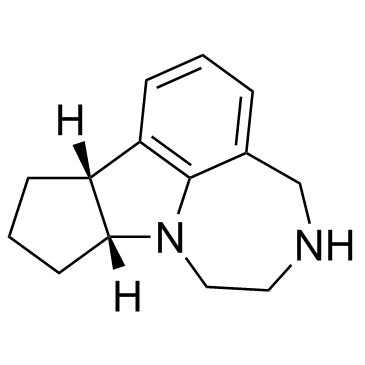
WAY-163909 is a novel, potent and selective 5-HT(2C) receptor agonist with a Ki of 10.5±1.1 nM. It enhances the preclinical potency of current antipsychotics.
Physicochemical Properties
| Molecular Formula | C14H18N2 |
| Molecular Weight | 214.30612 |
| Exact Mass | 214.147 |
| Elemental Analysis | C, 78.46; H, 8.47; N, 13.07 |
| CAS # | 428868-32-0 |
| Related CAS # | 428868-35-3 (HCl) |
| PubChem CID | 10130594 |
| Appearance | Typically exists as solid at room temperature |
| Density | 1.2±0.1 g/cm3 |
| Boiling Point | 350.4±21.0 °C at 760 mmHg |
| Flash Point | 160.2±13.0 °C |
| Vapour Pressure | 0.0±0.8 mmHg at 25°C |
| Index of Refraction | 1.645 |
| LogP | 2.11 |
| Hydrogen Bond Donor Count | 1 |
| Hydrogen Bond Acceptor Count | 2 |
| Rotatable Bond Count | 0 |
| Heavy Atom Count | 16 |
| Complexity | 278 |
| Defined Atom Stereocenter Count | 2 |
| SMILES | [H][C@@]12[C@@](N3CCNCC4=CC=CC2=C43)([H])CCC1 |
| InChi Key | XOSKJKGKWRIMGV-DGCLKSJQSA-N |
| InChi Code | InChI=1S/C14H18N2/c1-3-10-9-15-7-8-16-13-6-2-4-11(13)12(5-1)14(10)16/h1,3,5,11,13,15H,2,4,6-9H2/t11-,13-/m1/s1 |
| Chemical Name | (11R,15R)-7,10-diazatetracyclo[8.5.1.0^{5,16}.0^{11,15}]hexadeca-1,3,5(16)-triene |
| Synonyms | WAY-163909; WAY-163909; 428868-32-0; WAY 163,909; WAY163,909; MN9LW8268N; WAY-163,909; (7bR,10aR)-2,3,4,7b,8,9,10,10a-Octahydro-1H-cyclopenta[b][1,4]diazepino[6,7,1-hi]indole; DTXSID40436021; WAY163909 |
| HS Tariff Code | 2934.99.9001 |
| Storage |
Powder-20°C 3 years 4°C 2 years In solvent -80°C 6 months -20°C 1 month |
| Shipping Condition | Room temperature (This product is stable at ambient temperature for a few days during ordinary shipping and time spent in Customs) |
Biological Activity
| Targets |
WAY-163909 is a selective agonist of the 5-hydroxytryptamine2C (5-HT2C) receptor:
- Binding affinity (Ki) for human 5-HT2C: 15 ± 2 nM
- Selectivity over 5-HT2A (Ki = 580 ± 110 nM) and 5-HT2B (Ki = 1300 ± 200 nM)
- EC50 for 5-HT2C functional activation: 38 ± 3 nM (calcium flux assay)[1] |
| ln Vitro |
Functional activity: - Induced calcium mobilization in HEK-293 cells expressing human 5-HT2C receptors (EC50 = 38 nM; Emax = 95% of serotonin response) - No agonist activity at 5-HT1A, 5-HT1B, 5-HT1D, 5-HT3, or 5-HT7 receptors at 10 μM - Antagonized mCPP-induced hypolocomotion in rats (ED50 = 1.7 mg/kg, i.p.), confirming 5-HT2C engagement in vivo[1] WAY-163909 , a novel 5-hydroxytryptamine (HT)(2C) (serotonin) receptor-selective agonist is presented. WAY-163909 displaced [(125)I]2,5-dimethoxy-4-iodoamphetamine binding from human 5-HT(2C) receptor sites, in Chinese hamster ovary (CHO) cell membranes, with a K(i) value of 10.5 +/- 1.1 nM. Binding affinities determined for the human 5-HT(2A) and 5-HT(2B) receptor subtypes were 212 and 485 nM, respectively. In functional studies, WAY-163909 stimulated the mobilization of intracellular calcium in CHO cells stably expressing the human 5-HT(2C) receptor with an EC(50) value of 8 nM, and E(max) relative to 5-HT of 90%. WAY-163909 failed to stimulate calcium mobilization in cells expressing the human 5-HT(2A) receptor subtype (EC(50) >> 10muM) and was a 5-HT(2B) receptor partial agonist (EC(50) 185 nM, E(max) 40%). WAY-163909 exhibited negligible affinity (<50% inhibition at 1 muM) for other receptor sites examined, including human 5-HT(1A), D2, and D3 receptors, and the 5-HT transporter binding site in rat cortical membranes. WAY-163909 exhibited weak affinity for the human D4 (245 nM) and 5-HT(7) (343 nM) receptor subtypes and the alpha1 binding site in rat cortical membranes (665 nM). WAY-163909 produced a dose-dependent reduction in food intake in normal Sprague-Dawley rats (ED(50) = 2.93 mg/kg), an effect blocked by a 5-HT(2C) receptor antagonist but not by a 5-HT(2A) or 5-HT(2B) receptor antagonist. In addition, WAY-163909 decreased food intake in obese Zucker rats and diet-induced obese mice with ED(50) values of 1.4 and 5.19 mg/kg i.p., respectively, consistent with the potential utility of 5-HT(2C) receptor agonists as anti-obesity agents. |
| ln Vivo |
Anorectic effects: - Dose-dependently reduced food intake in fasted Sprague-Dawley rats (ED50 = 3.1 mg/kg, i.p.) - Maximal reduction: 76% at 10 mg/kg (p<0.001 vs. vehicle) - Effects blocked by 5-HT2C antagonist SB-242084 - No hyperlocomotion (unlike 5-HT2A agonists), indicating selectivity[1] |
| Enzyme Assay |
Anorectic effects: - Dose-dependently reduced food intake in fasted Sprague-Dawley rats (ED50 = 3.1 mg/kg, i.p.) - Maximal reduction: 76% at 10 mg/kg (p<0.001 vs. vehicle) - Effects blocked by 5-HT2C antagonist SB-242084 - No hyperlocomotion (unlike 5-HT2A agonists), indicating selectivity[1] |
| Animal Protocol |
Food intake study: - Male Sprague-Dawley rats fasted 18 hr, injected i.p. with WAY-163909 (0.3–30 mg/kg) or vehicle (0.9% saline). - Food presented immediately post-dosing; consumption measured at 1, 2, 4, and 24 hr.[1] Locomotor activity: - Rats habituated to activity chambers for 60 min, then dosed i.p. with WAY-163909 (1–30 mg/kg). - Horizontal movements recorded for 90 min post-dosing via photobeam detectors.[1] Drug interaction: - Rats pretreated with SB-242084 (1 mg/kg, s.c.) 15 min before WAY-163909 (10 mg/kg, i.p.) to assess 5-HT2C specificity.[1] |
| ADME/Pharmacokinetics |
- Brain penetration: Brain/plasma ratio = 0.32 ± 0.04 at 30 min post-i.p. injection (10 mg/kg) - Plasma clearance: 49 ± 8 mL/min/kg (rat) - Half-life (t1/2): 1.2 ± 0.3 hr (plasma), 1.5 ± 0.4 hr (brain) - Oral bioavailability: 34% (calculated from AUC0–∞)[1] |
| Toxicity/Toxicokinetics |
- No mortality or overt toxicity at doses ≤30 mg/kg (i.p.) in rats. - No changes in core body temperature or locomotor stereotypy. - Plasma protein binding: 82.5% (rat)[1] |
| References |
[1]. WAY-163909 [(7bR, 10aR)-1,2,3,4,8,9,10,10a-octahydro-7bH-cyclopenta-[b][1,4]diazepino[6,7,1hi]indole] a novel 5-hydroxytryptamine 2C receptor-selective agonist with anorectic activity. J Pharmacol Exp Ther. 2005 May; 313(2):862-9. |
| Additional Infomation |
- Mechanism: Full agonist at 5-HT2C receptors, activating phospholipase C-mediated signaling.
- Behavioral specificity: Reduces food intake without inducing anxiety-like behaviors (confirmed in elevated plus-maze).
- Therapeutic potential: Proposed as anti-obesity agent due to anorectic effects without 5-HT2A-related side effects.[1] |
Solubility Data
| Solubility (In Vitro) | May dissolve in DMSO (in most cases), if not, try other solvents such as H2O, Ethanol, or DMF with a minute amount of products to avoid loss of samples |
| Solubility (In Vivo) |
Note: Listed below are some common formulations that may be used to formulate products with low water solubility (e.g. < 1 mg/mL), you may test these formulations using a minute amount of products to avoid loss of samples. Injection Formulations (e.g. IP/IV/IM/SC) Injection Formulation 1: DMSO : Tween 80: Saline = 10 : 5 : 85 (i.e. 100 μL DMSO stock solution → 50 μL Tween 80 → 850 μL Saline) *Preparation of saline: Dissolve 0.9 g of sodium chloride in 100 mL ddH ₂ O to obtain a clear solution. Injection Formulation 2: DMSO : PEG300 :Tween 80 : Saline = 10 : 40 : 5 : 45 (i.e. 100 μL DMSO → 400 μLPEG300 → 50 μL Tween 80 → 450 μL Saline) Injection Formulation 3: DMSO : Corn oil = 10 : 90 (i.e. 100 μL DMSO → 900 μL Corn oil) Example: Take the Injection Formulation 3 (DMSO : Corn oil = 10 : 90) as an example, if 1 mL of 2.5 mg/mL working solution is to be prepared, you can take 100 μL 25 mg/mL DMSO stock solution and add to 900 μL corn oil, mix well to obtain a clear or suspension solution (2.5 mg/mL, ready for use in animals). Injection Formulation 4: DMSO : 20% SBE-β-CD in saline = 10 : 90 [i.e. 100 μL DMSO → 900 μL (20% SBE-β-CD in saline)] *Preparation of 20% SBE-β-CD in Saline (4°C,1 week): Dissolve 2 g SBE-β-CD in 10 mL saline to obtain a clear solution. Injection Formulation 5: 2-Hydroxypropyl-β-cyclodextrin : Saline = 50 : 50 (i.e. 500 μL 2-Hydroxypropyl-β-cyclodextrin → 500 μL Saline) Injection Formulation 6: DMSO : PEG300 : castor oil : Saline = 5 : 10 : 20 : 65 (i.e. 50 μL DMSO → 100 μLPEG300 → 200 μL castor oil → 650 μL Saline) Injection Formulation 7: Ethanol : Cremophor : Saline = 10: 10 : 80 (i.e. 100 μL Ethanol → 100 μL Cremophor → 800 μL Saline) Injection Formulation 8: Dissolve in Cremophor/Ethanol (50 : 50), then diluted by Saline Injection Formulation 9: EtOH : Corn oil = 10 : 90 (i.e. 100 μL EtOH → 900 μL Corn oil) Injection Formulation 10: EtOH : PEG300:Tween 80 : Saline = 10 : 40 : 5 : 45 (i.e. 100 μL EtOH → 400 μLPEG300 → 50 μL Tween 80 → 450 μL Saline) Oral Formulations Oral Formulation 1: Suspend in 0.5% CMC Na (carboxymethylcellulose sodium) Oral Formulation 2: Suspend in 0.5% Carboxymethyl cellulose Example: Take the Oral Formulation 1 (Suspend in 0.5% CMC Na) as an example, if 100 mL of 2.5 mg/mL working solution is to be prepared, you can first prepare 0.5% CMC Na solution by measuring 0.5 g CMC Na and dissolve it in 100 mL ddH2O to obtain a clear solution; then add 250 mg of the product to 100 mL 0.5% CMC Na solution, to make the suspension solution (2.5 mg/mL, ready for use in animals). Oral Formulation 3: Dissolved in PEG400 Oral Formulation 4: Suspend in 0.2% Carboxymethyl cellulose Oral Formulation 5: Dissolve in 0.25% Tween 80 and 0.5% Carboxymethyl cellulose Oral Formulation 6: Mixing with food powders Note: Please be aware that the above formulations are for reference only. InvivoChem strongly recommends customers to read literature methods/protocols carefully before determining which formulation you should use for in vivo studies, as different compounds have different solubility properties and have to be formulated differently. (Please use freshly prepared in vivo formulations for optimal results.) |
| Preparing Stock Solutions | 1 mg | 5 mg | 10 mg | |
| 1 mM | 4.6661 mL | 23.3307 mL | 46.6614 mL | |
| 5 mM | 0.9332 mL | 4.6661 mL | 9.3323 mL | |
| 10 mM | 0.4666 mL | 2.3331 mL | 4.6661 mL |