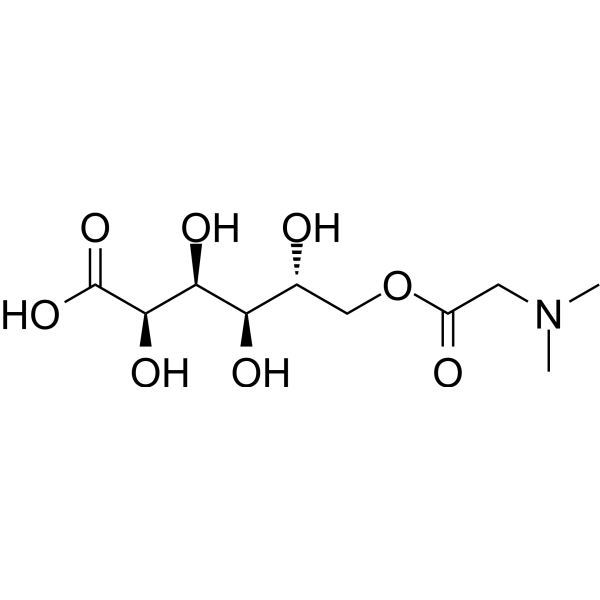
Physicochemical Properties
| Molecular Formula | C??H??NO? |
| Molecular Weight | 359.34794 |
| Exact Mass | 281.111 |
| CAS # | 20858-86-0 |
| PubChem CID | 45934203 |
| Appearance | Typically exists as solid at room temperature |
| LogP | -5 |
| Hydrogen Bond Donor Count | 5 |
| Hydrogen Bond Acceptor Count | 9 |
| Rotatable Bond Count | 9 |
| Heavy Atom Count | 19 |
| Complexity | 308 |
| Defined Atom Stereocenter Count | 4 |
| SMILES | [Na+].CC(N(CC(OCC(C(C(C(C([O-])=O)O)O)O)O)=O)C(C)C)C |
| InChi Key | ZQTHOIGMSJMBLM-BUJSFMDZSA-N |
| InChi Code | InChI=1S/C10H19NO8/c1-11(2)3-6(13)19-4-5(12)7(14)8(15)9(16)10(17)18/h5,7-9,12,14-16H,3-4H2,1-2H3,(H,17,18)/t5-,7-,8+,9-/m1/s1 |
| Chemical Name | (2R,3S,4R,5R)-6-[2-(dimethylamino)acetyl]oxy-2,3,4,5-tetrahydroxyhexanoic acid |
| Synonyms | Vitamin B 15; Vitamin B-15 |
| HS Tariff Code | 2934.99.9001 |
| Storage |
Powder-20°C 3 years 4°C 2 years In solvent -80°C 6 months -20°C 1 month |
| Shipping Condition | Room temperature (This product is stable at ambient temperature for a few days during ordinary shipping and time spent in Customs) |
Biological Activity
| ln Vivo | The experiment should see a steady level of liver hepatitis due to the increased vitamin B15 (2.5 mg/100 g diet in Wistar rats) [1][3]. The antioxidant properties of glutathione peroxidase and glutathione transferase are enhanced in the brain by vitamin B15 [1]. In tissues, vitamin B15 elevates the activities of succinate dehydrogenase and cytochrome oxidase [1]. |
| References |
[1]. Schneider D, et al. Studies on the chemical identity and biological functions of pangamic acid. Arzneimittelforschung. 1999 Apr;49(4):335-43. [2]. Zemskov AM, et al. Typical immune system responses to differential monotherapy with immune-correcting drugs. Fiziol Cheloveka. 2001 Jul-Aug;27(4):97-103. [3]. Ziemlański S, et al. Effect of long-term diet enrichment with selenium, vitamin E and vitamin B15 on the degree of fatty infiltration of the liver. Acta Physiol Pol. 1984 Jul-Aug;35(4):382-97. [4]. Vitamin B15 |
Solubility Data
| Solubility (In Vitro) | H2O : ~250 mg/mL (~888.86 mM) |
| Solubility (In Vivo) |
Note: Listed below are some common formulations that may be used to formulate products with low water solubility (e.g. < 1 mg/mL), you may test these formulations using a minute amount of products to avoid loss of samples. Injection Formulations (e.g. IP/IV/IM/SC) Injection Formulation 1: DMSO : Tween 80: Saline = 10 : 5 : 85 (i.e. 100 μL DMSO stock solution → 50 μL Tween 80 → 850 μL Saline) *Preparation of saline: Dissolve 0.9 g of sodium chloride in 100 mL ddH ₂ O to obtain a clear solution. Injection Formulation 2: DMSO : PEG300 :Tween 80 : Saline = 10 : 40 : 5 : 45 (i.e. 100 μL DMSO → 400 μLPEG300 → 50 μL Tween 80 → 450 μL Saline) Injection Formulation 3: DMSO : Corn oil = 10 : 90 (i.e. 100 μL DMSO → 900 μL Corn oil) Example: Take the Injection Formulation 3 (DMSO : Corn oil = 10 : 90) as an example, if 1 mL of 2.5 mg/mL working solution is to be prepared, you can take 100 μL 25 mg/mL DMSO stock solution and add to 900 μL corn oil, mix well to obtain a clear or suspension solution (2.5 mg/mL, ready for use in animals). Injection Formulation 4: DMSO : 20% SBE-β-CD in saline = 10 : 90 [i.e. 100 μL DMSO → 900 μL (20% SBE-β-CD in saline)] *Preparation of 20% SBE-β-CD in Saline (4°C,1 week): Dissolve 2 g SBE-β-CD in 10 mL saline to obtain a clear solution. Injection Formulation 5: 2-Hydroxypropyl-β-cyclodextrin : Saline = 50 : 50 (i.e. 500 μL 2-Hydroxypropyl-β-cyclodextrin → 500 μL Saline) Injection Formulation 6: DMSO : PEG300 : castor oil : Saline = 5 : 10 : 20 : 65 (i.e. 50 μL DMSO → 100 μLPEG300 → 200 μL castor oil → 650 μL Saline) Injection Formulation 7: Ethanol : Cremophor : Saline = 10: 10 : 80 (i.e. 100 μL Ethanol → 100 μL Cremophor → 800 μL Saline) Injection Formulation 8: Dissolve in Cremophor/Ethanol (50 : 50), then diluted by Saline Injection Formulation 9: EtOH : Corn oil = 10 : 90 (i.e. 100 μL EtOH → 900 μL Corn oil) Injection Formulation 10: EtOH : PEG300:Tween 80 : Saline = 10 : 40 : 5 : 45 (i.e. 100 μL EtOH → 400 μLPEG300 → 50 μL Tween 80 → 450 μL Saline) Oral Formulations Oral Formulation 1: Suspend in 0.5% CMC Na (carboxymethylcellulose sodium) Oral Formulation 2: Suspend in 0.5% Carboxymethyl cellulose Example: Take the Oral Formulation 1 (Suspend in 0.5% CMC Na) as an example, if 100 mL of 2.5 mg/mL working solution is to be prepared, you can first prepare 0.5% CMC Na solution by measuring 0.5 g CMC Na and dissolve it in 100 mL ddH2O to obtain a clear solution; then add 250 mg of the product to 100 mL 0.5% CMC Na solution, to make the suspension solution (2.5 mg/mL, ready for use in animals). Oral Formulation 3: Dissolved in PEG400 Oral Formulation 4: Suspend in 0.2% Carboxymethyl cellulose Oral Formulation 5: Dissolve in 0.25% Tween 80 and 0.5% Carboxymethyl cellulose Oral Formulation 6: Mixing with food powders Note: Please be aware that the above formulations are for reference only. InvivoChem strongly recommends customers to read literature methods/protocols carefully before determining which formulation you should use for in vivo studies, as different compounds have different solubility properties and have to be formulated differently. (Please use freshly prepared in vivo formulations for optimal results.) |
| Preparing Stock Solutions | 1 mg | 5 mg | 10 mg | |
| 1 mM | 2.7828 mL | 13.9140 mL | 27.8280 mL | |
| 5 mM | 0.5566 mL | 2.7828 mL | 5.5656 mL | |
| 10 mM | 0.2783 mL | 1.3914 mL | 2.7828 mL |