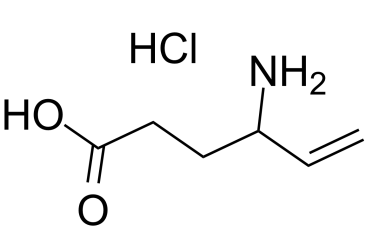
Vigabatrin hydrochloride (γ-Vinyl-GABA; Sabril) is an oral and structural analog of the inhibitory neurotransmitter γ-aminobutyric acid (GABA) that irreversibly inhibits the catabolism of GABA by GABA transaminase. It is an orally bioactive and irreversible GABA transaminase inhibitor. Vigabatrin hydrochloride is an antiepileptic agent, which acts by increasing GABA levels in the brain by inhibiting the catabolism of GABA by GABA transaminase.
Physicochemical Properties
| Molecular Formula | C6H11NO2.HCL |
| Molecular Weight | 165.61798 |
| Exact Mass | 165.055 |
| CAS # | 1391054-02-6 |
| Related CAS # | Vigabatrin;68506-86-5;Vigabatrin-13C,d2 hydrochloride |
| PubChem CID | 71666447 |
| Appearance | White to off-white solid powder |
| Hydrogen Bond Donor Count | 3 |
| Hydrogen Bond Acceptor Count | 3 |
| Rotatable Bond Count | 4 |
| Heavy Atom Count | 10 |
| Complexity | 112 |
| Defined Atom Stereocenter Count | 0 |
| InChi Key | FBNKOYLPAMUOHS-UHFFFAOYSA-N |
| InChi Code | InChI=1S/C6H11NO2.ClH/c1-2-5(7)3-4-6(8)9;/h2,5H,1,3-4,7H2,(H,8,9);1H |
| Chemical Name | 4-aminohex-5-enoic acid;hydrochloride |
| HS Tariff Code | 2934.99.9001 |
| Storage |
Powder-20°C 3 years 4°C 2 years In solvent -80°C 6 months -20°C 1 month Note: Please store this product in a sealed and protected environment (e.g. under nitrogen), avoid exposure to moisture. |
| Shipping Condition | Room temperature (This product is stable at ambient temperature for a few days during ordinary shipping and time spent in Customs) |
Biological Activity
| ln Vitro |
After systemic (intraperitoneal) administration of high doses (600 or 1200 mg/kg) of vigabatrin, a significant increase in epileptic threshold was noted. The seizure threshold was also raised by bilateral microinjections of vigabatrin (10 μg) into the anterior or posterior substantia nigra pars reticulata, but not to the same extent as systemic therapy. Vigabatrin administered locally to the subthalamic nucleus (STN) raises the epileptic threshold more than the drug is administered systemically or intranigra [1]. Vigabatrin irreversibly inhibits the GABA-degrading enzyme GABA aminotransferase (GABA-T), thereby increasing GABA levels in the brain. [1] |
| ln Vivo |
In Caco-2 and MDCK cells, vigabatrin at 30 mM reduced taurine uptake by 34% and 53%, respectively. Vigabatrin absorption in Caco-2 cells is concentration-dependent and saturable at neutral pH, with a Km value of 27 mM. In renal and intestinal cell culture models, vigabatrin decreases the absorption of taurine [2]. Intraperitoneal (i.p.) administration of Vigabatrin at doses of 600 mg/kg and 1200 mg/kg significantly increased the seizure threshold for both myoclonic twitch and clonic seizures induced by timed intravenous infusion of pentylenetetrazol (PTZ) in female Wistar rats. The peak effect for the clonic seizure threshold was observed 6 hours post-administration, with increases of 70% above pre-drug control for 600 mg/kg and 86% for 1200 mg/kg. The effect lasted up to 96 hours for the higher dose. [1] Bilateral microinjection of Vigabatrin (10 µg per hemisphere) into the subthalamic nucleus (STN) significantly increased the PTZ seizure threshold. The maximum increase was observed 24 hours post-injection, with thresholds elevated by 74% for myoclonic twitch and 115% for clonic seizure compared to pre-drug controls. This effect was more pronounced than that achieved by systemic administration of 600 mg/kg and was devoid of the severe adverse effects seen with systemic treatment. [1] Bilateral microinjection of Vigabatrin (10 µg per hemisphere) into the anterior substantia nigra pars reticulata (aSNr) significantly increased the PTZ threshold for clonic seizures (maximum 60% increase at 48 hours) but had a weaker effect on myoclonic twitch threshold. Injections into the posterior SNr (pSNr) increased thresholds for both endpoints, with maximum effects (22% for myoclonic, 46% for clonic) at 24 hours. The effects from SNr injections were less marked than those from STN injections. [1] Microinjection of Vigabatrin into brain sites adjacent to but outside the STN (e.g., zona incerta, cerebral peduncle) or into the striatum also increased seizure thresholds, but the effects were generally lower in magnitude compared to precise bilateral STN injections, demonstrating site specificity. [1] |
| Animal Protocol |
Systemic Administration for PTZ Seizure Threshold Test: Female Wistar rats (200-220 g) received Vigabatrin via intraperitoneal (i.p.) injection at doses of 600 mg/kg or 1200 mg/kg. The drug was dissolved in saline at an injection volume of 3 ml/kg. Seizure threshold was determined by timed intravenous infusion of a 0.8% PTZ solution into the lateral tail vein of conscious, freely moving rats at various time points (e.g., 2, 6, 24, 48, 96, 144 h) after drug administration. The infusion rate was 1.0 ml/min. The infusion was stopped immediately upon observation of the first clonic seizure, and the PTZ dose (mg/kg) required was calculated. The threshold for the first myoclonic twitch was also recorded. [1] Focal Intracerebral Microinjection for PTZ Seizure Threshold Test: Rats were anesthetized with isoflurane and placed in a stereotactic frame. Stainless steel cannulae were bilaterally implanted into target brain regions: Subthalamic Nucleus (STN), anterior Substantia Nigra pars reticulata (aSNr), or posterior SNr (pSNr), using coordinates from the Paxinos and Watson atlas. Vigabatrin (10 µg in 0.25 µl distilled water per hemisphere) or an equal volume of saline (control) was slowly infused over 4 minutes. The cannulae were left in place for 1 minute post-injection. After recovery from anesthesia, the PTZ seizure threshold was determined in the same rats at 6, 24, 48, and 96 hours after microinjection, following the same intravenous PTZ infusion protocol described for systemic administration. [1] |
| ADME/Pharmacokinetics | Following systemic administration of Vigabatrin (250–1000 mg/kg) in rats, the brain/plasma ratio is reported to be about 0.025, indicating poor penetration of the blood-brain barrier (BBB). Only about 2.5% of the administered dose reaches the brain. [1] |
| Toxicity/Toxicokinetics |
Systemic administration of high-dose Vigabatrin (600 and 1200 mg/kg i.p.) in rats was associated with severe adverse effects, including marked sedation and ataxia (lasting about 24 hours), a decrease in body temperature (by about 2°C within 2 hours), and significant loss of body weight (maximum 6% and 10% loss at 24 hours for 600 and 1200 mg/kg, respectively). [1] In contrast, bilateral microinjection of Vigabatrin (10 µg) into the STN or SNr was not associated with observable behavioral adverse effects (e.g., sedation, ataxia, stereotyped behaviors) at the time of anticonvulsant testing. A slight, non-significant decrease in body weight (4%) was noted after STN injection, but it was not different from saline-injected controls. [1] |
| References |
[1]. Vigabatrin for focal drug delivery in epilepsy: Bilateral microinfusion into the subthalamic nucleus is more effective than intranigral or systemic administration in a rat seizure model. Neurobiology of Disease (2012), 46(2), 362-376. [2]. The anti-epileptic drug substance vigabatrin inhibits taurine transport in intestinal and renal cell culture models. Int J Pharm. 2014 Oct 1;473(1-2):395-7. [3]. Gaily, Eija Vigabatrin monotherapy for infantile spasms. Expert Review of Neurotherapeutics (2012), 12(3), 275-286. |
| Additional Infomation |
Vigabatrin is an antiepileptic drug (AED) used clinically as add-on therapy for refractory complex partial seizures and as monotherapy for infantile spasms. Its clinical utility is limited by adverse effects, including visual field loss, thought to result from drug exposure of the retina and non-epileptic brain regions. [1] The study proposes that focal/targeted delivery of Vigabatrin directly into brain regions involved in seizure propagation (like the STN) could provide potent anticonvulsant effects while minimizing systemic exposure and associated side effects. [1] The study compared the efficacy of focal Vigabatrin delivery to that of muscimol (a GABAA receptor agonist), suggesting that vigabatrin, by boosting presynaptic GABA stores, may have an advantage over direct receptor agonists which can cause abnormal motor effects. [1] |
Solubility Data
| Solubility (In Vitro) |
H2O : ~33.33 mg/mL (~201.24 mM) DMSO : ~27.5 mg/mL (~166.04 mM) |
| Solubility (In Vivo) |
Solubility in Formulation 1: ≥ 2.5 mg/mL (15.09 mM) (saturation unknown) in 10% DMSO + 40% PEG300 + 5% Tween80 + 45% Saline (add these co-solvents sequentially from left to right, and one by one), clear solution. For example, if 1 mL of working solution is to be prepared, you can add 100 μL of 25.0 mg/mL clear DMSO stock solution to 400 μL PEG300 and mix evenly; then add 50 μL Tween-80 to the above solution and mix evenly; then add 450 μL normal saline to adjust the volume to 1 mL. Preparation of saline: Dissolve 0.9 g of sodium chloride in 100 mL ddH₂ O to obtain a clear solution. Solubility in Formulation 2: ≥ 2.5 mg/mL (15.09 mM) (saturation unknown) in 10% DMSO + 90% (20% SBE-β-CD in Saline) (add these co-solvents sequentially from left to right, and one by one), clear solution. For example, if 1 mL of working solution is to be prepared, you can add 100 μL of 25.0 mg/mL clear DMSO stock solution to 900 μL of 20% SBE-β-CD physiological saline solution and mix evenly. Preparation of 20% SBE-β-CD in Saline (4°C,1 week): Dissolve 2 g SBE-β-CD in 10 mL saline to obtain a clear solution. Solubility in Formulation 3: ≥ 2.5 mg/mL (15.09 mM) (saturation unknown) in 10% DMSO + 90% Corn Oil (add these co-solvents sequentially from left to right, and one by one), clear solution. For example, if 1 mL of working solution is to be prepared, you can add 100 μL of 25.0 mg/mL clear DMSO stock solution to 900 μL of corn oil and mix evenly. Solubility in Formulation 4: 10 mg/mL (60.38 mM) in PBS (add these co-solvents sequentially from left to right, and one by one), clear solution; with ultrasonication. (Please use freshly prepared in vivo formulations for optimal results.) |
| Preparing Stock Solutions | 1 mg | 5 mg | 10 mg | |
| 1 mM | 6.0379 mL | 30.1896 mL | 60.3792 mL | |
| 5 mM | 1.2076 mL | 6.0379 mL | 12.0758 mL | |
| 10 mM | 0.6038 mL | 3.0190 mL | 6.0379 mL |