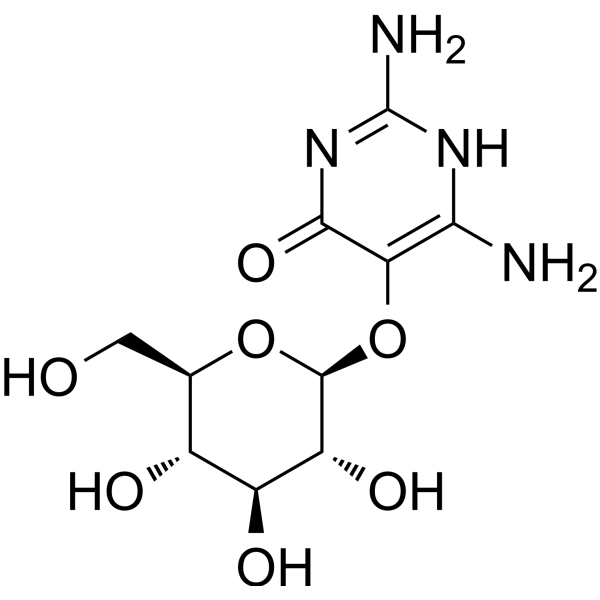
Physicochemical Properties
| Molecular Formula | C10H16N4O7 |
| Molecular Weight | 304.2566 |
| Exact Mass | 304.101 |
| Elemental Analysis | C, 39.48; H, 5.30; N, 18.41; O, 36.81 |
| CAS # | 152-93-2 |
| PubChem CID | 135413566 |
| Appearance | White to off-white solid powder |
| Density | 2.2±0.1 g/cm3 |
| Boiling Point | 627.4±65.0 °C at 760 mmHg |
| Melting Point | 242-244℃ |
| Flash Point | 333.2±34.3 °C |
| Vapour Pressure | 0.0±4.2 mmHg at 25°C |
| Index of Refraction | 1.820 |
| LogP | -2.55 |
| Hydrogen Bond Donor Count | 7 |
| Hydrogen Bond Acceptor Count | 9 |
| Rotatable Bond Count | 3 |
| Heavy Atom Count | 21 |
| Complexity | 494 |
| Defined Atom Stereocenter Count | 5 |
| SMILES | O1[C@]([H])([C@@]([H])([C@]([H])([C@@]([H])([C@@]1([H])C([H])([H])O[H])O[H])O[H])O[H])OC1C(N([H])C(N([H])[H])=NC=1N([H])[H])=O |
| InChi Key | KGNGTSCIQCLKEH-SYCVNHKBSA-N |
| InChi Code | InChI=1S/C10H16N4O7/c11-7-6(8(19)14-10(12)13-7)21-9-5(18)4(17)3(16)2(1-15)20-9/h2-5,9,15-18H,1H2,(H5,11,12,13,14,19)/t2-,3-,4+,5-,9+/m1/s1 |
| Chemical Name | 2,4-diamino-5-[(2S,3R,4S,5S,6R)-3,4,5-trihydroxy-6-(hydroxymethyl)oxan-2-yl]oxy-1H-pyrimidin-6-one |
| Synonyms | Vicine; 152-93-2; Vicioside; 2,6-Diamino-5-(beta-D-glucopyranosyloxy)-(1H)-pyrimidin-4-one; NSC-95092; COL14PJW3X; C08437; CID 91446; |
| HS Tariff Code | 2934.99.9001 |
| Storage |
Powder-20°C 3 years 4°C 2 years In solvent -80°C 6 months -20°C 1 month Note: This product requires protection from light (avoid light exposure) during transportation and storage. |
| Shipping Condition | Room temperature (This product is stable at ambient temperature for a few days during ordinary shipping and time spent in Customs) |
Biological Activity
| Targets | Natural alkaloid glycoside |
| ln Vivo |
Two studies were conducted to investigate the effects of feeding raw and water-soaked vetch seeds to male broiler chicks on performance, organ weights, and blood parameters. Intact and ground vetch seeds were soaked in water (1:5) at room temperature for 24 hours (study 1), and (1:10) at 40 degrees C for 24, 48, and 72 hours, with water change every 12 hours (study 2). In study 1, untreated vetch contained, on dry matter basis, 0.530%, 0.731%, and 0.081% total beta-cyanoalanine (BCA), vicine, and convicine, respectively. Toxins were not appreciably reduced in soaked intact and ground vetch. Diets containing untreated, soaked intact, and soaked ground vetch, each at 0%, 20%, 40%, and 60%, were fed to 7-day-old male broilers until onset of neurotoxicity symptoms. Survival time was not only decreased by BCA level but also by those of vicine and convicine (p <.05). In study 2, 60% of untreated or treated vetch seeds were incorporated in chick diets. Although untreated vetch used in this study contained 32% less BCA but 8% and 81% more vicine and convicine, respectively, yet, the chicks on 60% untreated vetch showed toxicity symptoms earlier than those of study 1. Soaking ground vetch for 48 hours or more reduced BCA and totally removed vicine and convicine. Consequently, birds on 60% ground vetch soaked for 48 and 72 hours survived through the starter period and had mean corpuscular hemoglobin concentration and organ weights comparable to those of control at 4 days post trial. The results indicated that "high levels" of vicine or convicine or both might have shortened the birds' survival time by enhancing the neurotoxicity induced by "lower levels" of BCA[1]. Vicine, along with convicine, was found to enhance the neurotoxicity induced by β-cyanoalanine (BCA) in male broiler chicks. Diets containing untreated vetch seeds (which contained vicine, convicine, and BCA) led to reduced survival time and increased mortality in a dose-dependent manner. [1] The toxicity was not solely dependent on BCA levels. High levels of Vicine and convicine, even in the presence of relatively lower BCA levels, were associated with earlier onset of neurotoxic symptoms (e.g., muscle inc coordination, respiratory difficulty, convulsions) and higher mortality. [1] Removal of Vicine and convicine from vetch seeds by extended soaking (grinding seeds and soaking in water at 40°C for 48 or 72 hours with water changes) significantly reduced toxicity, allowing chicks to survive the feeding period with performance comparable to controls, despite the presence of residual BCA. [1] |
| Animal Protocol |
Experiment 1: One-week-old male broiler chicks were fed experimental diets from day 7. Diets contained 0%, 20%, 40%, or 60% of untreated vetch seeds, or vetch seeds that had been soaked intact or ground before soaking (water, room temperature, 1:5 w/v, 24h). Diets were formulated to be isonitrogenous and isocaloric. Birds were housed in pens (8 birds/pen) with ad libitum access to feed and water. They were monitored until the onset of neurotoxicity symptoms. Performance data (weight gain, feed intake) were recorded. [1] Experiment 2: One-week-old male broiler chicks were fed diets containing 60% of untreated vetch seeds, or vetch seeds treated by soaking (intact or ground) in warm water (40°C, 1:10 w/v) for 24, 48, or 72 hours with water change every 12 hours. Diets were isocaloric and isonitrogenous. On day 4 post-feeding, blood samples were collected from half of the birds for hematological analysis. Birds were then sacrificed for organ (liver, kidney, gall bladder) weight measurement. Birds from control and selected treatment groups (ground vetch soaked for 48/72h) were continued on feed until day 21 for performance evaluation. [1] Compound/Diet Preparation: Vicine was not administered as a purified compound. It was present as a natural constituent in common vetch (Vicia sativa) seeds. The seeds were incorporated into complete poultry diets at specified percentages. Detoxification treatments involved soaking the intact or ground seeds in water under specified conditions (temperature, time, seed-to-water ratio). [1] |
| Toxicity/Toxicokinetics |
Vicine is identified as a toxin present in common vetch seeds. Dietary intake via vetch seed-containing feed caused toxicity in male broiler chicks. [1] In Experiment 1, feeding diets with 60% untreated vetch seeds (containing 0.388% vicine, 0.043% convicine, and 0.281% BCA on a dietary basis) resulted in 97.5% mortality with a survival time of 7.8 days. Diets with 40% untreated vetch (0.258% vicine) caused 40% mortality. Diets with 20% vetch (0.129-0.148% vicine) caused no mortality. [1] Vicine and convicine appeared to synergistically enhance the neurotoxicity of BCA. Diets with similar BCA levels but lower vicine/convicine levels resulted in lower mortality. For example, a diet with 40% untreated vetch (higher vicine) caused significantly higher mortality (40%) than a diet with 40% soaked intact vetch (lower vicine), which caused 17.5% mortality, despite similar BCA levels. [1] Birds fed high-toxin diets (e.g., 60% untreated vetch) showed significantly increased liver weight as a percentage of body weight compared to controls. [1] Birds fed diets containing vetch seeds with high levels of vicine/convicine (untreated, or intact soaked for 24h/48h) showed significantly lower mean corpuscular hemoglobin (MCH) and mean corpuscular hemoglobin concentration (MCHC) values in blood analysis at 4 days post-feeding, suggesting impaired hemoglobin synthesis or increased degradation. [1] The study suggests that the aglucone of Vicine (divicine) may be involved in inducing hemolysis, based on a reference to its role in favism in humans. [1] |
| References |
[1]. Vicine and convicine in common vetch (Vicia sativa) seeds enhance beta-cyanoalanine toxicity in male broiler chicks. Int J Toxicol. 2002 May-Jun;21(3):201-9. |
| Additional Infomation |
Vicine is a glycoside. Vicine has been reported in Vicia faba, Vicia narbonensis, and Momordica charantia with data available. Vicine is a water-soluble pyrimidine glucoside identified as an antinutritional factor in legumes like vetch (Vicia sativa) and faba beans. [1] In the context of this study, Vicine's primary significance is its contribution to the overall toxicity of raw vetch seeds when fed to poultry, specifically its synergistic interaction with β-cyanoalanine (BCA). [1] The study demonstrates that effective detoxification of vetch seeds for animal feed requires the removal of not only BCA but also Vicine and convicine. Grinding seeds followed by extended soaking in warm water with frequent water changes can completely remove detectable levels of Vicine and convicine. [1] The content of Vicine in seeds can vary based on growing conditions and crop maturity. [1] |
Solubility Data
| Solubility (In Vitro) | DMSO : ~50 mg/mL (~164.33 mM) |
| Solubility (In Vivo) |
Solubility in Formulation 1: ≥ 2.5 mg/mL (8.22 mM) (saturation unknown) in 10% DMSO + 40% PEG300 + 5% Tween80 + 45% Saline (add these co-solvents sequentially from left to right, and one by one), clear solution. For example, if 1 mL of working solution is to be prepared, you can add 100 μL of 25.0 mg/mL clear DMSO stock solution to 400 μL PEG300 and mix evenly; then add 50 μL Tween-80 to the above solution and mix evenly; then add 450 μL normal saline to adjust the volume to 1 mL. Preparation of saline: Dissolve 0.9 g of sodium chloride in 100 mL ddH₂ O to obtain a clear solution. Solubility in Formulation 2: ≥ 2.5 mg/mL (8.22 mM) (saturation unknown) in 10% DMSO + 90% (20% SBE-β-CD in Saline) (add these co-solvents sequentially from left to right, and one by one), clear solution. For example, if 1 mL of working solution is to be prepared, you can add 100 μL of 25.0 mg/mL clear DMSO stock solution to 900 μL of 20% SBE-β-CD physiological saline solution and mix evenly. Preparation of 20% SBE-β-CD in Saline (4°C,1 week): Dissolve 2 g SBE-β-CD in 10 mL saline to obtain a clear solution. Solubility in Formulation 3: ≥ 2.5 mg/mL (8.22 mM) (saturation unknown) in 10% DMSO + 90% Corn Oil (add these co-solvents sequentially from left to right, and one by one), clear solution. For example, if 1 mL of working solution is to be prepared, you can add 100 μL of 25.0 mg/mL clear DMSO stock solution to 900 μL of corn oil and mix evenly. (Please use freshly prepared in vivo formulations for optimal results.) |
| Preparing Stock Solutions | 1 mg | 5 mg | 10 mg | |
| 1 mM | 3.2867 mL | 16.4333 mL | 32.8666 mL | |
| 5 mM | 0.6573 mL | 3.2867 mL | 6.5733 mL | |
| 10 mM | 0.3287 mL | 1.6433 mL | 3.2867 mL |