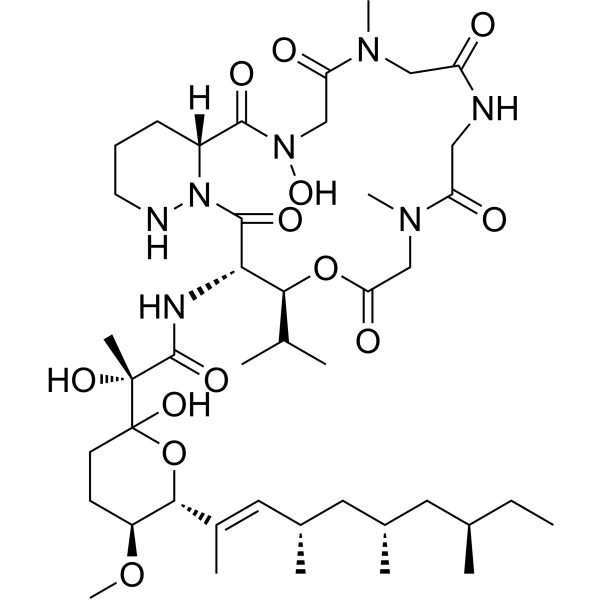
Physicochemical Properties
| Molecular Formula | C43H73N7O13 |
| Molecular Weight | 896.079 |
| Exact Mass | 895.527 |
| CAS # | 138067-14-8 |
| PubChem CID | 6444237 |
| Appearance | White to light yellow solid powder |
| Density | 1.27g/cm3 |
| Index of Refraction | 1.571 |
| LogP | 1.277 |
| Hydrogen Bond Donor Count | 6 |
| Hydrogen Bond Acceptor Count | 14 |
| Rotatable Bond Count | 12 |
| Heavy Atom Count | 63 |
| Complexity | 1680 |
| Defined Atom Stereocenter Count | 0 |
| SMILES | CCC(C)CC(C)CC(C)/C=C(\C)/C1C(CCC(O1)(C(C)(C(=O)NC2C(OC(=O)CN(C(=O)CNC(=O)CN(C(=O)CN(C(=O)C3CCCNN3C2=O)O)C)C)C(C)C)O)O)OC |
| InChi Key | IKTLLLGZSOKVRF-ZTKZIYFRSA-N |
| InChi Code | InChI=1S/C43H73N7O13/c1-12-26(4)18-27(5)19-28(6)20-29(7)38-31(61-11)15-16-43(59,63-38)42(8,58)41(57)46-36-37(25(2)3)62-35(54)24-48(10)33(52)21-44-32(51)22-47(9)34(53)23-49(60)39(55)30-14-13-17-45-50(30)40(36)56/h20,25-28,30-31,36-38,45,58-60H,12-19,21-24H2,1-11H3,(H,44,51)(H,46,57)/b29-20+ |
| Chemical Name | 2-hydroxy-N-(17-hydroxy-8,14-dimethyl-2,6,9,12,15,18-hexaoxo-4-propan-2-yl-5-oxa-1,8,11,14,17,23-hexazabicyclo[17.4.0]tricosan-3-yl)-2-[2-hydroxy-5-methoxy-6-[(E)-4,6,8-trimethyldec-2-en-2-yl]oxan-2-yl]propanamide |
| HS Tariff Code | 2934.99.9001 |
| Storage |
Powder-20°C 3 years 4°C 2 years In solvent -80°C 6 months -20°C 1 month Note: Please store this product in a sealed and protected environment, avoid exposure to moisture. |
| Shipping Condition | Room temperature (This product is stable at ambient temperature for a few days during ordinary shipping and time spent in Customs) |
Biological Activity
| ln Vitro | Vacuolar H+-ATPase (v-ATPase) subunit ATP6V1G [3]. With an IC50 of 388 nM, verucopeptin (0-30 μM; 72 h) had remarkable anticancer efficacy against K562R cells; nevertheless, these cells exhibited resistance to some other chemotherapeutic drugs, including vincristine at 10 μM and paclitaxel. therapeutic qualities [3]. With IC50 values less than 100 nM, verucopeptin (0-1 μM) exhibits wide antiproliferative action against 66% of the 1,094 cancer cell lines examined. Moreover, verucopeptin is categorized into the lower IC50 group, which includes leukemia, lymphoma, and melanoma, and the higher IC50 group, which includes non-small cell lung cancer and other cancer types [3]. Verucopeptin (10 nM; 1 hour) pretreatment prevented VE-P labeling of ATP6V1G1 in competitive binding tests, but not ATP1V1B2 or ATP6V1D. Verucopeptin and Baf A1, albeit to a lesser degree, both significantly reduce lysosomal acidification and v-ATPase activity in vitro [3]. At doses of 10-200 nM, verucopeptin (0-500 nM; 1 hour) strongly suppresses p-S6K and p-4EBP1. Furthermore, at dosages ranging from 50 nM to 500 nM, verucopeptin inhibited the phosphorylation of the majority of examined mTORC1 downstream substrates, including p-4EBP1, pmTORS2448, p-mTORS2481, p-Rictor, p-ULK1, and p-Grb10 [3]. Verucopeptin (0-335 nM; 24 hours) did not affect c-Raf in HT1080 cells, but it did decrease HIF-1 protein levels in a dose-dependent manner. On the other hand, HIF-1 and c-Raf production in cells is inhibited by the well-known hsp90 inhibitor tantespimycin [2]. |
| ln Vivo | Verucopeptin (IV; 1 mg/kg; twice daily; 7 days) effectively reduced tumor growth without significant weight loss or clear evidence of toxicity. HE staining demonstrated that Verucopeptin successfully promoted cell death and abolished mTORC1 signaling through dephosphorylation of S6K and 4EBP1 [3]. |
| Animal Protocol |
Animal/Disease Models: BALB/c nude mice were injected subcutaneously (sc) (sc) with SGC7901/VCR cells [3]. Doses: 1 mg/kg. Route of Administration: intravenous (iv) (iv)injection; subcutaneous injection of SGC7901/VCR cells. 1 mg/kg; twice (two times) daily; 7 days Experimental Results: Demonstrated profound in vivo antitumor efficacy against MDR tumors. |
| References |
[1]. Structure Elucidation of Verucopeptin, a HIF-1 Inhibitory Polyketide-Hexapeptide Hybrid Metabolite from an Actinomycete. Org Lett. 2015 Nov 6;17(21):5364-7. [2]. Total synthesis of verucopeptin, an inhibitor of hypoxia-inducible factor 1 (HIF-1). Chem Commun (Camb). 2019 Oct 1;55(79):11956-11959. [3]. Pharmacological Targeting of Vacuolar H +-ATPase via Subunit V1G Combats Multidrug-Resistant Cancer. Cell Chem Biol. 2020 Jun 30;S2451-9456(20)30234-8. |
| Additional Infomation |
Verucopeptin is a glycoside and a cyclodepsipeptide. Verucopeptin has been reported in Actinomadura verrucosospora with data available. |
Solubility Data
| Solubility (In Vitro) | May dissolve in DMSO (in most cases), if not, try other solvents such as H2O, Ethanol, or DMF with a minute amount of products to avoid loss of samples |
| Solubility (In Vivo) |
Note: Listed below are some common formulations that may be used to formulate products with low water solubility (e.g. < 1 mg/mL), you may test these formulations using a minute amount of products to avoid loss of samples. Injection Formulations (e.g. IP/IV/IM/SC) Injection Formulation 1: DMSO : Tween 80: Saline = 10 : 5 : 85 (i.e. 100 μL DMSO stock solution → 50 μL Tween 80 → 850 μL Saline) *Preparation of saline: Dissolve 0.9 g of sodium chloride in 100 mL ddH ₂ O to obtain a clear solution. Injection Formulation 2: DMSO : PEG300 :Tween 80 : Saline = 10 : 40 : 5 : 45 (i.e. 100 μL DMSO → 400 μLPEG300 → 50 μL Tween 80 → 450 μL Saline) Injection Formulation 3: DMSO : Corn oil = 10 : 90 (i.e. 100 μL DMSO → 900 μL Corn oil) Example: Take the Injection Formulation 3 (DMSO : Corn oil = 10 : 90) as an example, if 1 mL of 2.5 mg/mL working solution is to be prepared, you can take 100 μL 25 mg/mL DMSO stock solution and add to 900 μL corn oil, mix well to obtain a clear or suspension solution (2.5 mg/mL, ready for use in animals). Injection Formulation 4: DMSO : 20% SBE-β-CD in saline = 10 : 90 [i.e. 100 μL DMSO → 900 μL (20% SBE-β-CD in saline)] *Preparation of 20% SBE-β-CD in Saline (4°C,1 week): Dissolve 2 g SBE-β-CD in 10 mL saline to obtain a clear solution. Injection Formulation 5: 2-Hydroxypropyl-β-cyclodextrin : Saline = 50 : 50 (i.e. 500 μL 2-Hydroxypropyl-β-cyclodextrin → 500 μL Saline) Injection Formulation 6: DMSO : PEG300 : castor oil : Saline = 5 : 10 : 20 : 65 (i.e. 50 μL DMSO → 100 μLPEG300 → 200 μL castor oil → 650 μL Saline) Injection Formulation 7: Ethanol : Cremophor : Saline = 10: 10 : 80 (i.e. 100 μL Ethanol → 100 μL Cremophor → 800 μL Saline) Injection Formulation 8: Dissolve in Cremophor/Ethanol (50 : 50), then diluted by Saline Injection Formulation 9: EtOH : Corn oil = 10 : 90 (i.e. 100 μL EtOH → 900 μL Corn oil) Injection Formulation 10: EtOH : PEG300:Tween 80 : Saline = 10 : 40 : 5 : 45 (i.e. 100 μL EtOH → 400 μLPEG300 → 50 μL Tween 80 → 450 μL Saline) Oral Formulations Oral Formulation 1: Suspend in 0.5% CMC Na (carboxymethylcellulose sodium) Oral Formulation 2: Suspend in 0.5% Carboxymethyl cellulose Example: Take the Oral Formulation 1 (Suspend in 0.5% CMC Na) as an example, if 100 mL of 2.5 mg/mL working solution is to be prepared, you can first prepare 0.5% CMC Na solution by measuring 0.5 g CMC Na and dissolve it in 100 mL ddH2O to obtain a clear solution; then add 250 mg of the product to 100 mL 0.5% CMC Na solution, to make the suspension solution (2.5 mg/mL, ready for use in animals). Oral Formulation 3: Dissolved in PEG400 Oral Formulation 4: Suspend in 0.2% Carboxymethyl cellulose Oral Formulation 5: Dissolve in 0.25% Tween 80 and 0.5% Carboxymethyl cellulose Oral Formulation 6: Mixing with food powders Note: Please be aware that the above formulations are for reference only. InvivoChem strongly recommends customers to read literature methods/protocols carefully before determining which formulation you should use for in vivo studies, as different compounds have different solubility properties and have to be formulated differently. (Please use freshly prepared in vivo formulations for optimal results.) |
| Preparing Stock Solutions | 1 mg | 5 mg | 10 mg | |
| 1 mM | 1.1160 mL | 5.5799 mL | 11.1597 mL | |
| 5 mM | 0.2232 mL | 1.1160 mL | 2.2319 mL | |
| 10 mM | 0.1116 mL | 0.5580 mL | 1.1160 mL |