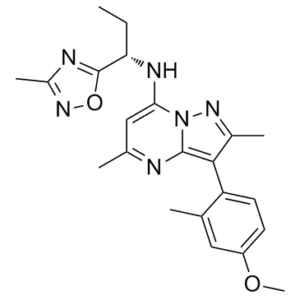
Verucerfont (also known as GSK561679 and NBI77860) is a novel and potent antagonist of corticotropin-releasing factor receptor 1 (CRF1) with IC50s of ~6.1, >1000 and >1000 nM for CRF1, CRF2, and CRF-BP, respectively. Although stress-induced alcohol seeking in rodents is suppressed by blocking corticotropin-releasing factor receptor 1 (CRF1), there is still a clinical application. After prolonged stress, verucirfont decreases the release of ACTH by blocking the CRH-1 receptor. Since long-term stress is frequently linked to the onset of alcoholism as well as relapse in individuals in recovery from alcohol abuse, it is being researched as a possible treatment for alcoholism. Although it hasn't been tried on people, studies on animals have yielded encouraging results.
Physicochemical Properties
| Molecular Formula | C22H26N6O2 |
| Molecular Weight | 406.480844020844 |
| Exact Mass | 406.212 |
| Elemental Analysis | C, 65.01; H, 6.45; N, 20.68; O, 7.87 |
| CAS # | 885220-61-1 |
| PubChem CID | 11596613 |
| Appearance | White to off-white solid powder |
| Density | 1.29 |
| LogP | 4.657 |
| Hydrogen Bond Donor Count | 1 |
| Hydrogen Bond Acceptor Count | 7 |
| Rotatable Bond Count | 6 |
| Heavy Atom Count | 30 |
| Complexity | 568 |
| Defined Atom Stereocenter Count | 1 |
| SMILES | CC1=NN2C(=CC(=NC2=C1C1C=CC(OC)=CC=1C)C)N[C@H](C1=NC(C)=NO1)CC |
| InChi Key | VKHVAUKFLBBZFJ-SFHVURJKSA-N |
| InChi Code | InChI=1S/C22H26N6O2/c1-7-18(22-24-15(5)27-30-22)25-19-11-13(3)23-21-20(14(4)26-28(19)21)17-9-8-16(29-6)10-12(17)2/h8-11,18,25H,7H2,1-6H3/t18-/m0/s1 |
| Chemical Name | 3-(4-methoxy-2-methylphenyl)-2,5-dimethyl-N-[(1S)-1-(3-methyl-1,2,4-oxadiazol-5-yl)propyl]pyrazolo[1,5-a]pyrimidin-7-amine |
| Synonyms | SK-561,679; GSK561679A; GSK561679; NBI-77860; GSK-561679; GSK 561679; NBI77860; NBI 77860; Verucerfont |
| HS Tariff Code | 2934.99.9001 |
| Storage |
Powder-20°C 3 years 4°C 2 years In solvent -80°C 6 months -20°C 1 month |
| Shipping Condition | Room temperature (This product is stable at ambient temperature for a few days during ordinary shipping and time spent in Customs) |
Biological Activity
| Targets | CRF1 ( IC50 = 6.1 nM ); CRF2 ( IC50 > 1000 nM ); CRF-BP ( IC50 > 1000 nM ) |
| ln Vitro | Verucerfont and NBI30775 (R121919), the prototypic non-peptide CRF1 receptor antagonist, differ significantly from vehicle, CP-316 311, and pexacerfont (P<0.001 for all comparisons collapse across time-points), according to post hoc analysis. The latter three treatments, on the other hand, do not differ from one another. Additionally, a significant treatment×time interaction (F[20,140]=6.4, P<0.001) demonstrates a differential effect of treatments over time. Consequently, thorough post hoc analysis reveals that over the course of the next six hours of measurement, NBI30775 and Verucerfont both inhibit ACTH release (P<0.001 vs. vehicle at each time-point and vs. the corresponding pretreatment baseline)[1]. |
| ln Vivo | Post hoc analysis showed that the prototype non-peptide CRF1 receptor antagonists NBI30775 (R121919) and Verucerfont were significantly different from vehicle, CP-316 311 and pexacerfont (comparisons at all time points were P<0.001); the latter three treatments were also There is no difference between each other. A significant treatment × time interaction also revealed a differential effect of treatment over time (F[20,140]=6.4, P<0.001). Accordingly, detailed post hoc analysis showed that both NBI30775 and Verucerfont inhibited ACTH release over the next 6 hours of measurement (P<0.001 compared to vehicle at each time point and compared to respective pre-treatment baseline) [1]. |
| Animal Protocol | Before receiving an adrenalectomy, male Sprague-Dawley rats weighing 175 to 200 g are kept in a 12-to 12-light cycle for a week. At Neurocrine Biosciences, rats undergo adrenalectomy and NaCl is refilled. Measuring plasma corticosterone confirms adrenalectomy. Femoral vein catheters are implanted in rats seven days following adrenalectomy. Rats are given an acclimatization period of one hour in individual opaque sampling cages and their catheters are attached to PE50 tubing and a syringe in preparation for blood collection after approximately four days. The rats in these cages are able to be sampled without being bothered. After acclimation, 0.3 mL of blood is drawn, and the blood volume is replaced with 5 μU/mL heparinized saline. Samples of blood are kept on ice with EDTA. Following a baseline blood sample, rats are given oral doses of the drug (including Verucerfont) in the same volume as the vehicle, or the respective drug at 5 mL/kg. Based on earlier pharmacokinetic research demonstrating that this dose yields a sufficient and comparable exposure, the dose in each instance is 10 mg/kg. After 1, 2, 3, 4, and 6 hours, blood samples are collected. In order to measure ACTH later on using radioimmunoassay, plasma is separated by centrifugation at 4°C and then stored at -80°C[1]. |
| References |
[1]. The CRF1 Antagonist Verucerfont in Anxious Alcohol-Dependent Women: Translation of Neuroendocrine, But not of Anti-Craving Effects. Neuropsychopharmacology. 2016 Nov;41(12):2818-2829. |
| Additional Infomation | Verucerfont has been used in trials studying the treatment of Congenital Adrenal Hyperplasia. |
Solubility Data
| Solubility (In Vitro) | DMSO: ~83.3 mg/mL (~205.0 mM) |
| Solubility (In Vivo) |
Note: Listed below are some common formulations that may be used to formulate products with low water solubility (e.g. < 1 mg/mL), you may test these formulations using a minute amount of products to avoid loss of samples. Injection Formulations (e.g. IP/IV/IM/SC) Injection Formulation 1: DMSO : Tween 80: Saline = 10 : 5 : 85 (i.e. 100 μL DMSO stock solution → 50 μL Tween 80 → 850 μL Saline) *Preparation of saline: Dissolve 0.9 g of sodium chloride in 100 mL ddH ₂ O to obtain a clear solution. Injection Formulation 2: DMSO : PEG300 :Tween 80 : Saline = 10 : 40 : 5 : 45 (i.e. 100 μL DMSO → 400 μLPEG300 → 50 μL Tween 80 → 450 μL Saline) Injection Formulation 3: DMSO : Corn oil = 10 : 90 (i.e. 100 μL DMSO → 900 μL Corn oil) Example: Take the Injection Formulation 3 (DMSO : Corn oil = 10 : 90) as an example, if 1 mL of 2.5 mg/mL working solution is to be prepared, you can take 100 μL 25 mg/mL DMSO stock solution and add to 900 μL corn oil, mix well to obtain a clear or suspension solution (2.5 mg/mL, ready for use in animals). Injection Formulation 4: DMSO : 20% SBE-β-CD in saline = 10 : 90 [i.e. 100 μL DMSO → 900 μL (20% SBE-β-CD in saline)] *Preparation of 20% SBE-β-CD in Saline (4°C,1 week): Dissolve 2 g SBE-β-CD in 10 mL saline to obtain a clear solution. Injection Formulation 5: 2-Hydroxypropyl-β-cyclodextrin : Saline = 50 : 50 (i.e. 500 μL 2-Hydroxypropyl-β-cyclodextrin → 500 μL Saline) Injection Formulation 6: DMSO : PEG300 : castor oil : Saline = 5 : 10 : 20 : 65 (i.e. 50 μL DMSO → 100 μLPEG300 → 200 μL castor oil → 650 μL Saline) Injection Formulation 7: Ethanol : Cremophor : Saline = 10: 10 : 80 (i.e. 100 μL Ethanol → 100 μL Cremophor → 800 μL Saline) Injection Formulation 8: Dissolve in Cremophor/Ethanol (50 : 50), then diluted by Saline Injection Formulation 9: EtOH : Corn oil = 10 : 90 (i.e. 100 μL EtOH → 900 μL Corn oil) Injection Formulation 10: EtOH : PEG300:Tween 80 : Saline = 10 : 40 : 5 : 45 (i.e. 100 μL EtOH → 400 μLPEG300 → 50 μL Tween 80 → 450 μL Saline) Oral Formulations Oral Formulation 1: Suspend in 0.5% CMC Na (carboxymethylcellulose sodium) Oral Formulation 2: Suspend in 0.5% Carboxymethyl cellulose Example: Take the Oral Formulation 1 (Suspend in 0.5% CMC Na) as an example, if 100 mL of 2.5 mg/mL working solution is to be prepared, you can first prepare 0.5% CMC Na solution by measuring 0.5 g CMC Na and dissolve it in 100 mL ddH2O to obtain a clear solution; then add 250 mg of the product to 100 mL 0.5% CMC Na solution, to make the suspension solution (2.5 mg/mL, ready for use in animals). Oral Formulation 3: Dissolved in PEG400 Oral Formulation 4: Suspend in 0.2% Carboxymethyl cellulose Oral Formulation 5: Dissolve in 0.25% Tween 80 and 0.5% Carboxymethyl cellulose Oral Formulation 6: Mixing with food powders Note: Please be aware that the above formulations are for reference only. InvivoChem strongly recommends customers to read literature methods/protocols carefully before determining which formulation you should use for in vivo studies, as different compounds have different solubility properties and have to be formulated differently. (Please use freshly prepared in vivo formulations for optimal results.) |
| Preparing Stock Solutions | 1 mg | 5 mg | 10 mg | |
| 1 mM | 2.4601 mL | 12.3007 mL | 24.6015 mL | |
| 5 mM | 0.4920 mL | 2.4601 mL | 4.9203 mL | |
| 10 mM | 0.2460 mL | 1.2301 mL | 2.4601 mL |