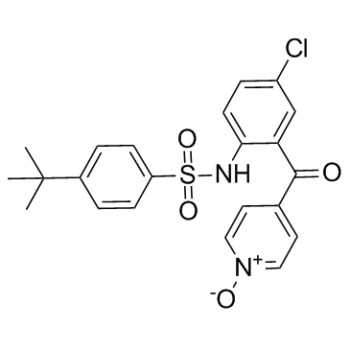
Vercirnon (formerly also known as CCX282-B and GSK1605786) is a novel, potent, orally bioavailable, selective antagonist of CCR9 with an IC50 of 10 nM, used in the research of inflammatory bowel diseases. Vercirnon is being developed at the moment to treat Crohn's disease. CCX282-B had IC(50) values of 5.4 and 3.4 nM, respectively, on Molt-4 cells, inhibiting the CCR9-mediated Ca(2+) mobilization and chemotaxis. With an IC(50) of 33 nM, CCX282-B inhibited CCR9-mediated chemotaxis. With an IC(50) of 6.8 nM, CCX282-B inhibited the chemotaxis of primary CCR9-expressing cells to CCL25. With IC(50) values of 2.8 and 2.6 nM, respectively, CCX282-B was an equipotent inhibitor of CCL25-directed chemotaxis of both splice forms of CCR9 (CCR9A and CCR9B). Additionally, CCX282-B prevented rat and mouse CCR9-mediated chemotaxis.
Physicochemical Properties
| Molecular Formula | C22H21CLN2O4S |
| Molecular Weight | 444.931143522263 |
| Exact Mass | 444.091 |
| Elemental Analysis | C, 59.39; H, 4.76; Cl, 7.97; N, 6.30; O, 14.38; S, 7.21 |
| CAS # | 698394-73-9 |
| Related CAS # | Vercirnon sodium; 886214-18-2 |
| PubChem CID | 10343454 |
| Appearance | White to off-white solid powder |
| LogP | 6.251 |
| Hydrogen Bond Donor Count | 1 |
| Hydrogen Bond Acceptor Count | 5 |
| Rotatable Bond Count | 6 |
| Heavy Atom Count | 30 |
| Complexity | 687 |
| Defined Atom Stereocenter Count | 0 |
| SMILES | O=S(C1=CC=C(C(C)(C)C)C=C1)(NC2=CC=C(Cl)C=C2C(C3=CC=[N+]([O-])C=C3)=O)=O |
| InChi Key | JRWROCIMSDXGOZ-UHFFFAOYSA-N |
| InChi Code | InChI=1S/C22H21ClN2O4S/c1-22(2,3)16-4-7-18(8-5-16)30(28,29)24-20-9-6-17(23)14-19(20)21(26)15-10-12-25(27)13-11-15/h4-14,24H,1-3H3 |
| Chemical Name | 4-tert-butyl-N-[4-chloro-2-(1-oxidopyridin-1-ium-4-carbonyl)phenyl]benzenesulfonamide |
| Synonyms | CCX282-B; Vercirnon; CCX282B; CCX 282B; 698394-73-9; Traficet-EN; GSK-1605786; CCX282-B; Verecimon; CCX-282-B; CCX-282b; GSK1605786; GSK 1605786; GSK-1605786 |
| HS Tariff Code | 2934.99.9001 |
| Storage |
Powder-20°C 3 years 4°C 2 years In solvent -80°C 6 months -20°C 1 month |
| Shipping Condition | Room temperature (This product is stable at ambient temperature for a few days during ordinary shipping and time spent in Customs) |
Biological Activity
| Targets | CCR9B ( IC50 = 2.6 nM ); CCR9A ( IC50 = 2.8 nM ) |
| ln Vitro | Vercirnon (GSK-1605786) inhibits CCR9 chemotaxis of primary cells toward CCL25 with an IC50 of 6.8 nM. Vercirnon inhibits CCL25-induced chemotaxis of retinoic acid (RA)-cultured human T cells. Vercirnon inhibits CCL25-induced chemotaxis of RA cultured cells in 100% human AB serum with an IC50 of 141 nM. Vercirnon is a potent CCL25-induced cell chemotaxis adapter with IC50 values of 6.9 nM and 1.3 nM [1]. |
| ln Vivo | Vercirnon (GSK-1605786) (10, 50 mg/kg; sc; twice daily; starting at 2 weeks of age to 12 weeks of age) improves the severity of induced inflammation in the TNFΔARE model [1]. Animal model: C57BL/6 mice (TNFΔARE terminal ileitis mouse model) [1] Dosage: 10, 50 mg/kg Administration: subcutaneous injection; twice daily; starting at 2 weeks of age until 12 weeks of age Results : Complete prevention of severe inflammation associated with TNF overexpression at a dose of 50 mg/kg. Lower doses were similarly protective. |
| Enzyme Assay | CCX282-B inhibited CCR9-mediated Ca(2+) mobilization and chemotaxis on Molt-4 cells with IC(50) values of 5.4 and 3.4 nM, respectively. In the presence of 100% human serum, CCX282-B inhibited CCR9-mediated chemotaxis with an IC(50) of 33 nM, and the addition of α1-acid glycoprotein did not affect its potency. CCX282-B inhibited chemotaxis of primary CCR9-expressing cells to CCL25 with an IC(50) of 6.8 nM. CCX282-B was an equipotent inhibitor of CCL25-directed chemotaxis of both splice forms of CCR9 (CCR9A and CCR9B) with IC(50) values of 2.8 and 2.6 nM, respectively. CCX282-B also inhibited mouse and rat CCR9-mediated chemotaxis[1]. |
| Animal Protocol |
C57BL/6 mice (TNFΔARE Mouse Model of Terminal Ileitis) 10, 50 mg/kg Subcutaneous; twice per day; starting at 2 weeks of age until 12 weeks of age mdr1a −/− Mouse Model of Ulcerative Colitis[2] All animal experiments and procedures were approved by the ChemoCentryx Institutional Animal Care and Use Committee under protocol number CCX-154-2002. Female mdr1a −/− and wild-type FVB mice were purchased from Taconic. CCX025, formulated in 1% hydroxypropyl methylcellulose, was dosed at 100 mg/kg s.c. once daily. CCX282-B, formulated in 5% Cremophor, was dosed at 50 mg/kg c.c. twice daily. During the course of the study, body weights and the incidence of diarrhea were recorded on a weekly basis. Any animals that exhibited weight loss of greater than 20% of their peak body weight were euthanized. Final body weights for any euthanized or dead animals were carried forward for data analysis. Diarrhea was scored on a 0–5 scale; when animals reached a score of ≥3, their diarrhea was constant and irreversible and was thus considered as established diarrhea. |
| References |
[1]. Characterization of CCX282-B, an orally bioavailable antagonist of the CCR9 chemokine receptor, for treatment of inflammatory bowel disease. J Pharmacol Exp Ther. 2010 Oct;335(1):61-9. [2]. CCR9 Antagonists in the Treatment of Ulcerative Colitis. Mediators Inflamm. 2015;2015:628340. [3]. Biarylsulfonamide CCR9 inhibitors for inflammatory bowel disease. Bioorg Med Chem Lett. 2015 Sep 1;25(17):3661-4. |
| Additional Infomation |
Vercirnon is a novel, orally active anti-inflammatory agent that targets a chemokine receptor protein implicated in both Crohn's disease and ulcerative colitis, the two principal forms of IBD. It is under investigation in clinical trial NCT01611805 (Japanese Phase I of GSK1605786). Mechanism of Action Vercirnon, a small molecule, orally-available drug, is intended to control the inappropriate immune system response underlying IBD by blocking the activity of the CCR9 chemokine receptor. In adults, CCR9 is a highly specific receptor expressed by T cells that migrate selectively to the digestive tract. The trafficking of T cells to the small and large intestine causes persistent inflammation that may result in Crohn's disease or ulcerative colitis - the two principal forms of IBD. |
Solubility Data
| Solubility (In Vitro) | DMSO: ~45 mg/mL (~101.1 mM) |
| Solubility (In Vivo) |
Solubility in Formulation 1: ≥ 2.5 mg/mL (5.62 mM) (saturation unknown) in 10% DMSO + 90% Corn Oil (add these co-solvents sequentially from left to right, and one by one), clear solution. For example, if 1 mL of working solution is to be prepared, you can add 100 μL of 25.0 mg/mL clear DMSO stock solution to 900 μL of corn oil and mix evenly. (Please use freshly prepared in vivo formulations for optimal results.) |
| Preparing Stock Solutions | 1 mg | 5 mg | 10 mg | |
| 1 mM | 2.2475 mL | 11.2377 mL | 22.4754 mL | |
| 5 mM | 0.4495 mL | 2.2475 mL | 4.4951 mL | |
| 10 mM | 0.2248 mL | 1.1238 mL | 2.2475 mL |