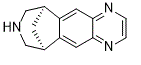
Varenicline (also known as CP 526555), an approved medication used to treat nicotine addiction, is a potent and selective α4β2 nicotinic receptor (nAChR) partial agonist. Varenicline is a partial agonist with 45% of nicotine's maximal efficacy atalpha4beta2 nAChRs in HEK cells expressing nAChRs. Varenicline is a potent, partial agonist at alpha4beta2 receptors, with an EC50 of 2.3 mM and an efficacy (relative to acetylcholine) of 13.4%. As a partial agonist it both reduces cravings for and decreases the pleasurable effects of cigarettes and other tobacco products. Through these mechanisms it can assist some patients to quit smoking.
Physicochemical Properties
| Molecular Formula | C13H13N3 |
| Molecular Weight | 211.26 |
| Exact Mass | 211.11 |
| CAS # | 249296-44-4 |
| Related CAS # | Varenicline dihydrochloride;866823-63-4;Varenicline Hydrochloride;230615-23-3;Varenicline Tartrate;375815-87-5;Varenicline-d4;2183239-01-0 |
| PubChem CID | 170361 |
| Appearance | Light yellow to yellow solid powder |
| Density | 1.247g/cm3 |
| Boiling Point | 400.6ºC at 760mmHg |
| Flash Point | 196.1ºC |
| Vapour Pressure | 1.25E-06mmHg at 25°C |
| Index of Refraction | 1.667 |
| LogP | 0.01 |
| Hydrogen Bond Donor Count | 1 |
| Hydrogen Bond Acceptor Count | 3 |
| Rotatable Bond Count | 0 |
| Heavy Atom Count | 16 |
| Complexity | 254 |
| Defined Atom Stereocenter Count | 0 |
| InChi Key | JQSHBVHOMNKWFT-UHFFFAOYSA-N |
| InChi Code | InChI=1S/C13H13N3/c1-2-16-13-5-11-9-3-8(6-14-7-9)10(11)4-12(13)15-1/h1-2,4-5,8-9,14H,3,6-7H2 |
| Chemical Name | 5,8,14-triazatetracyclo[10.3.1.02,11.04,9]hexadeca-2,4,6,8,10-pentaene |
| Synonyms | CP 526555; CP-526555; CP526555; CP-526555-18; CP 526555 18; CP52655518; Varenicline tartrate; Chantix; Champix |
| HS Tariff Code | 2934.99.9001 |
| Storage |
Powder-20°C 3 years 4°C 2 years In solvent -80°C 6 months -20°C 1 month |
| Shipping Condition | Room temperature (This product is stable at ambient temperature for a few days during ordinary shipping and time spent in Customs) |
Biological Activity
| Targets |
Varenicline acts as a partial agonist at the α4β2 neuronal nicotinic acetylcholine receptor (nAChR). It also has agonist activity at the α7 nAChR and the 5-HT3 receptor, but with lower potency and selectivity compared to its action at α4β2 nAChR. This review does not provide specific IC50, Ki, or EC50 values for varenicline at its endogenous targets. |
| ln Vitro |
Varenicline (1 μM, 24 hours) suppresses the rate of cell proliferation in RAW 264.7 macrophages as well as LPS-induced cytokine secretion (IL-1β, IL-6, and TNF α) [1]. Human adrenal chromaffin cells derived from male and female organ donors exhibit action potentials (Aps) in the absence of ACh activation when exposed to 250 nM vannicline [3]. By inhibiting VE-cadherin protein expression, vannicline (100 μM, 4 hours) increases HUVEC migration [4]. Varenicline activated several engineered chimeric ion channels with mutant α7 nAChR ligand-binding domains (LBDs) fused to the 5-HT3 ion pore domain in a membrane potential (MP) assay. At the α7L131G,Q139L,Y217F-GlyR channel, varenicline exhibited an EC50MP of 1.6 ± 0.1 nM, representing a 390-fold potency increase compared to the parent α7-GlyR channel. In HEK-293 cells expressing α7L131G,Q139L,Y217F-GlyR, varenicline acted as a strong agonist, producing sustained, slowly activating currents with a high affinity and slow off-rate. Competition binding assays using [³H]-ASEM displacement showed a Ki of 1.3 ± 0.4 nM for varenicline at the α7L131G,Q139L,Y217F-GlyR channel, which is 475-fold lower than its reported Ki at the wild-type α7 nAChR. Varenicline showed 160-fold agonist selectivity for the engineered channel over the α4β2 nAChR and 880-fold selectivity over the 5-HT3 receptor. |
| ln Vivo |
Varenicline (0.01-1 mg/kg subcutaneously, 3 days) injected subcutaneously at a dose of 0.5 mg/kg 10 minutes before to the onset of nicotine-induced suppression of conditioned place preference (CPP) [5]. Place aversion caused by vannicline (subcutaneous injection, 2.5 mg/kg, 3 days) is reliant on α5 nAChR but not β2 nAChR [5]. Subcutaneous injection of vannicline (0.1 and 0.5 mg/kg, 3 days) restores the somatic symptoms and hyperalgesia associated with nicotine withdrawal, as well as withdrawal-induced aversion, in a dose-related way [5]. In mice with unilateral substantia nigra reticulata (SNr) neurons expressing PSAM4-GlyR (the engineered channel), intraperitoneal administration of varenicline at 0.1 mg/kg induced contralateral rotation, a behavioral readout of neuronal silencing. The effect was evident within 20 minutes and lasted approximately 4 hours, consistent with varenicline's half-life. Oral administration of varenicline (5 µg/mL in drinking water) also elicited circling behavior in these mice. In a rhesus monkey with PSAM4-GlyR expressed in the globus pallidus internus (GPi), subcutaneous administration of varenicline (0.1 mg/kg) significantly inhibited neuron firing rates and burst firing rates compared to pre-transduction baseline. The effective dose for chemogenetic silencing in mice and monkey (0.1 mg/kg) was 10-fold lower in mice and 5-fold lower in monkey than doses previously reported to produce nicotine-substituting discriminative stimulus effects. |
| Cell Assay |
Cell proliferation assay [1] Cell Types: RAW 264.7 mouse macrophages (treated with 4 μg/mL LPS for 24 h) Tested Concentrations: 1 μM Incubation Duration: 0-48 h Experimental Results: LPS-induced cell proliferation rate diminished. Western Blot Analysis[4] Cell Types: HUVEC Tested Concentrations: 1, 10, 100 μM Incubation Duration: 24 hrs (hours) or 30 minutes Experimental Results: diminished VE-cadherin protein expression, activation of ERK1/2, p38 and JNK signaling. Membrane potential (MP) assays were performed using a panel of 41 chimeric channels with mutant α7 nAChR LBDs spliced onto the 5-HT3 ion pore domain expressed in cells. The assay measures sustained channel activation, reflected as changes in membrane potential, to generate dose-response curves (EC50MP values). Whole-cell voltage-clamp electrophysiology was performed on HEK-293 cells and other cell lines (e.g., an immune cell line) expressing engineered channels (e.g., α7L131G,Q139L,Y217F-GlyR) to characterize agonist-induced currents, desensitization, and off-rates. Competition binding assays were performed using the selective α7 nAChR antagonist [³H]-ASEM to determine Ki values for varenicline at the engineered receptors. |
| Animal Protocol |
Animal/Disease Models: ICR male mice [5] Doses: 0.01-1 mg/kg, 3 days Route of Administration: subcutaneous injection Experimental Results: Inhibited nicotine conditioned place preference (CPP) in a dose-dependent manner. For mouse behavioral assays (contralateral rotation), PSAM4-GlyR was expressed unilaterally in GABAergic neurons of the substantia nigra reticulata (SNr) via stereotaxic injection of recombinant adeno-associated virus (rAAV). Mice were administered low-dose amphetamine (3 mg/kg) to increase general activity. Varenicline was administered intraperitoneally at various doses (e.g., 0.1 mg/kg) or orally via drinking water (5 µg/mL). Rotation behavior was monitored to assess the onset and duration of neuronal silencing. For in vivo calcium imaging in mice, PSAM4-GlyR was expressed in hippocampal CA1 pyramidal neurons via viral delivery in Thy1::GCaMP6f transgenic mice. Mice were head-fixed on a treadmill, and calcium dynamics were monitored via two-photon imaging before and after intraperitoneal injection of varenicline or uPSEMs. For primate studies, PSAM4-GlyR was expressed in the globus pallidus internus (GPi) of a rhesus monkey via electrophysiologically guided injection of rAAV8. Neuronal firing was recorded before and after subcutaneous administration of varenicline (0.1 mg/kg). |
| ADME/Pharmacokinetics |
Varenicline exhibits excellent brain penetrance and is not a substrate for the P-glycoprotein (Pgp) efflux pump. It has low binding to plasma proteins. The elimination half-life (t₁/₂) is >17 hours in monkeys and humans, and approximately 1.4 hours in mice and 4 hours in rats. Steady-state brain concentrations in humans from a twice-daily 1 mg dose are estimated to be higher than the concentrations (10–16 nM) required for effective chemogenetic silencing of PSAM4-GlyR in this study, suggesting that chemogenetic applications may be achievable at sub-therapeutic (anti-nicotine) doses. |
| Toxicity/Toxicokinetics |
Toxicity Summary IDENTIFICATION AND USE: Varenicline is used as an adjunct in the cessation of cigarette smoking. HUMAN EXPOSURE AND TOXICITY: Safety and efficacy of varenicline as an adjunct for smoking cessation have been established in 6 placebo-controlled or active-comparator studies in 3659 patients (mean age: 43 years; 79-96% white; mean smoking history: about 25 years) who smoked at least 10 cigarettes daily (mean: about 21 cigarettes daily). Safety and efficacy of varenicline also have been evaluated in a randomized, double-blind, placebo-controlled study in 703 patients with stable, documented cardiovascular disease (other than hypertension) who smoked at least 10 cigarettes daily; patients receiving varenicline and placebo were comparable in baseline characteristics, including age (mean age 57 and 55.9 years, respectively), race (80.3 and 80.8% white, respectively), gender (75.2 and 82.2% male, respectively), and mean smoking history (40 and 39 years, and 22.1 and 22.9 cigarettes daily, respectively). Safety and efficacy of varenicline also have been evaluated in a randomized, double-blind, placebo-controlled study in 460 patients (mean age 57 years, 82-84% white, approximately 62% male, mean smoking history of approximately 40 years) with mild to moderate chronic obstructive pulmonary disease (postbronchodilator FEV1/FVC below 70% and FEV1 at least 50% of predicted normal value) who smoked at least 10 cigarettes daily. Serious neuropsychiatric symptoms, including changes in mood (e.g., depression, mania), psychosis, hallucinations, paranoia, delusions, homicidal ideation, hostility, agitation, aggression, anxiety, panic, and suicidality (e.g., suicidal ideation, attempted and completed suicides), have been reported during postmarketing experience in patients receiving varenicline. Hypersensitivity reactions, including angioedema, have been reported during postmarketing experience in patients receiving varenicline. Safety and efficacy of varenicline have not been established in patients younger than 18 years of age and use of the drug in this age group is not recommended. Varenicline was not genotoxic, with or without metabolic activation in vitro in human lymphocytes. ANIMAL STUDIES: Varenicline is distributed into milk in animals. Rats were administered varenicline (1, 5, and 15 mg/kg/day) by oral gavage for 2 years. In male rats (n = 65 per sex per dose group), incidences of hibernoma (tumor of the brown fat) were increased at the mid dose (1 tumor, 5 mg/kg/day, 23 times the maximum recommended human daily exposure based on AUC) and maximum dose (2 tumors, 15 mg/kg/day, 67 times the maximum recommended human daily exposure based on AUC). There was no evidence of carcinogenicity in female rats. Varenicline succinate has been shown to have an adverse effect on the fetus in animal reproduction studies. Administration of varenicline succinate to pregnant rabbits resulted in reduced fetal weights at an oral dose of 30 mg/kg/day (50 times the human AUC); this reduction was not evident following treatment with 10 mg/kg/day (23 times the maximum recommended daily human exposure based on AUC). In addition, in the offspring of pregnant rats treated with varenicline succinate there were decreases in fertility and increases in auditory startle response at an oral dose of 15 mg/kg/day (36 times the maximum recommended human daily exposure based on AUC). Varenicline succinate was not teratogenic in rats and rabbits at oral doses up to 15 and 30 mg/kg/day, respectively (36 and 50 times the maximum recommended human daily exposure based on AUC, respectively). Varenicline was not genotoxic, with or without metabolic activation, in the following assays: Ames bacterial mutation assay; mammalian CHO/HGPRT assay; and tests for cytogenetic aberrations in vivo in rat bone marrow. Effects During Pregnancy and Lactation ◉ Summary of Use during Lactation Varenicline is a partial nicotine agonist used orally to assist smoking cessation and by nasal spray for dry eyes. One researcher points out that based on animal data on nicotine, varenicline might interfere with normal infant lung development and recommends against its use in nursing mothers. Because no information is available on the use of varenicline during breastfeeding, an alternate drug is preferred, especially while nursing a newborn or preterm infant. However, maternal drug exposure after the nasal spray is only about 7.5% that of the oral drug, so the spray is much less likely to affect the infant. If a mother chooses to breastfeed while taking varenicline, she should monitor her infant for seizures and excessive vomiting. ◉ Effects in Breastfed Infants Relevant published information was not found as of the revision date. ◉ Effects on Lactation and Breastmilk Relevant published information was not found as of the revision date. Interactions Pharmacokinetic interactions unlikely with drugs metabolized by or affecting cytochrome P-450 (CYP) isoenzymes. In vitro studies indicate that varenicline does not inhibit CYP isoenzymes 1A2, 2A6, 2B6, 2C8, 2C9, 2C19, 2D6, 2E1, or 3A4/5 in vitro. The drug also does not induce CYP isoenzymes 1A2 or 3A4. Physiologic changes resulting from smoking cessation (with or without varenicline) may alter the pharmacokinetics or pharmacodynamics of some drugs (e.g., theophylline, warfarin, insulin); dosage adjustment may be required. The manufacturer states that clinical experience in patients receiving varenicline with other drugs has not revealed evidence of clinically important interactions. Pharmacokinetic interaction unlikely. Increased incidence of adverse effects (nausea, headache, vomiting, dizziness, dyspepsia, fatigue) and increased rate of discontinuance of combination (varenicline and transdermal nicotine replacement) therapy compared with those receiving transdermal nicotine and placebo. Safety and efficacy of varenicline in combination with other smoking cessation therapies have not been studied. Pharmacokinetic interaction unlikely. Warfarin pharmacokinetics may be affected by smoking cessation. For more Interactions (Complete) data for VARENICLINE (7 total), please visit the HSDB record page. Varenicline is generally well-tolerated at low doses in patients. At elevated doses, varenicline reduced food intake in mice, which is a behavior sensitive to off-target 5-HT3 receptor activation, indicating potential side effects at higher concentrations. |
| References |
[1]. Efficacy of varenicline combined with nicotine replacement therapy vs varenicline alone for smoking cessation: a randomized clinical trial. JAMA. 2014 Jul;312(2):155-61. [2]. Ultrapotent chemogenetics for research and potential clinical applications. Science. 2019;364(6436):eaav5282. [3]. Varenicline promotes endothelial cell migration by lowering vascular endothelial-cadherin levels via the activated α7 nicotinic acetylcholine receptor-mitogen activated protein kinase axis. Toxicology. 2017;390:1-9. [4]. Countering Opioid-induced Respiratory Depression in Male Rats with Nicotinic Acetylcholine Receptor Partial Agonists Varenicline and ABT 594. Anesthesiology. 2020 May;132(5):1197-1211. [5]. Effects of chronic varenicline treatment on nicotine, cocaine, and concurrent nicotine+cocaine self-administration. Neuropsychopharmacology. 2014 Apr;39(5):1222-31. [6]. Varenicline has antidepressant-like activity in the forced swim test and augments sertraline's effect. Eur J Pharmacol. 2009 Mar 1;605(1-3):114-6. |
| Additional Infomation |
Varenicline is a partial agonist of the nicotinic acetylcholine receptor (nAChR) subtype alpha4beta2. Nicotine stimulation of central alpha4beta2 nAChRs located at presynaptic terminals in the nucleus accumbens causes the release of the neurotransmitter dopamine, which may be associated with the experience of pleasure; nicotine addiction constitutes a physiologic dependence related to this dopaminergic reward system. As an AChR partial agonist, varenicline attenuates the craving and withdrawal symptoms that occur with abstinence from nicotine but is not habit-forming itself. A benzazepine derivative that functions as an ALPHA4-BETA2 NICOTINIC RECEPTOR partial agonist. It is used for SMOKING CESSATION. See also: Varenicline (annotation moved to). Therapeutic Uses Nicotinic Agonists Varenicline is used as an adjunct in the cessation of cigarette smoking. In this randomized, double-blind, multicenter trial, eligible adult smokers (18-75 years) who smoked an average of > or =10 cigarettes/day were randomized to either varenicline 1 mg twice daily (BID) or placebo for 52 weeks. Subjects made weekly clinic visits until week 8, and then every 4 weeks until week 52, with a follow-up visit at week 53. The target quit date was the morning of the week 1 clinic visit. Brief counseling was provided at each visit, and vital signs, adverse events, and smoking status were documented. Other laboratory measures were collected at specified visits. A total of 251 subjects were randomized to varenicline and 126 to placebo. Approximately half of the subjects in each arm completed the study (53.8% varenicline; 46.8% placebo). Treatment-emergent adverse events were observed in 96.4% of varenicline- and 82.5% of placebo-treated subjects during the study. Common varenicline-associated adverse events were nausea (40.2%), abnormal dreams (22.7%), and insomnia (19.1%). Most adverse events were considered mild or moderate in intensity. Adverse events leading to discontinuation of varenicline treatment included nausea (7.6%), insomnia (3.2%), and abnormal dreams (2.4%). A single varenicline-related serious AE, bilateral subcapsular cataracts, was observed. At week 52, 7-day point prevalence abstinence rates were 36.7% (varenicline) and 7.9% (placebo). Varenicline 1 mg BID can be safely administered for up to 1 year. Varenicline was also a more effective smoking cessation aid than placebo throughout the study, supporting both its short- (12-week) and long-term (52-week) efficacy. Drug Warnings /BOXED WARNING/ WARNING: SERIOUS NEUROPSYCHIATRIC EVENTS. Serious neuropsychiatric events including, but not limited to, depression, suicidal ideation, suicide attempt, and completed suicide have been reported in patients taking CHANTIX. Some reported cases may have been complicated by the symptoms of nicotine withdrawal in patients who stopped smoking. Depressed mood may be a symptom of nicotine withdrawal. Depression, rarely including suicidal ideation, has been reported in smokers undergoing a smoking cessation attempt without medication. However, some of these symptoms have occurred in patients taking CHANTIX who continued to smoke. All patients being treated with CHANTIX should be observed for neuropsychiatric symptoms including changes in behavior, hostility, agitation, depressed mood, and suicide-related events, including ideation, behavior, and attempted suicide. These symptoms, as well as worsening of pre-existing psychiatric illness and completed suicide, have been reported in some patients attempting to quit smoking while taking CHANTIX in the postmarketing experience. When symptoms were reported, most were during CHANTIX treatment, but some were following discontinuation of CHANTIX therapy. These events have occurred in patients with and without pre-existing psychiatric disease. Patients with serious psychiatric illness such as schizophrenia, bipolar disorder, and major depressive disorder did not participate in the premarketing studies of CHANTIX. Advise patients and caregivers that the patient should stop taking CHANTIX and contact a healthcare provider immediately if agitation, hostility, depressed mood, or changes in behavior or thinking that are not typical for the patient are observed, or if the patient develops suicidal ideation or suicidal behavior. In many postmarketing cases, resolution of symptoms after discontinuation of CHANTIX was reported, although in some cases the symptoms persisted; therefore, ongoing monitoring and supportive care should be provided until symptoms resolve. The risks of CHANTIX should be weighed against the benefits of its use. CHANTIX has been demonstrated to increase the likelihood of abstinence from smoking for as long as one year compared to treatment with placebo. The health benefits of quitting smoking are immediate and substantial. The U.S. Food and Drug Administration (FDA) is warning that the prescription smoking cessation medicine Chantix (varenicline) can change the way people react to alcohol. In addition, rare accounts of seizures in patients treated with Chantix have been reported. We have approved changes to the Chantix label to warn about these risks. Until patients know how Chantix affects their ability to tolerate alcohol, they should decrease the amount of alcohol they drink. Patients who have a seizure while taking Chantix should stop the medicine and seek medical attention immediately. Millions of Americans have serious health problems caused by smoking, which can be reduced by quitting. Chantix is a prescription medicine that is FDA-approved to help adults quit smoking. In clinical trials, Chantix increased the likelihood of quitting smoking and \"staying quit\" for as long as 1 year compared to treatment with a placebo, an inactive treatment. We reviewed the case series submitted by Pfizer, the manufacturer of Chantix, as well as the cases in the FDA Adverse Event Reporting System (FAERS) database describing patients who drank alcohol during treatment with Chantix and experienced adverse reactions. Some patients experienced decreased tolerance to alcohol, including increased drunkenness, unusual or aggressive behavior, or they had no memory of things that happened (see Data Summary). We also reviewed FAERS and the medical literature1 for cases of seizures with Chantix and identified cases in which the patients who had seizures while taking Chantix either had no history of seizures or had a seizure disorder that had been well-controlled. In most of these cases, the seizures occurred within the first month of starting Chantix. Information about these risks has been added to the Warnings and Precautions section of the drug label and to the patient Medication Guide. We also updated the Warnings and Precautions section of the label to include information about several studies that investigated the risk of neuropsychiatric side effects on mood, behavior, or thinking occurring with Chantix. These included observational studies,2-5 as well as analyses that Pfizer conducted of randomized controlled clinical trial data.6 These studies did not show an increased risk of neuropsychiatric side effects with Chantix; however, they did not examine all types of neuropsychiatric side effects, and they had limitations that prevented us from drawing reliable conclusions. We previously communicated about possible serious neuropsychiatric side effects with Chantix in 2009 and 2011, and these recent studies were discussed at an FDA Advisory Committee meeting in October 2014. Pfizer is conducting a large clinical safety trial of Chantix to investigate this risk and results from this study are expected in late 2015. We will update the public as appropriate when this new information becomes available. Varenicline is contraindicated in patients with a known history of serious hypersensitivity reactions or skin reactions to the drug. Serious neuropsychiatric symptoms, including changes in mood (e.g., depression, mania), psychosis, hallucinations, paranoia, delusions, homicidal ideation, hostility, agitation, aggression, anxiety, panic, and suicidality (e.g., suicidal ideation, attempted and completed suicides), have been reported during postmarketing experience in patients receiving varenicline. In most cases, symptoms developed during varenicline therapy but, in others, symptoms developed after discontinuance of the drug. Some of these reported cases may have been complicated by nicotine withdrawal symptoms in patients who had stopped smoking; depressed mood also may be a symptom of nicotine withdrawal, and depression, which rarely has included suicidal ideation, has been reported in patients undergoing a smoking cessation attempt without medication. However, some of these symptoms occurred in patients receiving varenicline who continued to smoke. Such effects have occurred in patients with or without psychiatric illnesses; worsening of preexisting psychiatric illness also has been reported. Nicotine withdrawal also has been associated with exacerbation of an underlying psychiatric illness. For more Drug Warnings (Complete) data for VARENICLINE (19 total), please visit the HSDB record page. Pharmacodynamics Varenicline is a partial nicotinic acetylcholine receptor agonist, designed to partially activate this system while displacing nicotine at its sites of action in the brain. Varenicline is an FDA-approved anti-smoking drug. Its primary therapeutic mechanism is partial agonism at α4β2 nAChRs. This study repurposes varenicline as an agonist for engineered chemogenetic receptors (PSAM4). The engineered PSAM4 receptor (α7L131G,Q139L,Y217F-GlyR) is highly sensitive and selective for varenicline, with minimal activation by endogenous ligands like acetylcholine or choline. The combination of PSAM4 and varenicline enables reversible neuronal silencing or activation (depending on the coupled ion pore domain) in rodents and non-human primates, with potential applications in basic neuroscience research and future clinical therapies (e.g., for movement disorders, epilepsy, or pain). |
Solubility Data
| Solubility (In Vitro) |
DMSO : ~20 mg/mL (~94.67 mM) H2O : ≥ 20 mg/mL (~94.67 mM) |
| Solubility (In Vivo) |
Solubility in Formulation 1: ≥ 2.5 mg/mL (11.83 mM) (saturation unknown) in 10% DMSO + 40% PEG300 + 5% Tween80 + 45% Saline (add these co-solvents sequentially from left to right, and one by one), clear solution. For example, if 1 mL of working solution is to be prepared, you can add 100 μL of 25.0 mg/mL clear DMSO stock solution to 400 μL PEG300 and mix evenly; then add 50 μL Tween-80 to the above solution and mix evenly; then add 450 μL normal saline to adjust the volume to 1 mL. Preparation of saline: Dissolve 0.9 g of sodium chloride in 100 mL ddH₂ O to obtain a clear solution. Solubility in Formulation 2: ≥ 2.5 mg/mL (11.83 mM) (saturation unknown) in 10% DMSO + 90% (20% SBE-β-CD in Saline) (add these co-solvents sequentially from left to right, and one by one), clear solution. For example, if 1 mL of working solution is to be prepared, you can add 100 μL of 25.0 mg/mL clear DMSO stock solution to 900 μL of 20% SBE-β-CD physiological saline solution and mix evenly. Preparation of 20% SBE-β-CD in Saline (4°C,1 week): Dissolve 2 g SBE-β-CD in 10 mL saline to obtain a clear solution. Solubility in Formulation 3: ≥ 2.5 mg/mL (11.83 mM) (saturation unknown) in 10% DMSO + 90% Corn Oil (add these co-solvents sequentially from left to right, and one by one), clear solution. For example, if 1 mL of working solution is to be prepared, you can add 100 μL of 25.0 mg/mL clear DMSO stock solution to 900 μL of corn oil and mix evenly. (Please use freshly prepared in vivo formulations for optimal results.) |
| Preparing Stock Solutions | 1 mg | 5 mg | 10 mg | |
| 1 mM | 4.7335 mL | 23.6675 mL | 47.3350 mL | |
| 5 mM | 0.9467 mL | 4.7335 mL | 9.4670 mL | |
| 10 mM | 0.4734 mL | 2.3668 mL | 4.7335 mL |